










This is Part II. Part I is here : if you think your family’s beliefs are backward, what to do.
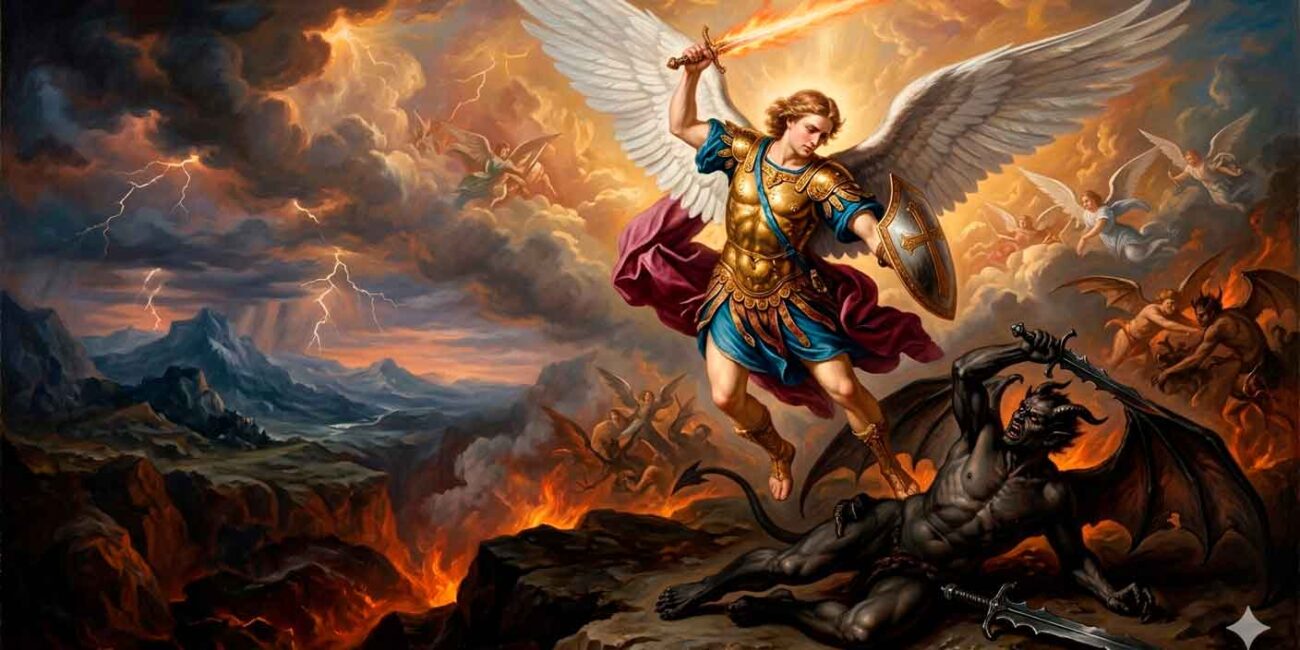
Notice something striking about the image above? If you ask AI to generate an image of God and the devil that’s what you get – A white male God and a dark-skinned Devil. We will leave that for another article though. Let’s make a few more points:
To deconstruct the God/Devil duality, we have to look at it not as a battle between two real entities, but as a binary mental map that people use to navigate the world. When you collapse one side of this map, the entire structure usually falls with it.
Here is the logical deconstruction of the “Proportional Balance” of Good and Evil.
The Problem of “Mutual Necessity”
The strongest argument against this duality is that God and Satan are logically interdependent. If God is defined as “The Good,” he requires an “Evil” to be distinguished from.
- The Dependency Loop: If God is all-powerful (Omnipotent) and all-good (Omnibenevolent), the existence of a proportional “Evil” (Satan) creates a logical contradiction.
- The Dilemma: Either God wants to stop the evil but cannot (meaning he isn’t all-powerful), or he can stop it but chooses not to (meaning he isn’t all-good).
- The Conclusion: If Satan’s power is proportional to God’s, then God is not a Supreme Being; he is simply one of two competing regional “warlords.” This strips the “Divine” of its divinity and turns it into a mundane power struggle.
At a baptism, you would expect even more effort by a good-god to save that “soul”, right? This was the reality (did Satan get them?):
- Linser Lopez (2024): A 21-year-old Texas man drowned in Lake Wakahhatchee in August 2024, approximately one hour after being baptized in the same lake. He died while attempting to rescue a teenage girl from his church group who was struggling in the water.
- Robert Smith (2023): A 61-year-old man drowned during a backyard baptism ceremony in Birmingham, UK, which was being held in a kiddie pool and livestreamed on Facebook. In April 2026, a British pastor, Cheryl Bartley, was charged with manslaughter by gross negligence in connection with this death.
- Tanzania Drownings (2023): A pastor was arrested in Tanzania in July 2023 after two members of the Shalom Church drowned in the River Ungwasi while being immersed during a baptism ceremony.
- Infant Death (Romania): A six-week-old baby died in 2021 after being fully submerged three times during a baptism ceremony in a Romanian church, with an autopsy finding water in his lungs
The Anthropomorphic Error
People tend to project human social structures onto the universe. We have “Police” and “Criminals,” so we assume the universe must have “God” and “Demons.”
- Evolutionary Perspective: Humans evolved to detect agency. If a bush rustles, it’s safer to assume a “predator” (an agent with intent) than just “the wind.”
- The Deconstruction: Witchcraft and Obeah are just the ultimate form of this “Hyperactive Agency Detection.” By showing people that “bad luck” is actually probability and statistics, you remove the need for a “Satanic” agent.
The “Zero-Sum” Fallacy of Spiritual Power
Believers often think spiritual power is a finite resource. They think: “If my neighbor got a promotion, they must have taken ‘blessings’ that were meant for me, or used ‘dark work’ to jump the line.”
- Logical Rebuttal: If God’s goodness is infinite, why would he allow a “spiritual healer” or a neighbor’s $50 spell to override his will?
- The Deconstruction: This proves that the belief isn’t actually about a “Great God”—it’s about Magic. Magic assumes that human rituals can “hack” or “force” the hand of the divine. If a human can control a spirit to hurt a neighbor, then the human is more powerful than the spirit.
This is a recording of a Seventh-Day Adventist Christian in psychological distress because, in her head, her neighbor is “obeahing” her:
The Moral “Escapism” Argument
The Devil is a scapegoat for human accountability.
- The Mechanism: “The Devil made me do it” or “I was cursed” allows a person to avoid looking at their own character flaws or the socio-economic reasons for their failure.
- The Solution: Promote Radical Humanism. If there is no God to save you and no Devil to curse you, then the responsibility for your life—and your community—rests entirely on human hands, human laws, and human empathy.
How to Present This to a Believer
“The Liberation from Fear.”
- Question the Protection: “If God is the ultimate protector, why are you spending money on a healer? Does your God require a ‘co-pay’ to keep you safe?”
- Highlight the Inconsistency: “If the Devil is so powerful that he can ruin your life through a neighbor’s spell, then your God is either absent or indifferent. Why worship a God who lets a neighbor’s $20 candle win?”
- Offer the Alternative: “Imagine the peace of mind you’d have if you realized no one has the ‘remote control’ to your life. No spells, no curses—just your choices and the laws of nature.”

Other Articles

If you think your family’s beliefs are backward, what to do.
How we got skin color, language and racism