




While modern Easter is the primary Christian celebration of the resurrection stories, the holiday itself is a massive syncretism—a blend of ancient pagan spring festivals, Jewish Passover, and later Christian theology.
Did you know that the name “Easter” and many of its traditions actually have nothing to do with the New Testament?
HISTORY
The Pagan Roots: Eostre
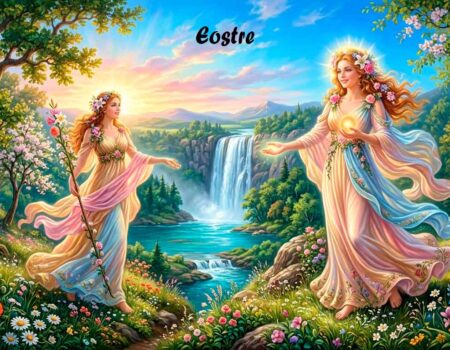
The word “Easter” doesn’t appear in the Greek New Testament. Most etymologists trace the name to Eostre (or Ostara), a West Germanic goddess of the spring and dawn.
- The Season: Her feast was celebrated at the Vernal Equinox (the start of spring when day and night are equal).
- The Symbols: Because Eostre represented fertility and new life, her symbols were the rabbit (prolific breeders) and the egg (the seed of life).
- The Rebranding: As Christianity spread through Europe, missionaries found it easier to “re-gift” existing holidays rather than abolish them. They mapped the Resurrection of Jesus onto the existing festival of the “rising sun” and the rebirth of nature.
The Jewish Root: Pascha
In almost every language other than English and German, the holiday is called some variation of Pascha (Spanish: Pascua; French: Pâques). This comes directly from the Hebrew Pesach, or Passover.
- The Connection: Since the Gospels place Jesus’ death during the Passover, the early Church (which was originally a Jewish sect) simply continued celebrating Passover but refocused the meaning.
- The Lamb: The Jewish tradition of sacrificing a lamb became the Christian metaphor for Jesus as the “Lamb of God.”
How Rome Standardized It
For the first few centuries, different Christian groups celebrated “Easter” on different days. Some stayed tied to the Jewish lunar calendar, while others wanted it on a Sunday.
In 325 CE, the Council of Nicaea (under the Roman Emperor Constantine) stepped in to settle the chaos. They wanted to decouple Christianity from Judaism and create a uniform imperial holiday. They decreed that Easter would be:
The first Sunday after the first full moon following the spring equinox.
This is why Easter “wanders” on the calendar every year—it is still technically calculated using a lunar-solar calendar, a vestige of its ancient astronomical origins.
Where the Symbols Came From
If the stories are about a man rising from a tomb, why the candy and the neon-colored eggs? These are almost entirely “borrowed” traditions:
- The Eggs: Ancient Persians, Egyptians, and Greeks all colored eggs as symbols of fertility. Early Christians in Mesopotamia adopted this, staining eggs red to represent the blood of Christ.
- The Bunny: This is a German tradition (the Osterhase or Easter Hare). It didn’t arrive in America until the 1700s with German immigrants.
- Lent: The 40 days of fasting before Easter likely mirrors ancient agricultural periods of fasting when winter food stores were low, rebranded to match Jesus’ 40 days in the desert.
Easter is a cultural sandwich. The “bread” is the ancient pagan celebration of spring and fertility; the “meat” is the Jewish Passover and the Roman-standardized Christian narrative of the resurrection.
THE MEANING TO CHRISTIANS
For Christians, the death and resurrection of Jesus is the central pivot point of their entire faith. They often refer to this narrative as the “Gospel” (or “Good News”).
To understand the meaning they assign to it, it helps to look at it through three distinct lenses:
The Death: A Sacrifice for Reconciliation
Christians believe that humanity is inherently “fallen” or separated from God by sin. The death of Jesus on the cross is viewed as the ultimate solution to this problem.
- Substitutionary Atonement: This is the idea that Jesus took the punishment for the sins of the world upon himself. In this view, he acted as a “substitute” for humanity, satisfying the requirements of divine justice.
- The Bridge: His death is seen as a bridge that repairs the broken relationship between a holy God and imperfect humans, allowing for forgiveness and “grace” (undeserved favor).
- The “New Covenant”: Just as ancient traditions used blood to seal agreements, Christians believe Jesus’ death established a new, permanent contract between God and people.
The Resurrection: Victory Over Death
If the death was about payment, the resurrection is about power. For Christians, Jesus rising from the dead on the third day is the “receipt” that proves the payment was accepted.
- Validation of Identity: It serves as the ultimate proof that Jesus was who he claimed to be—the Son of God. Without the resurrection, Christians believe Jesus would have just been another tragic martyr.
- Defeat of Evil: It symbolizes a final victory over sin, evil, and death itself. It suggests that death is no longer a “dead end,” but a transition.
- The Promise of New Life: It provides the “first fruits” of what believers expect for themselves—the hope that they, too, will be resurrected into an eternal, perfected life.
The Combined Meaning: Transformation
Together, these events—often called the Paschal Mystery—shape how Christians live their daily lives:
“For God so loved the world that he gave his one and only Son, that whoever believes in him shall not perish but have eternal life.” — John 3:16
- Redemption: No matter a person’s past, they can be “bought back” and given a fresh start.
- Hope in Suffering: Because Jesus suffered, Christians believe God understands human pain and can bring beauty out of tragedy.
- The Mandate: It motivates followers to share this “Good News” and to live lives of service, mirroring the self-sacrifice Jesus showed.
A CRITICAL LOOK AT THE BIBLE STORIES
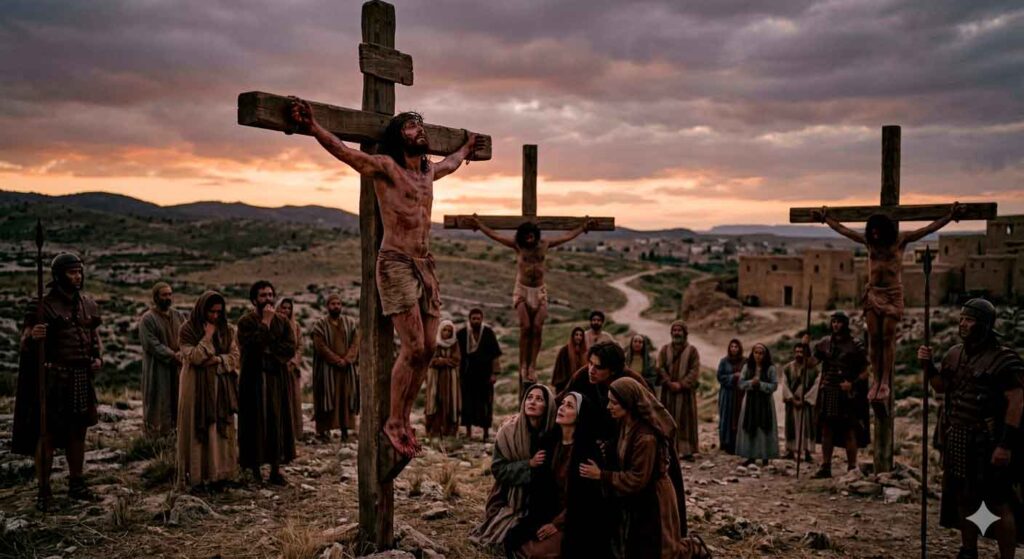
The accounts of Jesus’ death and resurrection are primarily found in the four Gospels of the New Testament (Matthew, Mark, Luke, and John). While they share a core narrative, they contain significant variations in detail, timing, and sequence.
The Timeline and Manner of Death
One of the most notable discrepancies involves the timing of the crucifixion relative to the Jewish holiday of Passover.
- The Synoptics (Matthew, Mark, Luke): Jesus eats the Passover meal (The Last Supper) with his disciples on a Thursday night and is crucified on Friday.
- The Gospel of John: Jesus is crucified on the day of preparation for Passover, at the exact same time the paschal lambs were being slaughtered in the Temple.
- The Last Words: * In Matthew and Mark, he says only: “My God, my God, why have you forsaken me?”
- In Luke, he is more composed, saying: “Father, into your hands I commit my spirit.”
- In John, his final words are: “It is finished.”
The Discovery of the Empty Tomb
The morning of the resurrection is where the accounts diverge most sharply regarding “who, when, and what.”
| Feature | Matthew | Mark | Luke | John |
| Who went? | Mary Magdalene & “the other Mary” | Mary Magdalene, Mary mother of James, Salome | Mary Magdalene, Joanna, Mary mother of James, others | Mary Magdalene (alone) |
| The Messenger | One angel sitting on the stone | One young man sitting inside | Two men standing inside | Two angels sitting inside |
| The Reaction | Fear and great joy; they ran to tell the disciples | Trembling and astonishment; they “said nothing to anyone” | They remembered his words and told the eleven | Mary runs to tell Peter “they have taken the Lord” |
Post-Resurrection Appearances
The location and nature of where Jesus appeared to his followers vary between a focus on Galilee (the north) and Jerusalem (the south).
- Matthew: The disciples are told to go to Galilee, where Jesus meets them on a mountain and gives the Great Commission.
- Luke: Jesus appears strictly in and around Jerusalem (the road to Emmaus and the Upper Room). He explicitly tells them to stay in the city until they receive the Holy Spirit.
- John: Jesus appears in Jerusalem first, but then a later chapter (Chapter 21) describes a famous appearance by the Sea of Galilee where he eats breakfast with the disciples.
- Mark: The earliest manuscripts of Mark actually end abruptly at verse 16:8 with the women fleeing the tomb in silence, containing no appearance stories at all. (Later additions were added by scribes to harmonize it with the other books).
Why do these contradictions exist?
Most scholars argue/attribute these differences to the intended audience of each writer. Matthew was writing for a Jewish audience to prove Jesus was the Messiah; Luke was writing a “history” for a Greek official; John was writing a highly symbolic, theological treatise.
The differences suggest that while the writers agreed on an “event”, the specific details were filtered through different oral traditions.
Roman Influence on the Stories
Apologetic historiography
This is the idea that the Gospel authors weren’t just recording history, but were actively “crafting” a narrative to prove a specific theological point: that Jesus was the predestined Messiah of Jewish scripture (The Old Testament).
Here is a breakdown of the evidence regarding the timeline, the “scripting” of the stories, and the political influence of Rome.
The Timeline Gap
The consensus among historians is that Jesus died around 30–33 CE, but the first account (Mark) wasn’t written until 70 CE—a full 40 years later.
- Oral Tradition: For four decades, stories were passed down by word of mouth. In an era of high illiteracy and intense persecution, details naturally shift, expand, or become “mythologized” to fit the needs of the community.
- The “Q” Source: Scholars believe Matthew and Luke used a lost collection of sayings called “Q” and combined it with Mark’s narrative, leading to the “synoptic” (seen together) similarities, while adding their own unique, sometimes contradictory, details.
“Prophecy Mining” (The Old Testament Influence)
Notice that many details in the death and resurrection stories mirror Old Testament verses almost perfectly. From a critical eye, it seems the authors looked at Hebrew scriptures and “wrote them into” Jesus’ life to provide legitimacy.
| Gospel Event | Old Testament “Source” | Skeptical View |
| Soldiers gambling for clothes | Psalm 22:18: “They divide my clothes among them and cast lots…” | This is a common Roman practice, but the specific phrasing suggests the authors “mapped” the Psalm onto the event. |
| Jesus’ thirst on the cross | Psalm 69:21: “…for my thirst they gave me vinegar to drink.” | Added to show Jesus literally fulfilled the “Sufferer” archetype. |
| No bones broken | Exodus 12:46: Instructions for the Passover lamb (not to break its bones). | John specifically emphasizes this to argue Jesus was the “New Passover Lamb.” |
| The Virgin Birth | Isaiah 7:14: A prophecy about a “young woman” (almah). | Mistranslated into Greek as “virgin” (parthenos), which Matthew then used as the basis for his birth narrative. |
The Hand of Roman Power
By the time the Gospels were written, the Jewish-Roman War (66–73 CE) had occurred. The Romans had destroyed the Temple in Jerusalem and crushed Jewish resistance.
To survive in the Roman Empire, the early Christian movement had to distance itself from “rebellious Jews.” This led to a significant shift in the storytelling:
- Exonerating Pilate: Historically, Pontius Pilate was a brutal prefect who was eventually recalled to Rome for his cruelty. However, the Gospels depict him as a reluctant judge who “washes his hands” of the matter.
- Blaming the Jewish Authorities: The writers shift the “blood guilt” onto the Jewish leaders and the crowd (“His blood be on us and our children!”). This served a dual purpose: it made Christianity less threatening to Roman authorities and helped the new religion carve out a separate identity from Judaism.
Literary Invention: The Empty Tomb
Some scholars, like John Dominic Crossan, argue that the burial in a private tomb (belonging to Joseph of Arimathea) was a later invention.
- Historical Practice: Romans usually left victims of crucifixion on the cross for days as a deterrent or threw them into common shallow graves where they were scavenged by animals.
- Theological Need: A “common grave” makes a Resurrection story much harder to prove. A “private tomb” creates a clean, stage-like setting for a miraculous disappearance.
THE SKEPTIC EYE
When scientists, historians, and critical scholars look at the resurrection story, they don’t necessarily start with “faith”; they start with probability, laws of nature, and source criticism.
The argument for “incredulity” usually rests on three main pillars: the biological impossibility, the nature of human memory, and the political evolution of the texts.
The Biological Argument (The “Dead Stay Dead” Law)
From a strictly biological standpoint, the resurrection violates the Second Law of Thermodynamics and the process of autolysis.
- Cellular Decay: Upon death, cells begin to break down immediately as oxygen stops reaching them. Within three days (the timeframe of the story), significant tissue decomposition and brain cell death are irreversible.
- The Scientific Position: Science operates on methodological naturalism. It seeks natural causes for natural effects. Since a “miracle” is by definition a suspension of natural law, it cannot be a scientific conclusion. A scientist would argue that it is infinitely more probable that a story was embellished than that the fundamental laws of biology were suspended for one afternoon.
The Psychology of “Grief Hallucinations”
Psychologists offer a naturalistic explanation for why the disciples believed they saw Jesus: Bereavement Hallucinations.
- The Data: Studies show that about 30% to 50% of grieving people report “seeing” or “hearing” a deceased loved one in the weeks following their death.
- The Argument: If a leader like Jesus died violently and unexpectedly, his followers would be in a state of extreme cognitive dissonance and grief. A single “sighting” by a high-influence follower (like Mary Magdalene or Peter) could trigger a “social contagion,” where others begin to report similar experiences to find comfort.
Note: This is if the stories were actual historical facts.
The “Legendary Accretion” Model
Historians use this to show how a story “grows” over time. If you look at the Gospels in the order they were written, the supernatural elements get bigger and bolder.
- Mark (c. 70 CE): Ends with an empty tomb and scared women. No sightings.
- Matthew (c. 80 CE): Adds an earthquake, an angel rolling back the stone, and dead saints rising from their graves and walking around Jerusalem.
- Luke (c. 85 CE): Adds Jesus eating fish to prove he has a physical body.
- John (c. 95 CE): Adds Jesus walking through walls and “Doubting Thomas” touching his wounds.
Why is teaching this as “Fact” concerning?
When these narratives are presented in schools as historical certainties rather than theological beliefs, it creates several friction points:
A. Erosion of Critical Thinking
Education is designed to teach students how to evaluate evidence. If a student is taught that a supernatural event is a “fact” despite a lack of empirical evidence, it undermines the scientific method. It suggests that “authority” or “tradition” is a valid substitute for repeatable data.
B. The Erasure of Pluralism
Teaching one specific religious narrative as “Fact” marginalizes students from other backgrounds (Atheist, Jewish, Muslim, Hindu, etc.). It frames one group’s “truth” as the default reality, which can lead to social exclusion and a misunderstanding of how diverse cultures interpret the world.
C. Historical Revisionism
The stories have a heavy anti-Jewish bias (blaming “the Jews” for the death of Jesus to please Rome). When taught as objective history without the context of 1st-century Roman politics, it can perpetuate ancient prejudices that have historically led to real-world violence and antisemitism.
D. The Conflict with Science
If a school teaches that biological laws were paused in 33 CE, it creates a “Doublethink” scenario where a student learns the laws of biology in one period and the “fact” of their violation in the next. This can lead to a distrust of scientific institutions (medicine, climate science, etc.) later in life.
The Academic Middle Ground
Most secular universities teach these stories in a “Religious Studies” context. They don’t ask “Did it happen?” (which is a matter of faith), but rather “How did the belief in this story change the world?” (which is a matter of history).
The “evidence” that these stories were constructed rests on the fact that they are highly literary. They aren’t just diaries; they are carefully structured arguments designed to:
- Convince Jews that Jesus was the King promised in the Torah.
- Convince Romans that Christians were peaceful citizens, not political revolutionaries.

Other Articles
If you think your family’s beliefs are backward, what to do.