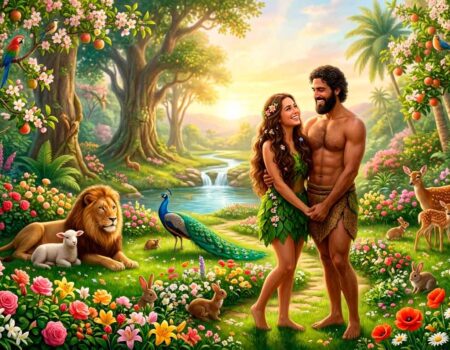





Let’s start with the history of skin color and language then conclude with racism.
When we look at skin color and language e’re basically looking at the story of how humans became “human.” It’s a mix of biological survival (skin) and cognitive explosions (language).
Here is the breakdown of how we ended up with such a colorful and talkative species.
The Evolution of Skin Color: A Solar Shield
The story of skin color isn’t about “race”; it’s about a biological balancing act between two essential vitamins: Folate and Vitamin D.
- The Loss of Fur: Around 2 to 3 million years ago, as our ancestors moved from shady forests to the open savannah, we developed more sweat glands and lost our thick body hair to stay cool.
- The Original Shield: Beneath that fur, early humans likely had pale skin (like chimpanzees). Once exposed to the harsh African sun, we evolved high levels of melanin—a natural sunscreen—to protect our Folate (Vitamin B9) from being destroyed by UV radiation. Folate is crucial for healthy reproduction.
- The Great Migration: As humans moved out of Africa into northern latitudes (Europe and Asia) roughly 50,000 to 80,000 years ago, they encountered a problem: too little sun.
- The Vitamin D Compromise: Melanin was now too effective. It blocked the UV rays needed for the body to produce Vitamin D, which is vital for bone health and the immune system. To survive in gloomier climates, human populations evolved lighter skin to let more UV light in.
Note: This wasn’t a one-time event. Recent DNA evidence shows that skin color is highly “adaptive.” Some populations, like those in the Arctic, maintained darker skin because their diet was so rich in Vitamin D (from fish) that they didn’t need to lighten their skin to compensate for the lack of sun.
The Evolution of Language: From Grunts to Grammar
While skin color is written in our DNA, language is a bit of a “ghost” in the fossil record. We have to look at throat anatomy and brain size to piece it together.
The Biological “Hardware”
- The Descent of the Larynx: Humans have a lower larynx (voice box) than other primates, which allows us to produce a vast range of vowel sounds.
- The FOXP2 Gene: Often called the “language gene,” mutations in this gene roughly 200,000 years ago are thought to have given us the fine motor control over our mouths and tongues needed for complex speech.
The Cultural “Software”
- The “Gossip” Theory: Some anthropologists argue language evolved as a way to “groom” each other socially. As tribes got too big for everyone to pick bugs off each other, we started using vocalizations to maintain social bonds.
- The Symbolic Explosion: Around 50,000 years ago (the “Great Leap Forward”), we see a massive spike in art, jewelry, and complex tools. This suggests humans had developed symbolic language—the ability to talk about things that weren’t right in front of them, like “the spirit of the forest” or “plans for next week.”
The Major Language Families
As humans settled into different regions, their speech diverged into thousands of “dialects” that eventually became distinct language families:
- Afroasiatic: (Middle East and North Africa) Includes Arabic and Hebrew.
- Indo-European: The most widespread family, including English, Spanish, Hindi, and Russian.
- Sino-Tibetan: Including Mandarin and Cantonese.
Why did they evolve together?
Interestingly, while skin color evolved as a response to the environment, language evolved as a response to the social group. One helped us survive the planet; the other helped us survive each other.
How English became a dominant language
It is a common misconception that English became dominant because it is “easier” to learn or more “logical” than other languages. In reality, the rise of English has almost everything to do with power, money, and timing.
The story moves through three major “waves” of expansion.
The First Wave: The British Empire (Colonialism)
From the 17th to the 19th century, Great Britain became the largest empire in history, covering nearly a quarter of the world’s land area.
- Administration: To govern colonies like India, Nigeria, Australia and the West Indies, the British established English as the language of law, government, and education.
- The “Elite” Filter: Even after these countries gained independence, English remained the lingua franca—the common language used between different ethnic groups within the same country who spoke different native tongues.
The Second Wave: The American Century (Economics & Tech)
As the British Empire faded after World War II, the United States emerged as the world’s leading economic and military superpower. This shifted English from a language of “conquest” to a language of “opportunity.”
- The Language of Business: If you wanted to trade with the world’s largest economy, you had to speak English. It became the default for international finance and oil.
- Scientific Dominance: Post-WWII, the majority of scientific research and peer-reviewed journals began publishing in English. Today, about 98% of scientific publications are in English.
- The Digital Revolution: The internet was born in the U.S., and the first programming languages (like Fortran and C) were based on English syntax. This baked English into the very “code” of the modern world.
The Third Wave: Pop Culture (Soft Power)
While empires and banks forced or incentivized English, Hollywood and the music industry made people want to learn it.
- The “Cool” Factor: For decades, the most popular movies, chart-topping songs, and global brands (Nike, Apple, Coca-Cola) have been American or British.
- Global Media: Platforms like YouTube, Netflix, and TikTok further solidify English as the “default” setting for global creators seeking the widest possible audience.
The “Snowball Effect”
Today, English has reached a critical mass. Because so many people already speak it, it is the most practical second language for everyone else to learn.
| Statistic | Impact |
| Aviation | English is the mandatory language for international pilots and air traffic controllers. |
| The Internet | Roughly 52% of all website content is in English. |
| Speakers | There are more non-native English speakers than native ones (approx. 1.5 billion total). |
English didn’t win because it’s “better.” In fact, English spelling is notoriously chaotic because it is a “mongrel” language—a mix of Old German, French, Latin, and Norse. It won because it was the language of the people who held the map, the money, and the microphone for the last 400 years.
Racism
Scientifically, there is only one human race. Genetically, two humans from opposite sides of the world are roughly 99.9% identical. In fact, there is often more genetic variation within a single African population than there is between an average European and an average East Asian.
So, if the biology doesn’t support it, where did the idea come from? It wasn’t always there.
Ancient Prejudice vs. Modern Racism
In the ancient world (think Rome, Greece, or Egypt), people were certainly prejudiced, but it wasn’t based on “race” in the way we think of it today.
- Ancient View: They divided people by culture, language, or religion. A Roman might look down on a “Barbarian” from Germany, but if that person learned Latin, wore a toga, and followed Roman law, they could become a Roman citizen regardless of their skin color.
- The Shift: Physical differences were noted (like “those people from the south have darker skin because of the sun”), but they weren’t seen as markers of “superior” or “inferior” DNA.
The Invention of “Race” (15th–18th Century)
The modern concept of racism was largely “invented” during the Age of Exploration and the Transatlantic Slave Trade. It served a very specific economic purpose: justification.
- The Economic Problem: European powers wanted to exploit the Americas for resources (sugar, cotton, tobacco) using enslaved labor. However, many of these societies were also developing Enlightenment ideals about “natural rights” and “liberty for all.”
- The “Solution”: To reconcile owning people while believing in “freedom,” they had to argue that the people being enslaved weren’t “fully human” or were a “lesser” category of human.
- Pseudoscientific Classification: In the 1700s, early “scientists” (like Carl Linnaeus) began categorizing humans into sub-species based on skin color and geography, assigning personality traits to them (e.g., claiming Europeans were “innovative” while others were “lazy”). This had zero basis in actual biology, but it provided a “scientific” cover for systemic oppression.
Language as a Tool of Division
Just as skin color was used to rank people, language was used to enforce those ranks.
- Devaluing Dialects: Colonial powers often labeled indigenous languages as “primitive” or “dialects” rather than “true languages.” This made it easier to argue that the speakers of those languages were intellectually inferior.
- Forced Assimilation: In places like the US, Canada, and Australia, indigenous children were often taken to boarding schools and beaten for speaking their native tongues. The goal was to “kill the Indian, save the man”—essentially using language to erase an entire identity.
The concept of race is a social construct, not a biological one. This doesn’t mean it isn’t “real”—it has real-world consequences in law, health, and opportunity—but it means the boundaries we’ve drawn are arbitrary.
Analogy: Think of the “color spectrum.” Where does “red” officially end and “orange” begin? There is no single line; it’s a continuous gradient. Human skin color is the same—a beautiful, continuous gradient of melanin levels based on where our ancestors lived.
Moving Forward
Racism persist
Our brains are naturally wired for “categorization” to help us navigate the world. Unfortunately, for centuries, we have been fed a “software” of social categories that tell us skin color dictates character. Unlearning that means looking at the data: we are one species that just happened to adapt to different levels of sunlight.
If we look at society through an “athletic race” metaphor, it becomes clear that we aren’t all starting from the same block, and some lanes have hurdles that others don’t.
Here is a breakdown of why racism is a “net-loss” strategy for humanity and how we can practically address those uneven starting lines.
Why Racism Fails Every Metric
From a purely pragmatic standpoint—setting aside the obvious moral and ethical failures—racism is deeply counterproductive for a functioning society.
- Economic Stagnation: Racism is a massive inefficiency. When people are barred from education, jobs, or credit based on race, the economy loses out on innovation, tax revenue, and consumer spending. It’s like a team benching its best players for no reason; the whole team loses.
- Social Fragmentation: It destroys “social capital”—the trust between citizens. A society that spends its energy on gatekeeping and internal conflict can’t focus on external threats or collective progress (like curing diseases or solving climate issues).
- The “Zero-Sum” Fallacy: Racism relies on the idea that for one group to win, another must lose. In reality, human progress is “non-zero-sum.” When more people are empowered to contribute, the “pie” gets larger for everyone.
Righting Past Wrongs
If life is a race, we have to acknowledge that for centuries, some runners were held at the starting line while others were given a head start. Simply saying “the race is fair now” doesn’t account for the distance already lost.
Leveling the Track (Structural Equity)
To right past wrongs, we have to look at the “track” itself. This means identifying where systemic barriers still exist—such as biased lending practices (redlining) or unequal school funding—and fixing them. It’s not about giving one runner a bike; it’s about removing the hurdles that only exist in certain lanes.
Targeted Investment (Closing the Gap)
In sports, if an athlete is malnourished or lacks equipment, you don’t just tell them to “run faster.” You provide the resources necessary to get them to peak performance. In society, this looks like:
- Early Childhood Intervention: Investing heavily in zip codes that have been historically under-resourced.
- Mentorship and Access: Opening doors to networks that have been historically “closed-loop.”
Truth and Reconciliation
You can’t fix a wound if you pretend it isn’t there. Acknowledging the specific history of how certain groups were held back allows us to create specific, data-driven solutions rather than “one-size-fits-all” policies that don’t actually move the needle.
The Goal: The aim isn’t to “punish” the runners in the lead, but to ensure that the win is determined by talent and effort, rather than by who had the clearest path or the earliest start.

Other Articles
The Beauty and Messiness of the Bible