




On the surface, it looks like a collision between two different worlds: one built on empirical evidence and the “show me the data” mindset, and the other built on faith and the “unseen.”
When a scientist—or anyone—holds two contradictory ideas at the same time (like “The universe is 13.8 billion years old” and “My faith tradition says it was created in six days”), they experience Cognitive Dissonance.
This isn’t just a metaphor; it’s a psychological state of mental discomfort that feels like a physical “clash” in the brain. To survive this, scientists don’t usually “ignore” facts; they use specific mental maneuvers to resolve the tension.
The Dissonance Loop
Cognitive Dissonance occurs when there is a gap between Belief and Evidence. The brain is hardwired to close this gap because living in a state of contradiction is taxing on our “mental RAM”.
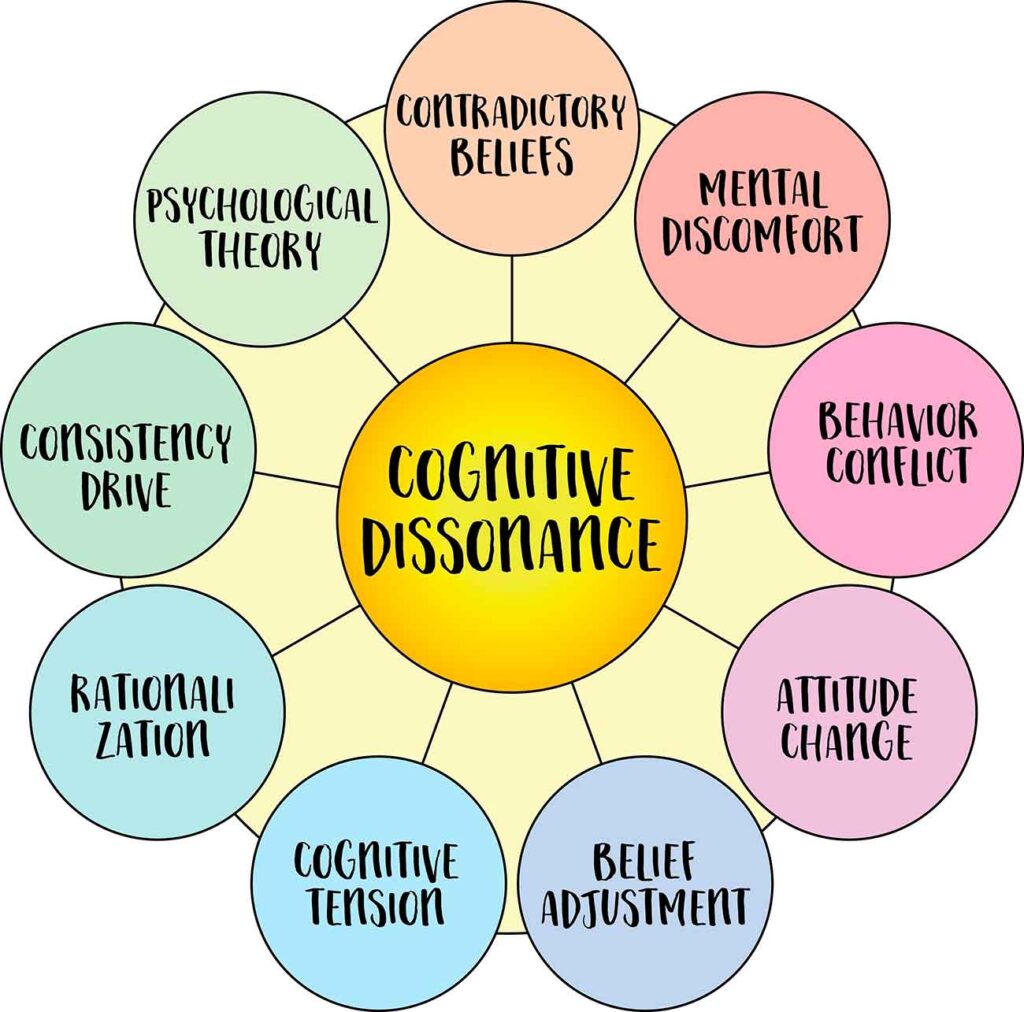
To resolve this, a scientist typically chooses one of three paths:
- Change the Belief: “The Bible is metaphorical, not a science textbook.” (The most common path for scientists).
- Change the Fact: “The dating methods for fossils are flawed.” (Rare among elite scientists, common in fundamentalist circles).
- Add a Consonant Belief: “God created the laws of physics, so the Big Bang is simply the ‘how’ of creation.” (The “reconciliation” path).
- So who/what created God? We will explore at another time…
Compartmentalization: The “Silo” Method
Many scientists use compartmentalization, which is the ability to keep conflicting ideas in separate mental “silos” so they never touch.
- In the Lab: They use the “Methodological Naturalism” rule—assuming only physical causes exist. This allows them to do high-level science without bias.
- At Home/Church: They use “Teleological” thinking—assuming there is a purpose or “final cause” to life.
By never letting these two “apps” run at the same time, the brain avoids the “crash” of dissonance.
The “Social Cost” of Resolution
Social evolution plays a huge role here. If a scientist resolves their dissonance by becoming a vocal atheist, they may lose their family, their spouse, or their childhood community.
Psychologists have found that we are often “Motivated Reasoners.” We don’t look for the truth; we look for a way to stay “right” in the eyes of the people we love. For a religious scientist, the most “rational” move is often to find a complex way to keep both, even if the reconciliation (Faith and Science) seems like an oxymoron to an outsider.
Does it hinder their work?
Interestingly, studies show that religious scientists are just as productive and rigorous as their secular peers. The human brain is remarkably good at “double-tracking.” As long as the scientist doesn’t let their faith change the data in their experiment, their colleagues often don’t care what they believe on Sundays.
| Method of Resolution | How it works | Outcome |
| Allegorizing | Viewing scripture as poetry/wisdom. | Science and Faith coexist easily. |
| Separation | Scientific facts = Physical; Faith = Spiritual. | No “clash” because they are different categories. |
| Integration | Seeing God through the complexity of DNA/Physics. |
Let’s look at scientists who were raised in deeply religious environments but concluded that the scientific facts were fundamentally incompatible with their faith.
A premier example is Edward O. Wilson (E.O. Wilson), often called the “Father of Sociobiology” and one of the most influential biologists of the 20th century.
The Journey: From Southern Baptist to “Provisional Deist”
Unlike many scientists who are raised secular, Wilson grew up in the Southern Baptist tradition in Alabama.
- The Upbringing: He was a “born-again” Christian, baptized at 14, and described himself as a very “faithful boy.”
- The Breaking Point: As he began to study evolutionary biology at university, he realized the evidence for natural selection and the deep history of life was overwhelming.
- The Resolution: He didn’t find a way to “harmonize” the two. He famously said that as he learned more about science, his faith “just fell away.” He couldn’t reconcile the literalist teachings of his youth with the physical reality he was seeing under the microscope.
Why He Chose “Fact” over “Social Connection”
Wilson is a unique case because he spent much of his career studying why humans are religious from an evolutionary perspective. He viewed religion as a powerful biological survival mechanism:
- Tribalism: He argued that religion evolved to create “in-group” loyalty. If your tribe believes in the same God, you are more likely to fight for one another and survive.
- The “Tragedy” of Faith: While he admired the social cohesion religion provides, he eventually argued that these “tribal” beliefs are now a hindrance to global human progress.
- His Final Stance: He called himself a “provisional deist” or “scientific humanist.” He didn’t hate religion; he just believed that science was a more accurate “map” of reality.
Contrasting Collins vs. Wilson
A prime example of a scientist navigating this “dissonance” is Dr. Francis Collins, the former director of the National Institutes of Health (NIH) and leader of the Human Genome Project.
Comparing these two elite scientists shows how the same “facts” can be processed differently:
| Feature | Francis Collins (The Harmonizer) | E.O. Wilson (The Secularizer) |
| Childhood | Atheist (Converted later) | Southern Baptist (Left later) |
| View of Evolution | God’s elegant tool for creation. | A blind process that replaces the need for God. |
| Dissonance Fix | Integration: Science and Faith are different “languages” for one truth. | Replacement: Science is the truth; Religion is a useful but outdated social myth. |
| Perspective on the Bible | Spiritual truth hidden in allegory. | A document of human social evolution. |
Why Science Often “Wins” the Dissonance
For scientists like Wilson, Richard Dawkins, or Jerry Coyne, the scientific method’s requirement for falsifiability is the dealbreaker.
- They argue that if you have to “explain away” every biblical miracle as a metaphor to make it fit with physics, you aren’t actually practicing faith anymore—you’re just practicing science with a religious vocabulary.
- To them, the incompatibility is real, and the only honest path is to admit that the two systems are in a state of war.
The Takeaway
The incompatibility is resolved in two main ways:
- The Collins Way: You redefine religion so it never touches the realm of facts (it becomes about meaning).
- The Wilson Way: You accept that science has proven the religious “facts” wrong and move on to a secular worldview.
it helps to look at the actual data of scientific vs religious beliefs. There is a measurable gap between the religious beliefs of the general public and those of the scientific community, and that gap widens significantly when you look at the most “elite” scientists.
The trend over the last century shows two parallel stories: a slow but steady increase in non-belief in the general public, and a much more dramatic, high-level rejection of traditional religious belief among elite scientists.
“Nature vs. Nurture”
The data suggests that upbringing is the single strongest predictor of whether a scientist is religious. Scientists aren’t necessarily “talked out” of their faith by their research; rather, the demographics of who becomes a scientist—and who stays in the field—are heavily influenced by their childhood home.
This touches on a fascinating area of study called Evolutionary Psychology and the Sociology of Religion. When a scientist—who is trained to prioritize empirical facts—maintains a religious faith that seems to contradict those facts, it often isn’t because they are “rejecting” science. Instead, it’s because humans have evolved to prioritize social cohesion and narrative meaning just as much as logical accuracy.
Here is how social evolution explains this “reconciliation”:
The “Social Glue” Hypothesis
From an evolutionary standpoint, humans did not survive because we were the strongest or fastest; we survived because we were the best at cooperating in large groups.
- Religion as a Technology: Evolutionists often view religion as a “social technology.” It provides shared rituals, moral codes, and costs of entry (like belief in miracles) that prove loyalty to the group.
- The Logic: A scientist might logically know the earth is 4.5 billion years old, but if their entire support system, family, and moral community is built around a literal biblical interpretation, the “evolutionary cost” of rejecting that community is higher than the “intellectual cost” of holding two conflicting ideas at once.
Cognitive Compartmentalization
The human brain is not a single, unified processor; it’s a collection of “modules.”
- The Technical Module: Used for solving equations, sequencing DNA, or engineering bridges. It demands strict adherence to physical laws.
- The Social/Existential Module: Used for navigating relationships, grieving death, and finding purpose.
A scientist can be a “hyper-rationalist” in the lab and a “traditionalist” at home because the brain uses different “software” for different life problems. They don’t see it as “rejecting facts,” but as using the right tool for the right job.
Motivated Reasoning vs. Fact-Checking
Social evolution suggests that our brains are “lawyers,” not “judges.” We often use our intelligence to justify the conclusions we want to reach (or need to reach to stay in our social circle).
- In-Group Signaling: For some scientists, maintaining faith is a way to signal that they are more than just “calculating machines.” It connects them to a heritage and a set of values that science doesn’t provide.
- Cognitive Dissonance: When a fact (Evolution) hits a belief (Creationism), the brain feels pain. To resolve it, a scientist might “re-interpret” the Bible as allegorical, or “re-interpret” the science as incomplete.
| Theory | Evolutionary Purpose | Why Scientists Use It |
| Group Selection | Survival through unity. | To remain part of a moral community. |
| Dual-Inheritance | Balancing genetic vs. cultural info. | To pass on both scientific skill and cultural values. |
| Meaning-Making | Reducing anxiety about the unknown. | To handle “Why?” questions science can’t touch. |
The “Cultural Evolution” of Science
It is also worth noting that science itself is a “social” evolution. Early scientists (like the Royal Society) were almost all deeply religious. They believed that because God was rational, the universe must be rational—therefore, studying science was an act of worship. For many modern scientists, “facts” and “faith” aren’t a tug-of-war; they are two different lenses. They might view the Bible not as a biology textbook (a factual claim), but as a “wisdom text” (a social/moral claim).
The Reality: Very few elite scientists actually reject “proven facts” (like the age of the Earth or Evolution). Instead, they reconcile them by viewing religious texts as metaphorical.
Belief by Scientific Discipline
At elite U.S. universities, the breakdown of those who do not believe in God looks roughly like this:
| Field | Rate of Non-Belief (Atheist/Agnostic) |
| Biology | ~41% |
| Physics | ~40% |
| Chemistry | ~26% |
| Sociology | ~34% |
| Political Science | ~27% |
| Economics | ~31% |
You’ll notice that Biologists and Physicists tend to have the highest rates of non-belief.
- Biologists often deal directly with evolution and the origins of life, which can create the most direct friction with traditional religious texts.
- Physicists deal with the fundamental laws of the universe, where some feel that “mathematical elegance” replaces the need for a divine creator.
The Social Science Explanation
For a long time, the “Secularization Thesis” suggested that social scientists would be the most atheistic because they “deconstruct” religion. However, the data shows that Sociologists and Political Scientists are often more likely to be religious than Biologists.
One theory is that social scientists spend their time looking at the positive functions of religion—how it builds communities, provides social safety nets, and motivates justice. This “functional” view can make them more sympathetic to faith than a bench scientist looking at a cold chemical reaction.
Comparison of Influence
To simplify how a scientist’s belief is formed, we can look at the “drivers” of religiosity:
| Influence | Impact on a Scientist’s Belief |
| Religious Upbringing | High. This is the #1 predictor. Scientists raised in religious homes are significantly more likely to remain religious. |
| Field of Study | Moderate. Biologists and physicists tend to be more secular; social scientists and engineers tend to be slightly more religious. |
| Elite Status | High. The more prestigious the institution or award (e.g., Nobel Prize, NAS), the higher the likelihood of non-belief. |
| Scientific Knowledge | Low. There is no data showing that “knowing more science” directly correlates to “believing less” on an individual level. |
Interestingly, many Western scientists identify as “cultural” Christians or Jews. They may not “believe” in the supernatural aspects of the faith, but they still value the community, the holidays, and the moral framework they were raised with. This is especially true among Jewish scientists, who represent about 15% of elite U.S. faculty (compared to ~2% of the general population) but often identify as secular or agnostic.
Notable Trends
While the U.S. remains more religious than many other Western nations, the “Religiously Unaffiliated” (often called “Nones”) is the fastest-growing group.
- General Population (2024-2026): Roughly 28-29% of U.S. adults identify as “Nones” (atheist, agnostic, or nothing in particular). This is a massive jump from just 7% in the 1990s.
- Scientists Overall: A famous Pew Research study found that about 41% of scientists identify as having no belief in God or a higher power, compared to only about 4-6% of the general public who identify specifically as atheist/agnostic.
The “Elite” Gap: National Academy of Sciences (NAS)
The most striking data comes from comparing the general public to “elite” scientists—those elected to the National Academy of Sciences. Researchers Larson and Witham replicated a famous 1914 study to see how these views changed over time.
| Group | Year | Believers in a Personal God | Disbelievers / Agnostics |
| General Public | 1914 | ~90%+ | ~10% |
| General Public | 2024 | ~63% | ~37% (including “Nones”) |
| NAS Scientists | 1914 | 27.7% | 72.3% |
| NAS Scientists | 1998* | 7.0% | 93.0% |
* Note: While some critics argue the 1998 study used a very narrow definition of “God” (a personal God who answers prayer), more recent surveys of elite scientists still show that about two-thirds are either atheist or agnostic.
The data suggests that the higher the level of scientific “prestige” or “eminence,” the lower the rate of religious belief. There are three common theories for this:
- The “Knowledge” Theory: As scientists gain a deeper understanding of natural laws, they feel less of a need for “supernatural” explanations (the “God of the Gaps” shrinks).
- Self-Selection: People who are already secular or skeptical may be more naturally drawn to careers in hard sciences.
- The Professional Culture: The scientific community is a secular environment. For an “elite” scientist, the social and professional pressure to rely solely on naturalism is high.
Most scientists who hold religious beliefs distinguish between the mechanisms of the universe and the meaning behind it.
- Science asks “How?”: How did the universe begin? How do cells divide? How does gravity work?
- Faith asks “Why?”: Why is there something rather than nothing? What is our purpose?
Sociologists and scientists like Neil deGrasse Tyson have debated about the number of elite scientists that pray to a personal God. There are two main theories:
- The Scientific Mindset: To reach the “elite” level, one must be exceptionally skilled at rejecting any claim that lacks empirical evidence. This mindset eventually makes “faith” (belief without proof) feel intellectually impossible.
- Self-Selection: People who are already skeptical or non-religious are more likely to pursue high-level science, while deeply religious people might steer toward fields where their faith isn’t constantly challenged.
We are all products of our upbringing and culture. But for those 7% of elite scientists who do believe, they often describe it as a “partitioned mind.”
They use Logic and Reason to solve a physics equation, but they use Intuition and Experience to decide that their life has meaning or that love is “real.” They argue that science is like a map: it’s incredibly useful for finding your way around, but it can’t tell you where you want to go.
Even for the 93% of elite scientists who don’t believe in the “God of the Bible,” many still feel a sense of “spiritual” awe. Albert Einstein famously spoke of a “cosmic religious feeling.” He didn’t believe in a God who answers prayers, but he felt a deep, poetic reverence for the beauty of the universe’s laws.
Both the scientist and the poet are looking for the same thing—Truth. The scientist finds it in the “song” of a gravitational wave; the believer finds it in a song of praise. One looks at the stars and sees Nuclear Fusion; the other looks at the stars and sees a poem:
“The heavens declare the glory of God; the skies proclaim the work of his hands.” (Psalm 19:1)

Other Articles

The Beauty and Messiness of the Bible
Did God rape Mary?