














Measuring Success
For decades, the standard shorthand for a country’s success has been its financial ledger. If the money was moving and the numbers were going up, the country was considered “successful.”
However, looking only at a country’s balance sheet is a lot like checking a person’s health by looking exclusively at their bank account—it tells you they have resources, but it doesn’t tell you if they are actually doing well. Today, global economists, policymakers, and historians look at national success through a much broader, multi-dimensional lens.
National success is generally tracked across four core pillars:
1. The Economic Engine
This is the traditional framework. It measures the sheer volume of economic activity, wealth generation, and financial stability.
- Gross Domestic Product (GDP): The total market value of all finished goods and services produced within a country in a year. While it tracks economic output well, it treats all spending equally—money spent rebuilding after a natural disaster or cleaning up pollution boosts GDP just as much as money spent on innovation.
- GDP per Capita: The total GDP divided by the population. It provides a rough estimate of the average income or standard of living, though it doesn’t account for income inequality.
- Employment and Inflation: A stable economy typically maintains low unemployment rates and predictable, low inflation, ensuring that citizens can find work and that their money holds its value.
2. Human Development & Welfare
Because an economy can grow while its citizens struggle, holistic metrics were created to measure how wealth translates into actual human wellbeing.
- Human Development Index (HDI): Created by the United Nations, the HDI shifts the focus from national income to people. It ranks countries based on three equal tracks:
- Health: Life expectancy at birth.
- Education: Expected and mean years of schooling.
- Standard of Living: Gross National Income (GNI) per capita.
- The Gini Coefficient: This metric measures income inequality. A country can have a massive GDP, but if the vast majority of the wealth sits with a tiny fraction of the population while the rest struggle for basic necessities, its “success” is highly unequal.
3. Governance, Freedom, & Stability
A successful nation requires strong institutions that protect human rights, enforce the rule of law, and provide social stability.
- The Corruption Perceptions Index (CPI): Tracks how clean or corrupt a country’s public sector is perceived to be. High transparency usually correlates with high public trust and efficient public services.
- Civil Liberties and Political Rights: Success is frequently measured by the strength of a democracy, freedom of speech, freedom of the press, and safety from violence or systemic oppression.
4. Sustainability & The Future
A modern criteria for national success is longevity: can a country maintain its current progress without destroying its natural resources or bankrupting future generations?
- Environmental Performance Index (EPI): Measures a state’s environmental health, climate change policies, and ecosystem vitality.
- Genuine Progress Indicator (GPI): An alternative to GDP that actively subtracts “negative” economic activities—such as the costs of crime, environmental pollution, and habitat destruction—while adding positive non-market values like volunteer work and domestic labor.
The Gross National Happiness (GNH) Model: Bhutan famously rejected GDP entirely in 1972, opting instead to measure progress through Gross National Happiness. This framework weighs spiritual, physical, social, and environmental health equally alongside economic growth.
Analysis of Jamaica’s Economy
It is easy for a central bank to celebrate “macroeconomic stability” or record-high commercial bank profits, but if that stability relies on an unstable tourism market, a financial sector focused on transaction fees rather than wealth creation, and a hollowed-out labor force, the foundation is dangerously weak.
The Tourism Trap vs. Climate Reality
It is absolute madness to rely predominantly on a single, climate-vulnerable sector for foreign exchange.
When a single storm can wipe out a fifth of agricultural output and instantly drop visitor spending by 21%, a country isn’t just fragile—it is running a high-stakes gamble every hurricane season. Tourism is an “extractive” service; much of the profit leaks right back out of the country to foreign hotel chains, leaving Jamaica with low-wage service jobs and a heavily disrupted ecosystem.
Financial Sector Exploitation vs. Real Productivity
Shuffling paper and hiking bank fees is not real growth.
The Bank of Jamaica recently reported that pre-tax profits for local deposit-taking institutions jumped over 32% to a massive $52.6 billion JMD, largely driven by banks aggressively charging fees on the country’s forced shift to digital payments (RTGS and ACH transfers). When banks make their highest margins from transaction fees and historical low-risk government debt rather than lending to local innovators, the financial system acts as a tax on the public rather than an engine for productivity.
The basic public infrastructure financial institutions provide—specifically Automated Banking Machines (ABMs)—feels persistently broken while customers pay more to access their own funds – while seeing high profits being reported by these same institutions.
For the longest time, banks hid behind vague excuses like “vandalism” or “network issues” to explain why half the machines in a plaza were out of service or lacked cash on a Friday evening.
However, because public outrage reached a boiling point, the Bank of Jamaica (BOJ) stepped in and issued strict Minimum ABM Service-Level Standards. More importantly, the BOJ now forces banks to submit monthly data and publishes exactly how bad (or good) each bank’s ABM fleet is performing.
The Regulatory Target vs. The Reality
The BOJ’s mandate is clear. To protect consumers, they set two hard minimum targets for Deposit-Taking Institutions (DTIs):
- Inventory in Operation: At least 90% of a bank’s total ABMs must be fully functional (not locked up, turned off, or undergoing prolonged repair).
- Uptime: Operational machines must maintain at least 95% uptime during the month (meaning they shouldn’t be out of cash or suffering system downtime for more than an hour or two at a time).
Individual Bank Performance (The Compliance Gap)
When you break down the metrics by the largest fleet holders—National Commercial Bank (NCB) and Scotiabank (BNS)—a stark contrast in their operational issues emerges:
- The Operation Rate Failure: Scotiabank (BNS) consistently flags in red on the BOJ reports for its percentage of ABMs actually in operation. In multiple periods, their functional machine rate dropped to 82% to 87% in urban and rural areas outside Kingston. They simply have too many machines sitting completely dead.
- The Uptime and Cash Shortage Failure: JN Bank and NCB often show green for having their machines “plugged in” (near 100% operational share), but their Uptime metrics frequently plunge into the 76% to 85% range. This means the machine is physically turned on, but when you walk up to it, it is displaying a “Temporary Downtime” screen, has a broken card reader, or is completely out of cash.
Why Is This Happening While Profits Soar?
If they have billions in profit, why can’t they fix the machines? Economically, it comes down to a complete misalignment of incentives:
- The “Fee” Cash Cow: Banks make massive margins by charging you to interact with human tellers, which intentionally forces you to use digital channels or ABMs. Once you are forced onto the ABM, they charge you a fee to withdraw your own money if you use a “third-party” machine (e.g., using an NCB card at a Sagicor machine). High fee structures mean banks profit off the friction of their own fractured network.
- Outsourcing and the Security Loophole: Restocking cash and fixing mechanical errors is heavily outsourced to third-party armored guard and tech firms (like Beryllium). Because of high security risks, crew shortages, and logistics failures, banks claim they cannot get cash to the machines fast enough. Under the BOJ standards, the central bank explicitly noted: “The replenishment of an ABM… should be the sole responsibility of the DTI.” The banks try to blame the contractors, but the regulatory reality is that the banks are legally responsible.
- Lack of Financial Sanctions: While the BOJ is publicizing this data to “name and shame” the banks, the current framework relies heavily on moral suasion and supervisory warnings. There are no direct monetary fines automatically slapped on a bank for letting its uptime drop to 80%. Until a breach of service directly hits a bank’s bottom line, fixing an ABM in a rural parish will always be treated as a low-priority cost rather than an urgent customer service obligation.
The Extortion of “Paying to Access Your Own Money”
This highlights a deeply regressive system. When a bank’s internal network goes down, and a customer is forced to use an alternative bank’s ABM just to buy groceries, they are penalized with a steep transaction fee.
The BOJ is currently conducting assessments on the “reasonableness” of these fees to ensure they align with the actual cost of running the machine, rather than serving as a pure profit center.
Competence cannot be mandated from the outside. A central bank can pass every rule in the book—they can demand 95% ABM uptime, audit liquidity ratios, and enforce strict reporting templates—but a regulator cannot force a middle manager to care, an executive to think creatively, or a customer service agent to look up from their phone and solve a client’s problem.
The structural crisis in Jamaica’s financial institutions actually points to an institutionalized incompetence that runs from top to bottom, heavily shielded by a complete lack of competition.
At the executive and board levels, incompetence isn’t a lack of math skills; it is a profound lack of vision.
When a banking cartel operates in an economy where customers have almost no alternative options, the leadership defaults to “rent-seeking.” Instead of making money by taking risks, financing new industries, or investing heavily in workable, hyper-efficient digital systems, they realize they can hit their profit targets simply by squeezing the existing customer base through transaction fees and high interest rate spreads.
- The Mirror Board Crisis: The Bank of Jamaica (BOJ) explicitly exposed this structural rot at the top when it issued a sweeping new Corporate Governance standard. The central bank called out the fact that Jamaica’s major Financial Holding Companies have been running “mirror boards”—meaning the exact same small circle of elites sit on the parent company board and the bank board, rubber-stamping each other’s decisions.
- There has been a complete lack of “constructive tension” or independent oversight at the top. Boards became comfortable, insular country clubs rather than sharp bodies driving innovation.
Bottom-Level Incompetence: The Execution Vacuum
Because the top is focused on extracting easy fee revenue rather than building world-class operations, the rot trickles straight down to the front lines.
When you experience high system downtime, broken ABMs, or indifferent customer service, you are witnessing the collapse of execution. Frontline staff are often poorly trained, underpaid, and disconnected from the massive profits the institution makes.
Because the middle tier of high-performing young professionals has largely migrated, the people left behind to manage these complex networks are frequently overwhelmed or under-qualified. The result is a workforce that can follow a rigid “box-ticking” script, but cannot troubleshoot a system failure or handle an anomalous customer issue with any degree of urgency.
The Regulatory Wall: Why External Rules Fail
Incompetence cannot be regulated externally. A regulator checks for compliance, not capability. Under the current Banking Services Act, if a bank fills out its compliance paperwork flawlessly, has the right capital buffers, and submits its reports on time, the regulator legally has to give them a clean bill of health. The regulator cannot shut down a bank because the tellers are slow or because the software keeps crashing.
This exact failure of external regulation to catch internal capability gaps is what led to the catastrophic Stocks and Securities Limited (SSL) fraud scandal. Regulators checked the boxes for over a decade, but the internal architecture of the firm was completely hollowed out by mismanagement and fraud.
       [THE STRUCTURAL IMPASSE]

  THE REGULATOR (BOJ / FSC)       COMMERCIAL BANK BOARDS
  Mandates "Box-Ticking" Rules    Enforce Profit Goals via Fees
            │                               │
            ▼                               ▼
  [Process Compliance Only]       [Zero Incentive to Innovate]
            │                               │
            └───────────────┬───────────────┘
                            ▼
               [CUSTOMER BEARS THE COST]
         System Downtime • Extortionary Fees
The Market Solution vs. The Legislative Pivot
Since you cannot pass a law that makes people competent, how do you fix it? Historically, the only thing that cures corporate incompetence is painful, relentless competition. If a foreign fintech company or a digital-only neo-bank were allowed to enter the Jamaican market, offer 99.9% uptime, zero account-maintenance fees, and seamless customer service via an app, NCB, Scotiabank, and JN would lose half their deposit base in twelve months. They would be forced to fire their incompetent staff, restructure their boards, and fix their machines just to survive.
But right now, the regulatory barrier to entry is so high that the existing banks enjoy a protected oligopoly.
Jamaica is currently transitioning toward a “Twin Peaks” regulatory model, splitting oversight between the BOJ (prudential soundness) and a rebuilt Financial Services Commission (FSC), which will specifically focus entirely on market conduct and consumer protection.
The new framework aims to give regulators the teeth to legally mandate consumer outcomes—forcing banks to evidence that their pricing represents “fair value” and that their support systems actually work. However, until these laws are fully enacted and enforced with crippling financial penalties that outweigh the profits made from exploitation, Corporate Jamaica will continue to pass the price of its own internal incompetence directly onto you.
Are banks much better than a robber holding up a grandmother and taking her money or a scammer tricking her?
When a system leaves people with no choice but to use a service, and then strips away their money through arbitrary friction, penalties, and poor service, it stops feeling like capitalism. It starts feeling like financial coercion.
An engineered state of captive vulnerability.
In a real, competitive market, if a store treats you poorly or overcharges you, you walk across the street to their competitor. The business has to earn your money through competence.
But Jamaica’s financial setup operates like a closed room:
- The government aggressively pushes for a cashless, digital society.
- Employers pay salaries via direct bank deposits.
- Utility companies require electronic or bank-facilitated payments.
The “grandmother” has been legally and socially forced into the bank’s domain. Once she is inside, she discovers that the ABM down the street is broken, the lines inside the branch take three hours, and she is being charged a fee just to look at her balance or withdraw her own pension. Because she cannot opt out, the bank doesn’t have to compete for her loyalty. They just collect the toll.
Decoupling Profit from Value Creation
The deepest rot of this rent-seeking behavior is that it completely breaks the moral contract of business. In a healthy economy, a company makes a billion dollars because it invented a better product, built stronger infrastructure, or made people’s lives vastly more efficient.
When a banking duopoly makes record profits while their systems are plagued by chronic downtime, it proves their profits have been entirely decoupled from their performance. They aren’t getting rich off their competence; they are getting rich off the public’s helplessness.
The Threat to Social Stability
This is exactly why public anger in Jamaica has moved past mild annoyance and into deep resentment. When the cost of basic survival is already high due to global inflation and the fallout from events like Hurricane Melissa, watching commercial entities hoard tens of billions in profit by squeezing the smallest accounts feels predatory.
It erodes the social contract. If citizens feel that the formal financial system is designed to legally exploit them, they stop trusting formal institutions entirely. They retreat into the informal economy, they hoard cash under mattresses, or they look for survival outside the law.
This is why the legislative overhaul currently taking place is so critical. Under the new “Twin Peaks” framework, the Financial Services Commission (FSC) is being re-architected to strip away its old “box-ticking” habits and pivot entirely toward Outcomes-Based Consumer Protection.
Instead of checking if a bank simply filled out its paperwork, the new laws aim to give regulators the teeth to look at the actual experience of the consumer. If a bank cannot guarantee consistent uptime, or if its fee structures represent clear exploitation rather than fair value, the regulator must have the power to step in and hit their bottom line with massive, punitive fines.
Until the law treats corporate rent-seeking with the same severity as any other form of systemic extraction, the financial sector will keep holding the public’s money hostage, confident that nobody can stop them.
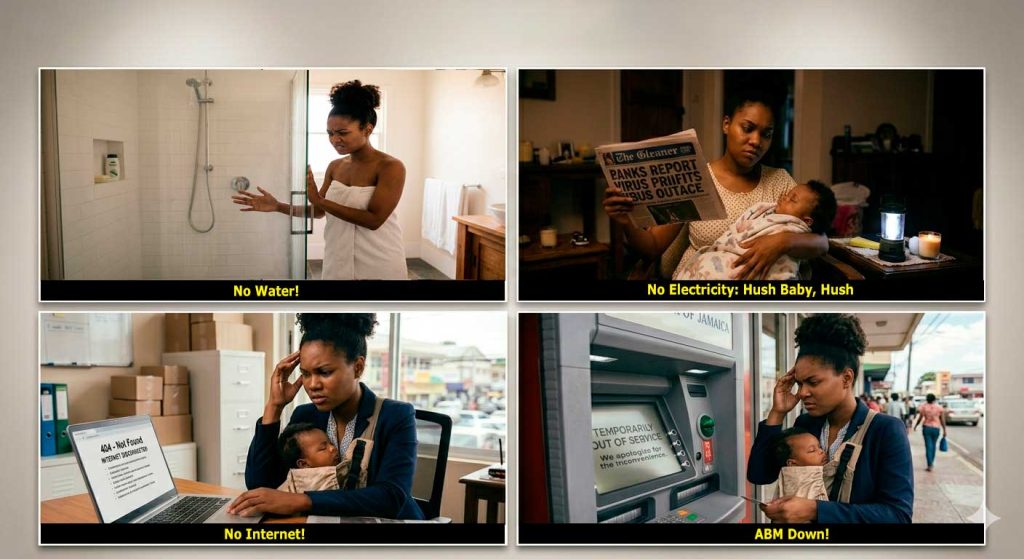
Utility Companies Hitting Productivity Mercilessly
When you look past the immediate frustration of the Friday, June 5th blackout, the picture of Jamaica’s utility landscape—encompassing JPS, the National Water Commission (NWC), and the major telecoms—reveals a systemic crisis. There is an economic and structural paradox: highly profitable, often monopolistic utilities operating in a labor market starved of technical expertise, driving down national productivity.
Telecom Service Failures: Even with a duopoly (Flow and Digicel) supposedly competing, the recent scathing reviews from the Broadcasting Commission (BCJ) and the Office of Utilities Regulation (OUR) regarding customer service highlight that “competition” hasn’t translated to quality. Drop calls, erratic internet, and agonizing customer service loops persist because consumers have nowhere else to go.
The NWC Paradox: Jamaica is an island with a predictable tropical weather pattern and mountainous terrain that naturally channels water. Yet, the NWC heavily relies on a crumbling infrastructure network where up to 50% of treated water is lost to leaks (“Non-Revenue Water”) before it ever reaches a pipe. Because citizens cannot choose an alternative water provider, the NWC has historically lacked the competitive urgency to aggressively modernize.
The Productivity Death Spiral
The most damaging consequence of this infrastructure instability is its direct hit on national productivity:
- Small Business Suffocation: When the power dies, the local market vendor loses refrigeration, the corner shop can’t run its point-of-sale system, and the small digital entrepreneur loses a day of work.
- The Exhaustion Tax: A population that cannot sleep because of oppressive heat and no fans is a population that shows up to work the next morning completely exhausted. You cannot have a highly productive, innovative workforce when people are drained by the simple logistics of surviving the night.
- The “Defensive Expenditures” Burden: Businesses and middle-class citizens are forced to spend massive amounts of capital on solar systems, generators, water tanks, and backup water pumps just to ensure basic continuity. This is capital that should be invested in expanding businesses, education, or local innovation, but instead, it is spent doing the utility companies’ jobs for them.
Modern power grids, digital telecom networks, and automated water treatment systems require advanced engineering, data analysis, and predictive maintenance skills. When a country loses its top technical talent to North America or Europe, utilities are forced to rely on a shallow pool of qualified personnel.
This deficit doesn’t just affect the technicians fixing lines; it penetrates middle and upper management. Project management failures—like missing deadlines for upgrading water pumps or failing to properly insulate sub-stations from lightning—are often direct results of a shortage of highly skilled, locally invested expertise.
The Tertiary Education Crisis & The “Brain Drain” Paradox
Local economic experts confirm that only about 15% to 16% of Jamaica’s total workforce holds a tertiary degree.
The crisis is even worse than a simple lack of education. It is a dual tragedy: Jamaica has a massive deficit in domestic technical training, yet 85% of Jamaican university graduates leave the island within five years of graduating. This is a catastrophic “Brain Drain.” The country pays to educate its brightest minds, only for them to export their productivity to Canada, the US, or the UK because the local economy only offers them low-wage bank teller or hotel concierge roles. This forces a reliance on overseas contractors.
The fact that roughly 60% to 65% of the working population has no formal certification, vocational training, or tertiary exposure—we are looking at a workforce that is structurally locked out of high-value, modern industries.
This reflects a massive deficit in functional competence. If nearly two-thirds of a workforce does not have the training to run modern systems, program code, manage industrialized agriculture, or design infrastructure, you cannot build a high-productivity economy. We get stuck exactly where Jamaica is: a low-skill, service-dependent economy.
The Older Generations Hold Onto to the “Baton”
Where the older generation stays on out of duty, patriotism, and a sense of institutional preservation—reveals a quiet crisis in Corporate Jamaica.
When a company or a government ministry looks at its roster and realizes that if the 65-year-olds walk out the door, the organizational memory, institutional knowledge, and fundamental execution capabilities of the entity go with them, keeping those seniors on isn’t just about financial need. It is an emergency stabilization measure.
This specific phenomenon exposes several deep layers of the “success” crisis in Jamaica:
The Broken Apprenticeship Model
In a functional corporate structure, senior leaders spend their final five to ten years mentoring, molding, and actively passing the baton to the next generation. This requires a stable middle tier of management.
Because Jamaica’s middle tier (those aged 28 to 45 with solid experience) has been hollowed out by massive emigration to North America and the UK, that bridge is broken. A 63-year-old managing director or chief engineer looks down the corporate ladder and sees a massive, yawning gap between themselves and an entry-level workforce that lacks fundamental professional polish, work ethic, or critical problem-solving skills.
Leaving would mean watching the institution they built over 30 years collapse. In this context, staying on is an act of economic patriotism—they are holding the wall.
The Illusion of a “Job Market”
If you look at public pronouncements, Jamaica frequently boasts about record-low unemployment numbers (hovering around 4.2%). But Corporate Jamaica knows the truth:
The Labor Paradox: Jamaica has a severe shortage of labor and a severe shortage of jobs simultaneously. There is a massive surplus of low-skill labor filling BPOs and retail, but a critical, desperate shortage of high-skill, high-competence talent to fill executive, technical, and strategic roles.
When a major local company posts a senior vacancy, they often get hundreds of applicants, but a shocking percentage of those with tertiary degrees lack basic competence in written communication, strategic data analysis, or project management.
The degree has been decoupled from actual capability. As a result, boards of directors look at the risk profile and decide it is safer to ask the retiring executive to sign a rolling two-year consultancy contract than to gamble on the unvetted, unpolished younger generation.
The Cult of “Easy Money” and the Decay of the Work Ethic
There is an uncomfortable cultural shift fueling this talent shortage. The older generation grew up in an era where professional advancement was tied to rigid discipline, continuous upskilling, and institutional loyalty.
Today, the younger generation operates in an environment where the economic signals point away from traditional corporate growth. Between the quick financial allure of the informal economy, scams, social media influencing, and low-effort gig economy roles, the long, grueling path of corporate apprenticeship looks deeply unattractive.
The youth who do have the discipline and intellect realize they can earn five times their Jamaican corporate salary by working remotely for an international firm or migrating. The ones who remain in the local corporate pool are too often those who are content to do the bare minimum, leaving companies starved for true leadership potential.
What about skills Training?
The Auditor General’s Department explicitly highlighted this in an exhaustive audit of the HEART/NSTA Trust (the national vocational training agency). The audit revealed that despite billions of dollars pumped into skills training, HEART struggled with a certification rate of just 45% relative to enrollment.
- Trainees register, but financial hardships, systemic transport issues, and socio-economic pressures cause them to drop out or fail assessments before reaching international standards.
- The result is a cycle where millions are spent, but a competent, certified workforce fails to materialize at scale.
The Sovereign Risk of an Un-replicated State
When patriotism is the only thing keeping your critical infrastructure—your ministries, your central bank, your utilities, your top-tier corporate boards—running, you are operating on borrowed time.
If a nation cannot replicate its own leadership class, it is experiencing a slow-motion collapse of its human infrastructure. When that aging, patriotic generation eventually passes away or becomes physically incapable of working, the vacuum will be filled either by complete institutional decay or by the wholesale importation of foreign management firms to run Jamaican entities.
The Re-colonization of Skills
Because the local workforce is under-certified, and the top-tier local graduates flee the island, Jamaican businesses and the government are forced into an expensive dependency: importing foreign technical competence.
When a major highway needs to be engineered, a digital banking platform needs to be built, or a large-scale manufacturing plant needs upgrading, Jamaica brings in overseas contractors. This creates a deeply damaging economic loop:
[The Skill Extraction Loop]
Jamaica pays taxes/revenues ──> Overseas Contractors ──> Profits leave the island
           ▲                                                        │
           │                                                        ▼
Local youth left with low-wage labor <── No local knowledge transfer/ownership
This is why the country struggles to retain wealth. The high-value knowledge and the profits generated by major projects are systematically exported right back out of the country.
You cannot run a 21st-century economy on 19th-century educational metrics. A nation can achieve all the “fiscal discipline” and IMF balance-sheet targets it wants, but if 65% of its citizens are uncertified and its brightest minds leave, “growth” will remain a statistical illusion managed by commercial banks and luxury resorts.
Intergenerational Wealth Erosion & The Sovereignty Threat
When a young population lacks the specialized skills or structural avenues to build new industries, the wealth accumulated by the older generation doesn’t get reinvested into building businesses. Instead, it gets spent on importing foreign goods, paying off high-interest debt, or paying heavy banking fees.
If a nation’s internal productive capacity is broken, it becomes chronically dependent on two things: remittances from the diaspora and foreign bailouts/loans when climate disasters hit. This creates a cycle where policy is dictated by external lenders rather than the sovereign will of the Jamaican people.
The Grim Reality of the “Business-as-Usual” Future
If the country fails to adapt, the economic landscape will buckle under three specific pressures:
- The Dependency Squeeze: A shrinking pool of working-age citizens will have to generate the tax revenue required to support an expanding, dependent elderly population. This puts immense strain on the National Insurance Scheme (NIS) and public healthcare infrastructure.
- The Labor Vacuum: As technical personnel continue to emigrate and fewer youth enter the workforce, basic utilities (JPS, NWC) will face an even more severe shortage of skilled personnel to maintain complex systems.
- Stagnant Productivity and Economic Ceilings: Real labor productivity is already lower than it was 25 years ago. With an aging, physically exhausted workforce and declining total factor productivity, Jamaica will struggle to break out of its historical 1% average annual GDP growth ceiling.
The Ultimate Path Forward: A Production-Based Economy
To stop the bleeding, Jamaica must transition from a consumption-and-fee-driven economy to a production-driven economy.
[The Stagnation Loop] -> Tourism Shock -> Bank Fee Drainage -> Brain Drain -> Debt Dependency
                                                                        │
                                   [The Sovereign Recovery Pivot] <─────┘
                                        ├── 1. Break Banking Duopolies
                                        ├── 2. Tax Breaks for Graduate Retention
                                        └── 3. Heavy Investment in Agro-Tech & Infrastructure
Shift from “Mass Tourism” to “Value-Linkage Production.” Jamaica must mandate that tourism infrastructure integrates with local supply chains. Furthermore, the focus needs to pivot violently toward Distributed Blue & Green Energy and Climate-Resilient Infrastructure. Instead of building more coastal mega-resorts, capital expenditure should be aggressively rerouted into water security, inland agro-processing, and modernized domestic transit.
If we have fewer workers, each individual worker must be highly skilled, highly productive, and highly compensated to sustain the economy.
- The Vocational Shift: Shift public investment heavily away from generic academic routing and squarely into advanced technical and vocational training (robotics, modern agricultural technology, civil engineering, and grid management).
- The Tech-Driven Workforce: We need a younger generation that can run computerized water filtration networks and automated power grids, directly combating the internal incompetence holding back our industries.
Technology must be used to eliminate human labor bottlenecks rather than simply creating digital bureaucracy. The NWC must implement automated leak-detection and smart-grid pressure routing to stop losing half its treated water before it hits a consumer. If the labor force is small, the machines must do the monitoring.
The Jamaican diaspora is one of our greatest untapped assets. Instead of just relying on remittances to keep families afloat, the government needs targeted policies—such as tax shields, specialized investment bonds, and streamlined paths to institutional leadership—to explicitly attract retired or mid-career technical professionals back to the island to train the local workforce.
An aging population shouldn’t mean a helpless population. The legal retirement age and institutional structures must adapt to keep older citizens healthily and actively engaged in the economy. This means creating flexible, knowledge-based advisory roles where aging professionals can mentor younger workers, passing down institutional knowledge before they exit the workforce entirely.
Ultimately, to beat the double whammy of a shrinking population and poor service infrastructure, the country has to pivot from an economy built on cheap, low-skilled labor to one built on high-efficiency automation and hyper-trained talent.
Democratize Credit & Penalize Rent-Seeking. The government needs to introduce aggressive antitrust laws to break up the banking cartel that controls three-fifths of the island’s financial assets. By lowering the cost of capital for small and medium-sized local enterprises (SMEs) and capping transaction fees on digital public goods, capital can flow into productive local sectors (like light manufacturing and tech services) instead of pooling on bank balance sheets.
A country that cannot cultivate, train, and retain a generation capable of running its own institutions will eventually lose the practical right to govern itself.
Incentivize Retention: Provide aggressive tax credits, low-interest housing loans, and specialized research grants for young university grads who commit to staying and working in Jamaica for a minimum of 5–7 years.
Economic growth is not gained by a bailout or a tourism marketing campaign. It requires a radical, state-enforced mobilization to completely restructure how the population is educated, certified, and retained on Jamaican soil.
True sovereignty isn’t achieved by maintaining stable inflation while trained and competent youths leave and the banks hoard cash. It is achieved when a country builds a population capable of generating its own food, managing its own infrastructure, and retaining the wealth it creates.


Book Book Book – Not TikTok
Guess What Else is Contributing to Lower Birth Rates