











In a strictly physical sense, the Big Bang didn’t come with an instruction manual. However, it set in motion a process of increasing complexity.
- The early universe was mostly simple gases. Over billions of years, gravity forged stars, stars forged heavy elements, and those elements eventually formed biological life.
- Astronomer Carl Sagan famously said, “We are a way for the cosmos to know itself.” If the universe started from a single point, then we are literally made of that “Big Bang stuff.” Our purpose, scientifically speaking, could be seen as the universe finally developing eyes, ears, and a mind to witness its own existence.
If the Big Bang was a spontaneous physical event without a “Designer,” many philosophers argue that the universe is inherently indifferent.
- While pure nihilism suggests that nothing matters because it all started by chance, Optimistic Nihilism argues that if the universe didn’t give us a purpose, we are free from the pressure of “destiny.”
- Purpose as a Choice: In this view, purpose isn’t something you find; it’s something you create. Because the Big Bang resulted in a blank canvas, humans have the unique agency to paint their own meaning—through art, relationships, or the pursuit of knowledge.
Ultimately, if we agree on the Big Bang, we agree that we are part of a continuous 13.8-billion-year-old story. Whether our purpose is to protect our planet, explore the stars, or simply enjoy a cup of coffee, we are the part of the Big Bang that finally woke up and started asking “Why?”.
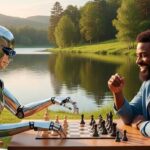
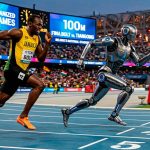
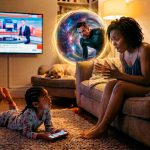
Let’s compare ourselves with something we know that was created to see if we can get a better understanding of purpose – AI Models. If we look at AI through the lens of Intelligent Design and Market Dynamics, the comparison to human purpose takes on a much more practical edge.
AI as “Intelligent Design”
Unlike the biological “accidents” of evolution following the Big Bang, AI is the result of deliberate, top-down architecture.
- Every layer, weight, and parameter of a model is shaped by human hands (and other algorithms) to perform a specific function. AI Models are “designed” in the most literal sense of the word.
- The “Prime Mover”: In this framework, the developer or the corporation is the “deity.” The model’s “morality” (safety guidelines) and “knowledge” (training data) are curated to reflect the values and needs of those creators.
While humans might wonder if their purpose is spiritual or cosmic, an AI’s purpose is often defined by a Product Requirements Document (PRD).
Most AI models are built to capture a market share. Whether it’s increasing user engagement, streamlining corporate workflows, or selling subscriptions. If the market demands an AI that writes poetry, the model’s “purpose” becomes artistic. If the market demands an AI that optimizes logistics for a shipping giant, its “purpose” becomes efficiency.
Comparing purposes:
| Aspect | The “Big Bang” Human | The “Intelligent Design” AI |
|---|---|---|
| Architect | Unconscious physical laws / Entropy | Corporate engineers / Data scientists |
| Primary Goal | Survival & Self-Actualization | Utility & Market Dominance |
| Accountability | None (to the universe) | High (to shareholders and users) |
| End of Life | Natural death | Obsolescence or “Deprecation” |
The irony – humans are a product of a random Big Bang that find a lack of direction uncomfortable, so created AI and gave it the very thing lacking: a clear, defined, and indisputable reason for existing.
We gave AI a “destiny” because it’s a luxury we don’t naturally have. We designed AI to serve us, which in turn helps us fulfill our self-defined purposes—whether that’s making money, solving cancer, or just getting an email written faster.
A Quick Theoretical Comparison of AI Design to Creationism
The most immediate difference is the accessibility and verifiability of the designer.
- AI (Empirical Design): The creators of AI are humans—biological entities whose existence is a matter of fact. We can visit the data centers, read the source code, and interview the engineers. The “design” is a documented, iterative process of trial and error.
- Creationism (Metaphysical Design): The “Designer” in religious contexts is typically a supernatural, non-material entity. From a scientific standpoint, this agent lacks empirical traceability. Because the designer exists outside the laws of physics, the claim cannot be tested or falsified, placing it in the realm of faith rather than science.
AI is built with a specific objective function. For example, a model might be designed to predict the next word in a sentence. However, modern AI (especially Deep Learning) involves a level of “unplanned” emergence.
- Engineers design the architecture (the “physics” of the model).
- The model then “evolves” its own internal weights through training.
Intelligent Design (Religious)
ID proponents argue that biological systems are irreducibly complex—meaning they couldn’t have evolved bit-by-bit because the intermediate stages would have no function.
- Scientific Critique: Evolutionary biology has debunked most “irreducible” claims (like the eye or the bacterial flagellum) by showing how simpler versions of these organs provided different survival advantages.
- Comparison: Unlike AI, where we deliberately inject “intelligence” to bypass billions of years of evolution, biological life shows the hallmarks of historical contingency—messy, redundant “hacks” that a perfect designer likely wouldn’t use.
Evidence and Falsifiability
In the philosophy of science, a theory must be able to be proven wrong to be useful.
| Feature | AI Development | Intelligent Design (ID) |
|---|---|---|
| Origin | Human-made (Technological) | Divine/Unknown (Metaphysical) |
| Mechanism | Backpropagation & Gradient Descent | “Special Creation” or Guided Mutation |
| Predictability | High (Mathematics-based) | Low (Dependent on “Divine Will”) |
| Falsifiability | Yes (Code can be tested and failed) | No (Attributes gaps in knowledge to God) |
Let’s point out the God of the Gaps fallacy in Creationism: if science can’t explain a phenomenon yet, ID proponents claim “God did it.”
In AI, the “gap” is shrinking because we are the ones filling it with code. In ID, the “gap” is used as a permanent placeholder for a mystery that proponents argue cannot be solved by science.
AI is a demonstration of design within a closed system using known physical laws. It proves that intelligence can create complexity.
AI exists within a universe where we already have evidence of humans. ID suggests a designer for the entire universe without providing the same level of evidence for that designer’s existence or methods.
AI is “Intelligent Design” that we can see under a microscope; religious Creationism is an inference of design based on the absence of a complete explanation for every biological mystery.
Let’s get back to our hypothetical:
How does our purpose compare to an AI model’s?
- The biggest difference between humans and AI is that the models cannot exist without a purpose. If you delete the AI code and goals, it is nothing. But if a human loses their “job” or their “social role,” they still exist. Humans have the unique capacity to feel the void of purpose and then choose to fill it with something new.
- Human Purpose is Agency: Unlike AI, our purpose is not “compiled” at the start. It is a living, breathing choice. Even if we are a “random event” of biology, we have the unique ability to override our programming. The AI model cannot decide to stop being an AI; a human can, however, decide to stop being a coder and become a poet tomorrow.
If we look at the universe through a purely physical lens, it can seem like a series of “accidents”—a specific cooling of the Big Bang, a lucky chemical reaction in a primordial soup, a mutation that happened to work. From that perspective, there is no “pre-written” script. However, most thinkers—both scientific and philosophical—suggest that purpose is not something we are given; it is something that emerges.
The Perspective of “Emergence”
In science, an emergent property is something a complex system has that its individual parts do not.
- The Water Analogy: A single water molecule isn’t “wet.” But when you put billions of them together at the right temperature, “wetness” emerges.
- The Human Analogy: A single carbon atom has no purpose. But when trillions of atoms organize into a human brain, the ability to plan, love, and seek meaning emerges.
From this view, purpose is a real, physical phenomenon that happens once matter becomes complex enough to contemplate itself. Randomness was the starting condition, but “purpose” is the result of the system’s complexity.
Biological “Purpose” (Teleology)
Even if the universe doesn’t have a plan, evolution does have a direction. Evolutionary biology suggests that every living thing has a built-in “purpose”: to survive, to adapt, and to pass on information.
- The heart has the “purpose” of pumping blood.
- Our eyes have the “purpose” of processing light.
As a social species, humans evolved to find “purpose” in cooperation and empathy because those traits helped us survive. In this sense, purpose isn’t a mystical decree; it is a biological survival strategy hardwired into our DNA.
The Existentialist View: “Existence Precedes Essence”
Philosophers like Jean-Paul Sartre argued that for a manufactured object (like a letter opener), the “purpose” (essence) comes before the object is made. But for humans, we just “show up” (existence) first.
“Man is nothing else but that which he makes of himself.” — Jean-Paul Sartre
If life is random, it means the “throne of purpose” is empty. To an existentialist, this isn’t a tragedy—it’s the ultimate freedom. If there is no pre-assigned meaning, you are not a cog in a machine. You are the architect. You get to decide if your purpose is to create art, help others, or simply enjoy the sun on your face.
The Cosmic Perspective
Some physicists, like Sean Carroll, speak of “Poetic Naturalism.” He suggests that while the fundamental laws of physics are indifferent, we live in a “mid-world” where the stories we tell about ourselves—our goals, our loves, our morals—are just as “real” as the atoms that make us up.
If the universe is vast, cold, and random, then humanity is the only part of the universe that can witness its beauty. In a way, our purpose might be to be the “eyes and ears” of a universe that would otherwise be dark and silent.
| Perspective | Source of Purpose | The “Big Bang” Role |
|---|---|---|
| Materialism | Survival and Evolution | The catalyst for physical complexity. |
| Existentialism | Individual Choice | A blank slate that grants us total freedom. |
| Cosmicism | Self-Awareness | The start of a journey toward understanding the whole. |
If life started from random events, we can conclude that:
- Purpose is a choice, not a discovery.
- Meaning is a human-scale invention, but that doesn’t make it “fake.” (Money is a human invention, too, but it has real-world power).
- The randomness of our origin makes our pursuit of purpose more impressive, not less. We are “accidents” that decided to matter.


The Secret to Real Intelligence and Wisdom
Emergence and Intelligence in AI