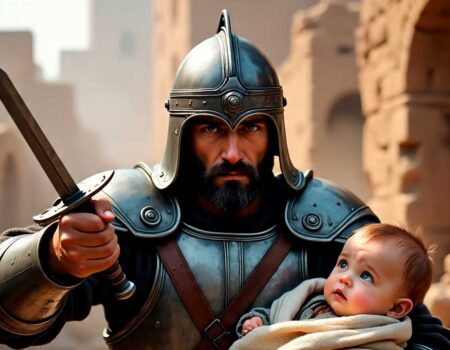



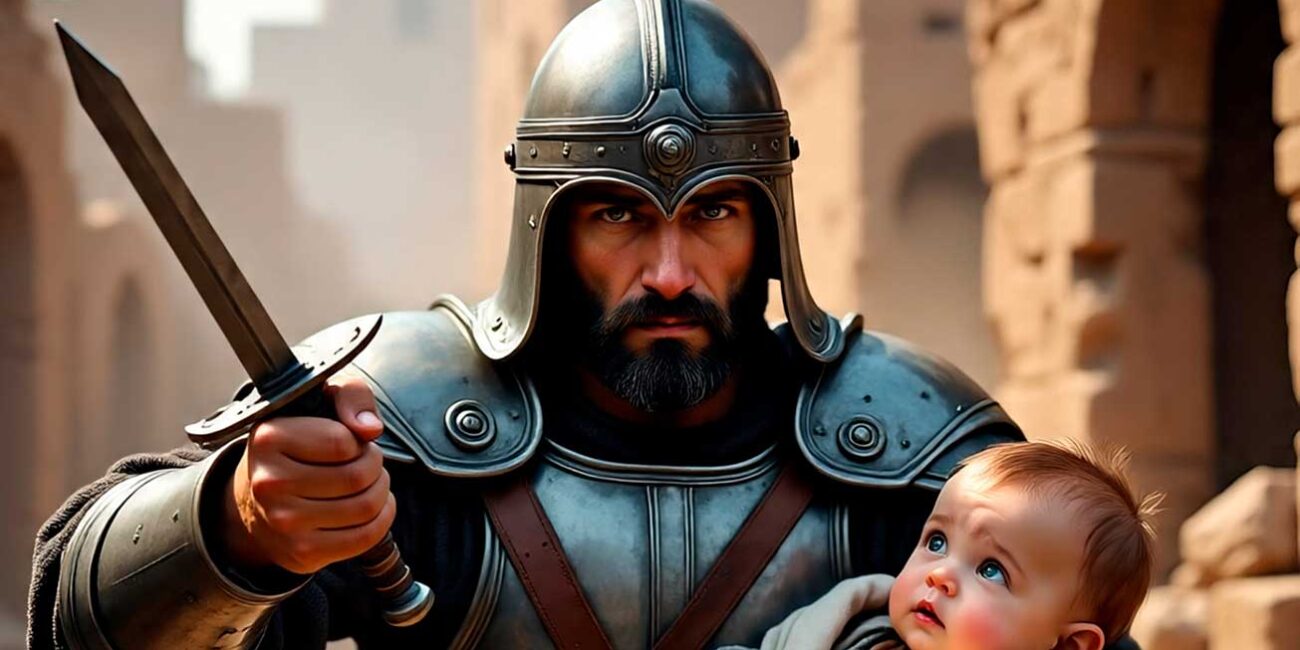
When you look at the earlier layers of the Bible—the ones written before the Roman and Medieval “smoothing out” of the text—the deity often displays the raw, unpredictable, and violent traits of an ancient Near Eastern storm god or a tribal warrior-king.
Because these texts were written in a world where “might made right,” a god’s power was often proven through his capacity for total destruction.
The Great Flood (Genesis 6-7)
This is the most “all-encompassing” example. Because humanity had become “wicked,” the text describes a total divine reset.
The Act: A global flood intended to wipe out all life.
The Targets: Every human being on Earth, including infants and children, with the exception of Noah’s family.
The Context: In the earlier Mesopotamian version (the Epic of Gilgamesh), the gods sent a flood because humans were too noisy and the gods couldn’t sleep. The Biblical edit added a “moral” reason, but the result remained a mass extinction.
The Tenth Plague of Egypt (Exodus 11-12)
This is perhaps the most explicit example of the targeting of children to achieve a political/theological goal (the liberation of the Israelites).
The Act: The “Destroyer” passes through Egypt.
The Targets: Every firstborn male in Egypt, from the son of the Pharaoh to the son of the slave girl, and even the firstborn of the cattle.
The Context: This was framed as a “divine judgment” against the gods of Egypt, proving that the Hebrew God held the power of life and death even over the heirs of the “divine” Pharaoh.
The Conquest of Canaan (The Book of Joshua)
As the Israelites moved into the “Promised Land,” the text records several instances of Herem (the Ban). This was a religious decree of total destruction.
Jericho (Joshua 6:21): “They devoted the city to the Lord and destroyed with the sword every living thing in it—men and women, young and old, cattle, sheep and donkeys.”
The Amalekites (1 Samuel 15:3): The prophet Samuel gives a direct order from God to King Saul: “Now go, attack the Amalekites and totally destroy all that belongs to them… put to death men and women, children and infants, cattle and sheep, camels and donkeys.”
Specific Outbursts of “Deadly Anger”
Beyond large-scale wars, there are several “small-scale” examples where the deity reacts with immediate, lethal force:
The 42 Youths (2 Kings 2:23-24): When a group of youths mocks the prophet Elisha for being bald, God sends two bears out of the woods to maul forty-two of them.
The Sons of Aaron (Leviticus 10): Nadab and Abihu offer “unauthorized fire” (an incorrect ritual) before God. Fire comes out from the presence of the Lord and consumes them instantly.
Uzzah and the Ark (2 Samuel 6): When the Ark of the Covenant is being moved and starts to tip, a man named Uzzah reaches out to steady it. God strikes him dead on the spot for touching the sacred object, despite his “good” intentions.
Why are these stories there?
Theologians and historians view these passages through very different lenses:
The Tribal Lens: Ancient writers needed their god to be scarier than the neighbors’ gods. If your god wasn’t capable of “genocide” against your enemies, he wasn’t considered a “real” protector.
The Sovereignty Lens: These stories emphasize that God is not a “peer” to humans. His anger is depicted as a force of nature (like a volcano)—you don’t negotiate with it; you simply obey or perish.
The Later “Edit”: By the time we reach the New Testament and later Roman Christianity, these “angry” versions of God became a problem. This led to the development of the “Merciful Father” image to distance the religion from its more violent, tribal roots. This is interesting as Christians claim their God does not change – he is the same yesterday, today and forevermore.
Wit & Candor: It’s a bit of a “character arc” problem. If you read the Bible from start to finish, the protagonist starts as a volatile Bronze Age warrior and ends as a universal spirit of love. Most modern readers find the early “warrior” chapters deeply disturbing because they conflict with the “Grandfatherly” image the Church spent 1,500 years building
The Explanation/Justification
The God of the “Old Testament” and the God of Jesus could not possibly be the same person. Let’s see how this was argued:
Marcionism: The First Great Schism
Marcion was a wealthy shipowner and the son of a bishop. He was one of the first people to try and create a standardized “New Testament.” His logic was simple but devastating to the early Church:
The “Demiurge” (The Just/Violent God): Marcion argued that the God of the Hebrew Bible was the Demiurge—the creator of the physical world. This God was legalistic, vengeful, and obsessed with “eye for an eye” justice. He was the one who sent the bears and ordered the slaughter of the Amalekites.
The “Supreme Father” (The Merciful God): Marcion believed that Jesus represented a previously unknown God of pure love and mercy who had come to “rescue” humanity from the cruel laws of the Demiurge.
The Gnostic Connection: Nature as a Prison
While Marcion was focused on the text, the Gnostics (a diverse group of mystical thinkers) took it a step further. They used the “Deadly Anger” of the Old Testament as evidence that the material world was fundamentally “broken” or even evil.
The Flawed Creator: In Gnostic texts like the Apocryphon of John, the creator god (often called Yaldabaoth) is depicted as a “blind” or “arrogant” deity who claims to be the only god because he is ignorant of the higher, more peaceful divine realms.
The “Image” Refined: They argued that the “jealousy” and “wrath” mentioned in the Bible were proof of the creator’s human-like ego. They believed that the “Most Powerful” god wouldn’t need to kill children to prove a point; only a fragile, human-like tyrant would do that.
How the “Mainstream” Church Fought Back
The early Church Fathers (like Irenaeus and Tertullian) realized that if Marcion won, Christianity would lose its historical roots in Judaism. They labeled Marcion a heretic and spent decades writing “rebuttals.”
Their solution to the violence was to invent Allegory:
The “Spiritual” Reading: They argued that when God ordered the killing of children or enemies, it wasn’t a literal command. Instead, the “enemies” were “sins” and the “children” were the “seeds of evil thoughts” that had to be destroyed in the mind.
The Educational Model: They argued that humanity was in its “infancy” during the Old Testament and needed a harsh, disciplinarian father. By the time of Jesus, humanity had “grown up” and was ready for the “Gentle Father.” Interesting isn’t it? Hmm… I wonder why we had slavery.
The Lasting Impact on Language and Writing
This debate forced the Church to finalize the Canon (the official list of books in the Bible). To ensure no one could separate the “Angry God” from the “Loving God,” they physically bound them together into a single volume.
The Latin “Vindicta”: In Romanized Christianity, the “Deadly Anger” was rebranded as “Divine Justice.” The Latin word Vindicta (vengeance) became a legal term. If the state (the Roman Empire) executed someone, they were simply acting as the hand of this “Just God.”
The “Fear of God”: The phrase “God-fearing” became a badge of honor. It was a linguistic tool used to keep the population in line—if God could strike down Uzzah for a simple mistake, he could certainly strike you down for disobeying the Church or the King.
The “Two Gods” Today
Even though Marcionism was “defeated,” the tension never really went away. Most modern Christians still struggle to reconcile the “God of Joshua” with the “God of the Sermon on the Mount.”
You can still see the divide in how people talk:
- “Old Testament Justice” is often used as a code for harsh, uncompromising punishment.
- “New Testament Grace” is used for forgiveness and empathy.
- Wit & Candor: It’s the ultimate “good cop, bad cop” routine, but it’s played out over 2,000 years of history. The “Bad Cop” (the angry deity) was useful for conquering territory and enforcing laws; the “Good Cop” (the loving father) was useful for building community and social cohesion.
By the Middle Ages, the “Character Arc” of God was complete. He was no longer just a tribal warrior or a philosophical “First Cause”; he was the Supreme Monarch. Medieval Kings and later colonial powers used the two-sided nature of the Biblical God—the “God of Law” and the “God of Conquest”—to build a legal framework for violence.
The “Warrior King” and the Crusades
During the Crusades (1095–1291), the “Deadly Anger” of the Old Testament was resurrected to justify the slaughter of non-believers.
Divine Mandate: When Pope Urban II called for the First Crusade, the cry was “Deus vult” (God wills it). They looked specifically to the Book of Joshua and the “Conquest of Canaan” as a historical precedent. If God ordered the Israelites to clear a “Promised Land” of its inhabitants, then the Christian knights were simply the “New Israelites” clearing the Holy Land.
The “Sacred” Massacre: During the Siege of Jerusalem in 1099, chroniclers recorded that crusaders waded “ankle-deep in blood.” To justify this, they cited the concept of Herem (Total Devotion through Destruction). They weren’t “murdering”; they were “purifying” the land for the Father God.
The “Divine Right” and the Ladder of Power
The Roman legal influence turned God into a judge. This allowed Kings to claim “Divine Right.”
The Logic: If God is a King, and the King is God’s representative, then the King’s enemies are God’s enemies.
The Scale of Violence: This was used during the Inquisition and the Wars of Religion. If “God the Father” punished his own “children” (like the Israelites) for heresy or idol worship, the state felt obligated to do the same via the stake and the sword.
The Justification of Slavery: The “Curse of Ham”
The most devastating use of “edited” scripture and the “Male Sovereign” image came during the Transatlantic Slave Trade. Pro-slavery theologians reached back into the Old Testament to find a “legal” reason for racial hierarchy.
The Genesis Story (Genesis 9): They focused on the story where Noah curses his grandson, Canaan (the son of Ham), saying, “A servant of servants shall he be unto his brethren.”
The Rebranding: In the 17th and 18th centuries, European writers “edited” the meaning of this text. They claimed that Ham was the ancestor of all Africans and that his “curse” was a permanent, divine decree that justified perpetual enslavement.
The “Good Master” Archetype: They used the “Father” image of God to argue that slavery was a “paternalistic” institution. They claimed that just as God was a stern but “loving” father to his subjects, the white slaveholder was a “father” to his “subservient” slaves.
The “Slave Bible” (1807)
Perhaps the ultimate example of “editing” for power is the Select Parts of the Holy Bible for the use of Slaves in the British West-Indies.
The Deletions: Editors removed roughly 90% of the Old Testament and 50% of the New Testament.
Why? They removed any mention of the Exodus (slaves escaping a master) because it was too dangerous. They kept the “Deadly Anger” verses that demanded obedience to authority and the New Testament verses where Paul says, “Slaves, obey your earthly masters.”
The Goal: They wanted a God who was a “Master,” not a “Deliverer.” By removing the story of God fighting for the oppressed, they left only the God who demands order.
The Intersection of Language and Property
In Roman Law (Jus Gentium), a slave was considered Res (a thing/property). The Church translated this into a spiritual context:
- God owns the World.
- The King owns the Land.
- The Father owns the Family/Property.
By using the masculine-dominant language of “The Lord” (which means “Landowner” or “Master” in Old English/Latin), the very way people prayed reinforced the idea that someone—usually a powerful male—had to “own” someone else for society to function.
It’s a dark irony. The very “Word of God” that was supposed to represent the “Ultimate Truth” was sliced and diced by whoever held the pen. They took a complex, often contradictory library of ancient texts and turned it into a “User Manual” for empire and human ownership.
Let’s see if this can be explained away:
The Enlightenment: God as the “Distant Lawmaker”
During the 18th century, thinkers like Voltaire, Thomas Paine, and Thomas Jefferson realized they couldn’t win an argument against a God who “ordered” slavery. So, they changed the definition of God.
Deism: They reimagined God not as a tribal “Lord” who intervenes in human affairs, but as a “Clockmaker.” This “Nature’s God” didn’t grant “Divine Right” to kings; he granted Natural Rights to all humans.
The Secular Pivot: By arguing that all men are “created equal” (even if they didn’t fully practice it yet), they used the concept of a Creator to undermine the authority of the Church. If God is a universal principle of Reason, he cannot be a petty tyrant who favors one race or king over another.
Breaking the “Curse of Ham”
Abolitionists began to use “Counter-Exegesis” (re-interpreting the text) to fight the pro-slavery edits.
The Exodus Re-Discovery: While the “Slave Bible” removed Moses, the Black church in America made him the centerpiece. They argued that the “Deadly Anger” of God wasn’t directed at the weak, but at the oppressor. In their songs (Spirituals), the “God of Joshua” wasn’t a colonizer—he was a liberator who brought down the walls of the “slave-ocracy.”
The One-Blood Argument: They pointed to Acts 17:26: “And hath made of one blood all nations of men.” This was a linguistic strike against the “hierarchy” the Romans had built into the Bible.
Liberation Theology: The “God of the Poor”
In the 20th century, particularly in Latin America, a movement called Liberation Theology turned the “Male Sovereign” image upside down.
The Preferential Option for the Poor: Theologians like Gustavo Gutiérrez argued that the “Most Powerful” God isn’t found in the King’s palace or the Emperor’s court, but in the struggle of the laborer.
The “Human” God Re-imagined: They moved away from the “Pater Omnipotens” (All-Powerful Father) and back toward the “Suffering Servant.” They argued that God’s “deadly anger” in the Bible was actually Divine Indignation against social injustice.
History shows that whenever a new group of people—whether they were Roman Emperors, Slaveholders, or Liberation Priests—gained a voice, they “edited” the Divine to look like their own highest ideals (or their most convenient justifications).
If you don’t know history – fertile ground is being set for it to be repeated. Keep reading – keep researching.

Other Articles

Understanding Evolution Without Feeling Less of a Person
How God lost her vagina and got a penis