













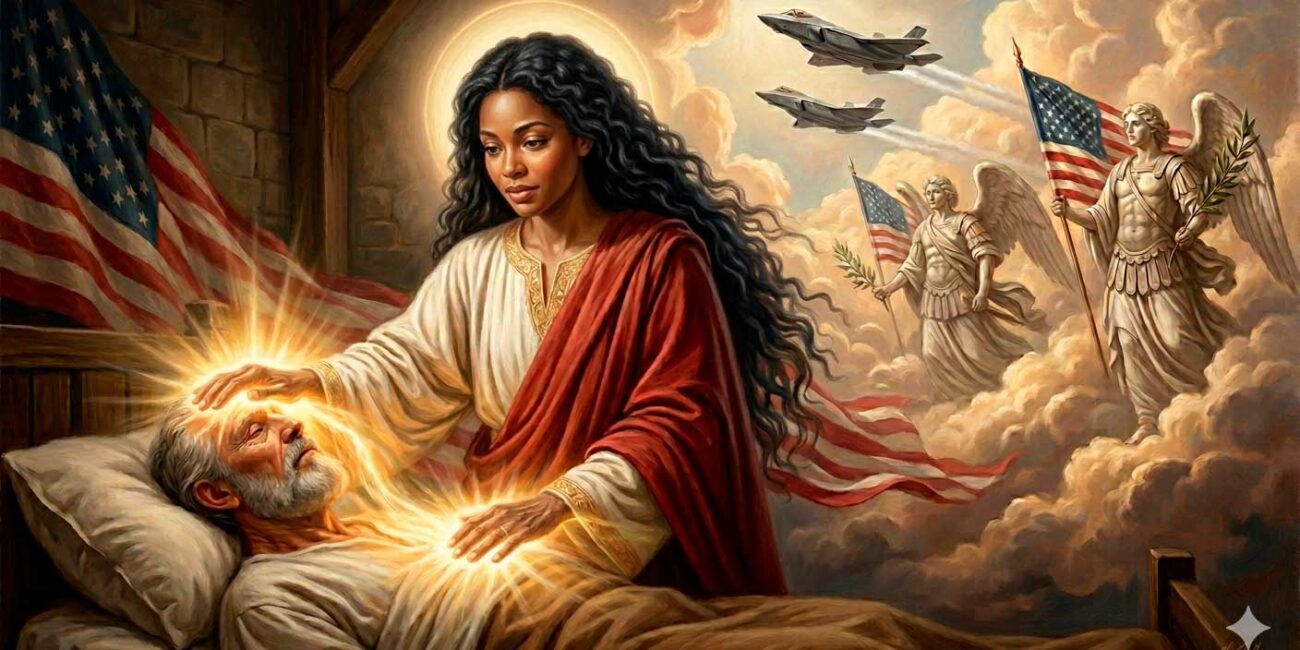
In recent times, the most powerful Christian in the world has depicted himself as Jesus. It created controversy so he got another image of himself beside a white, male God. Commentators like Megyn Kelly were outraged at the original image and called it blasphemous. This is the same Megyn Kelly that famously said. “Jesus was a white man, too. It’s like we have, he’s a historical figure that’s a verifiable fact, as is Santa, I just want kids to know that. How do you revise it in the middle of the legacy in the story and change Santa from white to black?“.
The story of Jesus is from the Middle East so how come the new colonizers (the US) have Jesus as white male?
Let’s look at this with simple logic: If life started in Africa, and we know the important role the female’s body plays in reproduction, then God is more likely a brown or black female. It really shouldn’t matter but humans are fascinating, aren’t we?
The most famous image of Jesus—the one with long flowing light-brown hair and blue eyes—is largely a product of Renaissance Europe. Because European powers were responsible for much of the global spread of Christianity through colonization (and slavery), this specific “European Jesus” was exported as the “standard” image. Over centuries, this version became so culturally ingrained that many people, even those of different ethnicities, began to view it as the “true” likeness rather than a cultural interpretation. It should not be shocking to know that the title above is one of the least likely to be clicked – even by women. Self-hate is real.
Today, we are going to show that though men created God in their own images, there is actual evidence that the most powerful gods were once females.
The transition from worshiping abstract forces of nature to “human-like” gods is one of the most significant pivots in human history. It mirrors our own journey from being subjects of nature to masters of our environment.
When did we start making gods “human”?
While early humans (c. 30,000 years ago) focused on animism (spirits in animals, trees, and storms), the shift toward anthropomorphism (giving gods human traits) accelerated during the Neolithic Revolution (around 10,000 BCE).
As humans settled into farming communities, we stopped viewing the world as a wild place to survive and started viewing it as something to manage. We created gods who looked like us because we were now the most powerful “engineers” we knew.
Why are the “Most Powerful” gods usually male?
The dominance of male deities, including the Abrahamic God, isn’t a cosmic accident; it’s largely a reflection of the social structures that existed when these religions were formalized.
The Shift to Patriarchy: Early agrarian societies often shifted toward patriarchal structures to manage land ownership, inheritance, and warfare.
The “Protector” and “King” Archetypes: In the ancient Middle East and Mediterranean, power was synonymous with physical strength and military leadership. Naturally, the “King of Kings” was modeled after the human kings of the era.
The Erasure of Goddesses: Many early cultures had powerful female deities (like Inanna in Sumer or Isis in Egypt). However, as monotheism rose—particularly within the Hebrew tradition—the “Divine” was increasingly consolidated into a single, male-coded figure to distinguish it from “pagan” fertility cults.
The Intersection of Language and Writing
The way we wrote about gods changed how we perceived them. The evolution of language in the Middle East, Greece, and Rome turned gods from vague “forces” into “characters.”
The Middle East: The Power of the “Word”
In ancient Mesopotamia and early Hebrew culture, writing was seen as an act of creation. The Bible begins with God speaking the world into existence. Because Hebrew and other Semitic languages use gendered grammar, the “Creator” was linguistically categorized as masculine, cementing the “Father” image through the literal structure of the language.
Ancient Greece: The Humanization of Form
The Greeks took anthropomorphism to the extreme. Their gods weren’t just “like” humans; they were humans with “the volume turned up.”
The Homeric Epic: The transition from oral tradition to written Greek allowed for complex character development. Zeus, Apollo, and Athena were written with distinct personalities, flaws, and family dramas.
The Phidias Effect: Greek sculpture and writing worked together to create a visual “standard” for what a god looked like—perfected human anatomy.
Rome: The Bureaucratic Divine
The Romans were masters of law and administration. When they adopted the Greek gods, they “rebranded” them to fit a Roman legalistic framework. Jupiter wasn’t just a god of lightning; he was the ultimate Pater Familias (Head of the Household). Writing became a tool for the state to codify religion, linking the authority of the male Emperor directly to the authority of the male God.
The Philosophical Pivot
By the time we get to the late Roman Empire, Greek philosophy (Plato and Aristotle) merged with Middle Eastern monotheism.
The “Prime Mover”: Aristotle’s idea of a “First Cause” was an abstract concept, but because Latin and Greek writers required gendered pronouns, this abstract force was described as He.
Logos: The Greek concept of Logos (Reason/Word) became a bridge. Writing allowed theologians to argue that “Man” was the only creature with reason; therefore, the source of that reason must be the “Ultimate Man.”
It’s worth mentioning that while the “Main” gods became male, many mystical traditions (like Gnosticism) argued for a dual-gendered or genderless Divine. However, those views were often suppressed by the institutionalized, male-led church structures of the time.
The transition from the “Great Mother” archetypes to the dominant “Sky Father” is one of history’s most dramatic “rebranding” campaigns. As nomadic tribes settled and writing became the tool of the state, the divine feminine was often systematically sidelined, fragmented, or absorbed.
Here is how that demotion played out across the cultures that shaped Western thought:
Fragmentation: From “All” to “Some”
In many early civilizations, the Goddess was a “Generalist”—she controlled life, death, war, and agriculture. As patriarchal city-states rose, her powers were split into specialized, “safer” roles.
Inanna/Ishtar (Mesopotamia): Originally a terrifyingly powerful goddess of both sex and war. Over time, as Babylonian and Assyrian kings sought to centralize power, her “warrior” aspect was often downplayed in favor of her role as a consort to a male king-god.
Asherah (The Levant): Archival evidence and inscriptions (like those at Kuntillet Ajrud) suggest that early Israelites may have worshipped Asherah as the wife/consort of Yahweh.
The Demotion: As the Hebrew Bible was compiled and edited (the “Deuteronomistic reform”), worship of Asherah was labeled as idolatry. Her “sacred poles” were cut down, and the divine was redefined as strictly singular and male.
Subordination: The Greek “Daughter” Model
By the time the Greeks were writing their Great Epics (Homer and Hesiod), the hierarchy was firmly established. The powerful female forces of the older world were literally “swallowed” or tamed.
Metis and Athena: In myth, Zeus swallows the goddess Metis (Wisdom). Athena is then born from Zeus’s head. This shifted the source of wisdom from the maternal/female to the paternal/male. Athena, though powerful, is a “father’s girl” who often sides with men in Greek legal and mythological dramas.
The Furies to the Eumenides: In Aeschylus’s Oresteia, the ancient female spirits of blood-vengeance (The Furies) are legally “domesticated” by the male god Apollo and the “father-born” Athena, turning them into the “Kindly Ones” who serve the city-state.
Translation and the Loss of “The Spirit”
The evolution of language and the translation of sacred texts played a massive role in removing the feminine from the “Main” God.
The Gender of “Spirit”: In Hebrew, the word for Spirit (Ruach) is feminine. In Greek, the word (Pneuma) is neuter. By the time it reached Latin (Spiritus), it became masculine.
The Wisdom Tradition: In the Old Testament, “Wisdom” (Hokhmah) is personified as a woman who was with God at the beginning of creation. However, in early Christian writing (influenced by Greek philosophy), this feminine “Wisdom” was largely merged into the concept of the Logos (The Word), which was identified strictly with Jesus, the Son.
The Rise of the “Virgin” over the “Creator”
In the Roman era, as Christianity became the state religion, the multifaceted “Mother Goddess” (like Isis or Cybele) was replaced by the Virgin Mary.
The Shift: While Isis was a “Queen of Heaven” who held the power of life and death, Mary was framed as the “Handmaid of the Lord.” She became a figure of intercession (asking the male God for favors) rather than a figure of sovereign power.
It’s a bit like a corporate takeover. The old “Goddess Inc.” was broken up; her assets (fertility, wisdom, war) were distributed among smaller “subsidiaries,” and the “CEO” position was permanently reserved for the “Father” figure to reflect the earthly kings and emperors of the time.
The Legal Male Head: Roman law was built on the Pater Familias—the oldest male who had absolute legal authority over his household. By framing God as the ultimate Pater, the Roman state made patriarchy a divine law, not just a social one.
The Linguistic Shift: The Romans translated the Greek Pantokrator (Almighty) into the Latin Omnipotens. This shifted the “vibe” from a creator who holds all things together to a Supreme Judge who has total power.
The Language of the “Authorized” Version
Before the Middle Ages, there were dozens of different “Gospels” and writings, some of which depicted a more balanced divine (like the Gnostic Gospel of Mary). The Romans “cleaned up” the library.
The Council of Nicaea (325 CE): This was essentially a board meeting to standardize “The Brand.” They established a single creed. Any writing that suggested God had a feminine side or that there were multiple “emanations” of the divine was labeled Heresy.
The Vulgate: Jerome translated the Bible into Latin. Because Latin was the language of the courts and the military, the “King James” style of authoritative, masculine language became the only way to speak to the divine. If you couldn’t read Latin, you had to rely on a male priest to tell you what God said.
Creating the “Great Chain of Being”
Roman writers and later Medieval philosophers (like Thomas Aquinas) used these edited texts to create a “ladder” of existence that dominated the Middle Ages.
- God (The Supreme Male)
- Angels (Genderless but depicted as male warriors)
- Kings (God’s representatives on Earth)
- Men (The “Reasoning” half of humanity)
- Women (The “Emotional/Physical” half)
- Animals/Nature
By placing the male God at the top, the “image of God” was legally defined as a male trait. In fact, some medieval theologians debated whether women even possessed the “Image of God” in the same way men did, citing the “edits” made to the Genesis story (where Eve is created from Adam, rather than alongside him).
The Erasure of Local Polytheism and Female Power
As Rome expanded into Northern Europe, they encountered Celts and Germanic tribes who still worshipped powerful goddesses (like Brigid or Freya).
The “Saint” Strategy: Instead of just banning goddesses, the Romans “repackaged” them. Many local goddesses were turned into Christian Saints.
Example: The goddess Brigid became St. Brigid. She kept her “miracles,” but she lost her status as a Source of Creation and became a Servant of the Father. This allowed the Church to absorb polytheistic cultures while keeping the “Male CEO” at the top of the pyramid.
The Result: The “Closed Loop”
By the start of the Middle Ages, the evolution was complete:
- Language (Latin) made the male gender of God a grammatical necessity.
- Law (Roman) made the male head of the house a mirror of the male God.
- Writing (The Bible) had been edited to remove the “Wife of God” and the “Divine Council.”
This created a “closed loop” where it became almost impossible for a person in 1000 CE to even imagine a powerful female deity without it feeling like a threat to the natural order of the world.
Was there a Resurgence of female power? Let’s see:
The Renaissance and the Scientific Revolution
The Renaissance (14th–17th centuries) and the subsequent Scientific Revolution represent a fascinating “glitch in the matrix.” While the Church remained strictly patriarchal, the rediscovery of Greek and Roman texts—unfiltered by medieval censors—brought the “suppressed” feminine and polytheistic archetypes back into the light.
However, they didn’t come back as “Gods” to be worshipped; they came back as Science, Art, and Philosophy.
The Renaissance: The Return of the Goddess as “Art”
When Botticelli painted The Birth of Venus, it was a revolutionary act. For a thousand years, the only “holy” woman allowed in art was the modest, clothed Virgin Mary.
Neoplatonism: Philosophers like Marsilio Ficino argued that “Venus” wasn’t a pagan demon, but a symbol of Divine Love. By using Greek mythology, artists could bypass the strict “Male Father” iconography of the Church.
The Muse: The idea of “The Muse”—nine goddesses who provide inspiration—returned. This shifted the source of creativity from “God the Father” to a feminine, ethereal force.
Alchemy: The Secret “Gendered” Universe
While the Church preached a singular male God, the “underground” science of the era—Alchemy—insisted that the universe was made of a balance between the “Solar/Male” (Sulfur) and the “Lunar/Female” (Mercury).
The Rebis: Alchemists sought the Magnum Opus (Great Work), often symbolized by the Rebis—a single being with two heads (one male, one female).
The “Chemical Wedding”: They believed that for any transformation to occur (like lead into gold), the “King” and the “Queen” had to be joined. This was a direct, albeit secret, challenge to the idea that the “Creator” was exclusively male.
The Scientific Revolution: Nature as “She”
As we moved into the 1600s, the “Male God” was reimagined by thinkers like Isaac Newton and René Descartes as a “Great Clockmaker.” But the thing he was “fixing”—Nature—was still coded as female.
The “Mastery” of Nature: Francis Bacon, often called the father of modern science, famously used language that mirrored the patriarchal structures of the time. He wrote about “capturing” Nature and “making her a slave” to human needs.
The Mechanical Universe: While the “God” stayed male and external (the Engineer), the “Goddess” (Nature) was stripped of her divinity and turned into a Machine. This allowed men to study biology and physics without feeling like they were “disobeying” the Father God.
The “Ghost” of the Feminine in Language
During this time, the development of modern European languages (English, French, Italian) continued to wrestle with the “edits” of the past.
Grammatical Gender: In languages like French and Italian, “Knowledge” (La Connaissance), “Science” (La Science), and “Wisdom” (La Sagesse) remained feminine.
The Personification of Liberty: Even as societies became more secular, they still reached for feminine icons to represent their highest ideals. This is why “Lady Justice” (The Roman Themis) and later “Liberty” (Marianne/The Statue of Liberty) are women. We had spent so long suppressing the “Goddess” that when we needed a symbol for an abstract, powerful truth, we instinctively went back to the older, pre-Roman archetypes.
The “lost” gospels
The “lost” gospels found in the Egyptian desert in 1945 (the Nag Hammadi library) were the ultimate threat to the Roman-filtered version of Christianity. These texts depict a world where the “Divine” isn’t a singular male monarch, but a complex, gender-balanced, and internal force.
When the Roman Church finalized the Bible, they deliberately excluded these writings because they challenged the very hierarchy—the male priest, the male king, and the male God—that kept the Empire stable.
The Gospel of Mary Magdalene: The “Apostle to the Apostles”
In this text, Mary Magdalene is not the “repentant prostitute” (a label created by Pope Gregory I in 591 CE). She is the visionary leader who understands Jesus’ teachings better than the men do.
The Conflict: After Jesus’ death, Peter is depicted as jealous and angry. He asks, “Did he really speak privately with a woman and not openly to us?” * The Demotion: This reflects the real-world 2nd-century battle over whether women could lead the Church. By excluding this gospel, the Roman-influenced editors ensured that the “Divine Voice” only passed through men.
The Lesson: Mary teaches that the “Son of Man” is a state of consciousness inside every person—male and female—rather than a king in the sky.
The Gospel of Thomas: The “I am You” God
While the Roman Bible emphasized that humans were “sinners” who needed a King/God to save them, the Gospel of Thomas suggests that humans are twins of the divine.
No Cross, No Sacrifice: There is no story of a “deadly angry” God demanding the death of his son. Instead, Jesus is a teacher of “secret sayings.”
The Edit: The Roman Church preferred the Gospel of John, which emphasizes Jesus as the “Only Son,” because it created a hierarchy. If Jesus is the only one with power, and the Church is his only representative, then everyone else must obey.
The Thunder, Perfect Mind: The “She” who is Everything
Perhaps the most shocking text for a Roman-era reader was The Thunder, Perfect Mind. It is a poem spoken entirely in the voice of a female divine power.
“For I am the first and the last. I am the honored one and the scorned one. I am the harlot and the holy one. I am the wife and the virgin. I am the mother and the daughter.”
The “Whole” Image: This goddess doesn’t fit into the “Good Mother” or “Bad Seductress” boxes. She is a paradox.
Why it was Deleted: This version of the divine was too “untamed.” It didn’t support the Roman legal code where everything had to be “either/or” (Good/Evil, Master/Slave).
The Result of the Exclusion
By removing these texts, the Roman “brand” of Christianity became a Pyramid of Power:
If the Gnostic gospels had been included, the pyramid would have collapsed into a Circle. If God is both male and female, and the divine is “inside” everyone, you don’t need an Emperor or a Pope to tell you what is true.
We are currently living in a time where these “lost” voices are being re-integrated. History is a cycle: we went from the Body (Ancient Goddesses) to the Law (Roman/Medieval Father God) and now, through the rediscovery of these texts, toward a Synthesis.
It’s almost like a long-lost family secret finally coming out. For 2,000 years, the “Father” has had sole custody of the narrative. Now, we’re finding the “Mother’s” letters in the attic, and they tell a completely different story about where we came from and who we are.
The Modern Legacy
Today, we still live with the “architectural” leftovers of these historical edits:
- We say “Mother Nature” (The chaotic, physical world).
- We say “God the Father” (The orderly, spiritual law).
This split is the direct result of the Greeks humanizing the gods, the Romans legalizing them, and the Middle Ages “editing” out the parts that didn’t fit a male-led empire.
Modern Feminism and the “God-She”
The final stage of this “un-editing” is the movement to restore the gender balance that was lost in the Greek and Roman translations.
The Sophia Movement: Scholars have returned to the original Hebrew and Greek to highlight Sophia (Wisdom) as a female personification of the Divine.
Gender-Neutral Liturgy: Many modern translations are removing the “He/Him” requirement for the Divine, recognizing that “God in our image” was a historical choice made by men in power, not a biological reality of the universe.
Thanks for reading and hope that, after the interest in the title, you will continue reading and researching on your own.


Why people leave the church
The Evolution of the Vagina and Mating in Humans