













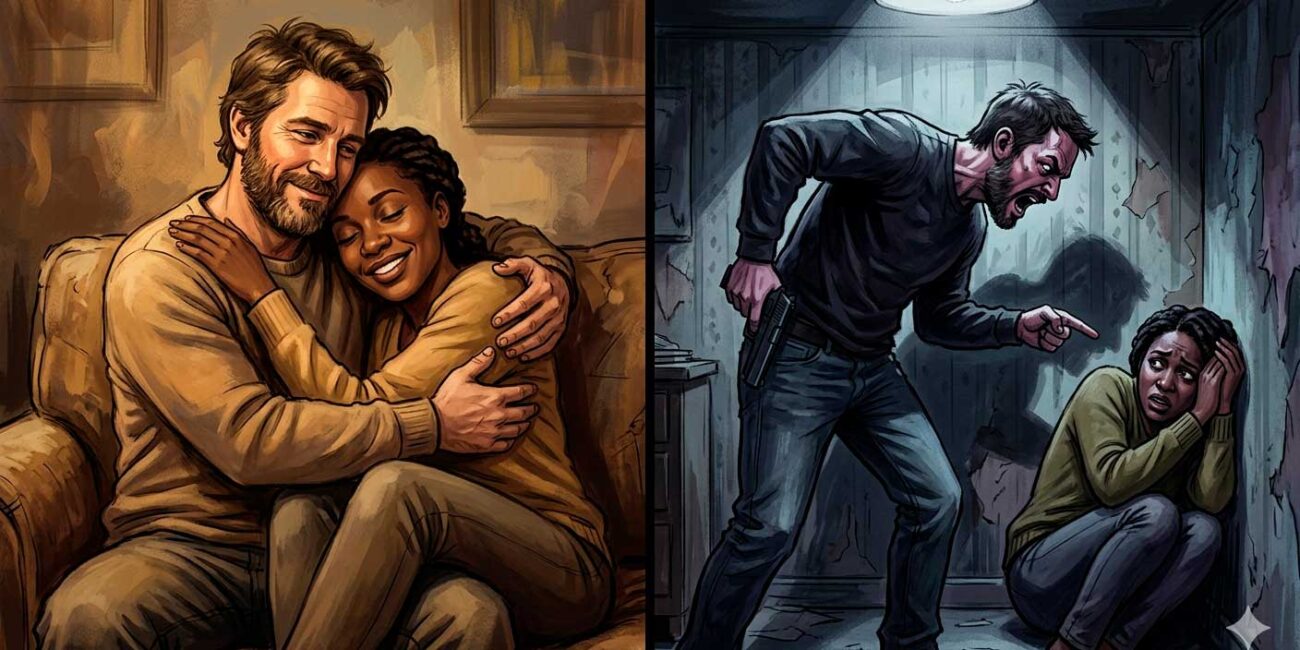
The psychology behind falling in love with a criminal or an abuser—often referred to in clinical circles as Hybristophilia (when attracted to criminals) or part of a cycle of Traumatic Bonding (in abusive relationships)—is rarely about a “lack of common sense.” It is a complex cocktail of neurobiology, past conditioning, and psychological defense mechanisms.
Psychological Drivers
Traumatic Bonding & Intermittent Reinforcement: This is perhaps the most powerful factor. Much like a gambler at a slot machine, the victim receives sporadic “rewards” (affection, apologies, “love bombing”) amidst the “losses” (abuse). This creates a chemical dependency on the highs, making the low periods feel like a withdrawal.
The “Savior Complex”: Some individuals believe they possess a unique kind of love that can “fix” or “tame” a dangerous person. This provides the individual with a sense of purpose and a feeling of being “the only one” who truly understands the perpetrator.
A Need for Security or Power: Paradoxically, being with a “dangerous” person can make someone feel safe from the rest of the world. They feel protected by the very person others fear.
Familiarity and Attachment Style: If a person grew up in a household where love was unpredictable or tied to conflict, they may unconsciously equate “chaos” with “passion.” A healthy, stable partner might feel “boring” because their nervous system is calibrated to high-stress environments.
Responsibility Vs Deception
The question of responsibility is sensitive because it sits at the intersection of agency and victimology. It isn’t an “either/or” situation; usually, both elements are at play.
The Role of Deception
It is a fact that abusers and high-level criminals are often masters of impression management. They don’t start with violence; they start with “The Mask.” By the time the mask slips, the victim is already deep in a psychological fog created by:
- Gaslighting: Systematically eroding the victim’s sense of reality.
- Isolation: Cutting off friends and family so there is no external perspective.
- Economic Control: Making it physically and legally difficult to leave.
The Role of Adult Responsibility
While a victim is never responsible for the abuse itself, psychological health usually involves reclaiming agency over one’s choices.
- Empowerment through Accountability: Framing a woman as “purely a victim with no choice” can actually be patronizing. Acknowledging that an adult has the power to make choices—even difficult ones—is the first step in recovery.
- Addressing the “Why”: For an individual to avoid repeating the pattern, they must eventually look inward at their own “choice architecture.” For example: “Why did I ignore the initial red flags?” or “What void was this person filling?”
Societally, we tend to swing between two extremes: Victim Blaming (claiming she “asked for it” or is “stupid”) and Infantilization (claiming she had “no idea” and was “tricked” entirely). The most grounded approach is to recognize that criminals and abusers are predators who exploit vulnerabilities. A person can be a capable adult and still be victimized by a sophisticated psychological predator. Responsibility isn’t about blaming the person for being deceived; it’s about supporting their agency to choose a different path once the deception is revealed.
The Similarities to a Deity and Religious Systems
Now that you have digested that, let’s make a comparison.
The psychological mechanisms that tie a person to a “dark” partner and those that tie a believer to a deity described in harsh, Old Testament terms are remarkably similar. In both cases, the individual must reconcile their love for a figure with that figure’s capacity for extreme violence.
Here are the psychological parallels between the two dynamics:
Trauma Bonding and Intermittent Reinforcement
In abusive relationships, the “highs” (moments of grace) make the “lows” (violence) bearable. This is mirrored in the relationship with a vengeful deity:
- The Abuser: “I only hit you because I love you and you didn’t listen.”
- The Deity: “I sent the plague/flood because you were unfaithful, but I will spare the remnant who worship me.” The brain becomes wired to seek the mercy of the very being that causes the terror. This creates a survival bond where the victim believes their only safety is found in the shadow of the aggressor.
Moral Justification
When an adult loves a criminal, they often use rationalization to maintain their world view (“He killed for a reason” or “They didn’t give him a choice”).
- In a religious context, this is called Theodicy.
- Believers justify the killing of children or the seizing of land by claiming a “Higher Moral Plane.” They argue that because God is the source of morality, his actions—no matter how violent—are by definition “good.” This resolves the dissonance by surrendering personal moral judgment to the authority figure.
When a human criminal does something bad, their partner might make excuses. But when a “perfect” God does it, the believer often undergoes a moral bypass. They stop using their own conscience entirely and replace it with the deity’s “will.” At that point, the person’s own empathy is effectively held hostage.
The “Special Status” (In-Group vs. Out-Group)
Just as the partner of a criminal feels safe because they are “on the inside,” the believer feels protected by being “chosen.”
- The Criminal’s Partner: “He’s dangerous to the world, but he’s a lamb to me.”
- The Believer: “God destroys the heathens and the wicked, but he provides for his children.” This creates a sense of exclusive safety. The violence directed at “others” (women of a rival tribe, animals of an enemy city) is seen as a demonstration of power used on the believer’s behalf.
Fear Disguised as Love
Psychologically, the line between profound awe and profound fear is thin.
- In abusive dynamics, victims often mistake vigilance (constantly watching the partner’s mood) for devotion.
- In the Bible, the “Fear of God” is presented as the beginning of wisdom. The psychological state of a person trying to appease a deity who has the power to destroy them is nearly identical to that of a person walking on eggshells around a volatile partner.
| Mechanism | The Abusive Partner | The Vengeful Deity |
|---|---|---|
| Sovereignty | The abuser claims “rules don’t apply to me.” | The deity is “Above the Law.” |
| Internal Logic | “I did it for your own good/our future.” | “I did it for my glory/the holy land.” |
| Responsibility | The victim blames themselves for the partner’s anger. | The believer blames “sin” for God’s wrath. |
| Isolation | “No one understands our love but us.” | “The world cannot understand the ways of God.” |
When the source of your fear is also the only perceived source of your salvation—and that source is an omnipresent, invisible entity—the psychological cage has no bars to rattle and no locks to pick.
In a human abusive relationship, there is at least the theoretical possibility of the abuser dying, being arrested, or you physically running to a place where they aren’t. But with an all-powerful deity, the “abuser” is everywhere. There is no geographical escape, and in many traditions, not even death offers an exit.
This creates a unique psychological phenomenon:
The Internalized Panopticon
In psychology, the Panopticon is a metaphor for a prison where the inmates don’t know if they’re being watched, so they eventually police themselves. When a person loves a God who commands the slaughter of others, they don’t just watch their actions; they watch their thoughts. They feel “guilty” even for feeling “horrified” by the violence in the text. They begin to gaslight themselves: “If I think this is wrong, it’s because my human mind is broken, not because the act itself is evil.”
In a criminal relationship, the stakes are your life or your happiness. In this religious dynamic, the stakes are eternal. This “Ultimate Power” utilizes the ultimate leverage. It is very hard to exercise “adult responsibility” or “choice” when the alternative presented is infinite torture or total erasure.
Those Who “Escaped”
When you are inside the system, the violence is rationalized as justice. Once you are outside, that same “justice” is recognized as trauma.
For someone who was once part of it, watching others still “in love” with that power can feel like watching someone stand in a burning building while insisting the fire is actually a warm hug.
For those looking back, the feeling is often a mix of profound empathy and a chilling sense of danger. When you’re in it, your brain is performing “mental gymnastics” to protect your identity. If God is good, and God ordered a massacre, then the massacre must be good. Breaking that cycle requires a person to admit that the very foundation of their reality was built on a foundation of abuse. To an outsider, it looks like a choice; to the insider, it feels like a fight for spiritual survival.
The Danger of “Divine Permission”
The “danger” becomes most acute when the believer starts to emulate the “Ultimate Power.” If the deity is allowed to take land or destroy “enemies,” the follower may feel they have a moral mandate to do the same. This is where the psychology of an abusive relationship turns into a collective social danger. The “abuser” isn’t just hurting the partner; he’s using the partner to hurt others.
The Reality of the Expatriate
Those who leave often face a unique kind of “exile.” Because the system is built on total loyalty, leaving is viewed by the community as a betrayal.
- The Abused Partner: Leaves the criminal and is often hunted or harassed.
- The Ex-Believer: Leaves the religion and is told they are “lost,” “possessed,” or destined for the very violence they are trying to escape.
Reclaiming the “Moral Compass”
Is a person “tricked” if they are told from birth that “Love is Fear”? Or is there a point where an adult, seeing the blood on the pages or the cruelty in the world, becomes responsible for saying, “This does not look like love to me”?
If we view the believer as “tricked,” we assume they are victims of indoctrination (often from childhood), where their critical thinking was bypassed before it could develop. However, if we view the believer as an agentic adult, we might say they are making a psychological trade: they trade their “moral autonomy” for a sense of “cosmic security.”
It’s the ultimate test of agency: standing up to a power that you’ve been told owns your very soul.
In both the relationship and the religion, “responsibility” usually begins at the moment the individual recognizes the harm being done and has to decide whether to continue justifying it or to step away.
The most dangerous moment for the “Ultimate Power” is when the individual realizes their own empathy is superior to the “morality” they were taught. When an adult says, “I don’t care if a God or a King commanded this; killing children is wrong” , they are reclaiming responsibility. They are moving from a state of obedience to a state of conscience.

Other Articles

What is Love?
The Apex Predator with Morality