










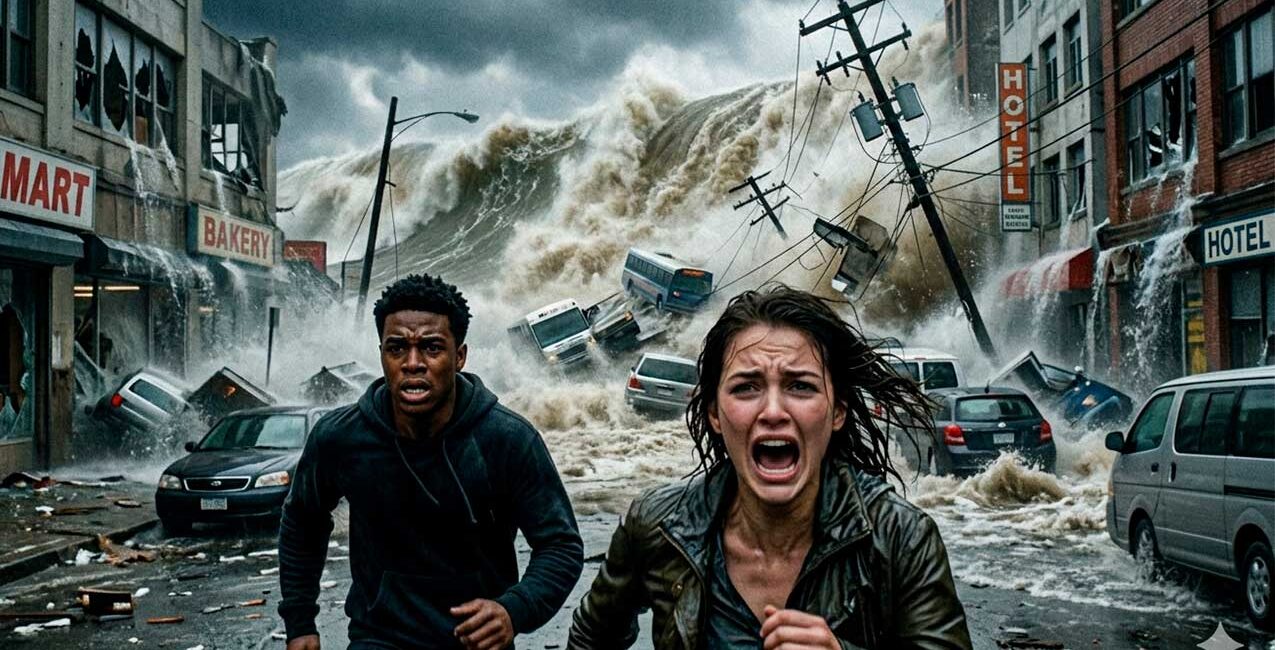
The above is usually what you would see from Hollywood. Still possible, but today we are talking about more subtle things that can eventually reach that scale of destruction. We are going to look at our planet’s atmosphere and pollution.
The evolution of Earth’s atmosphere is a four-billion-year saga of chemical transformation. It shifted from a toxic mix of volcanic gases to the oxygen-rich shield that allows complex organisms to thrive today.
Earth’s gravitational pull keeps our atmosphere in place. Atmospheric pressure creates another force that determines why it is thickest at sea level and thins out as you climb a mountain.
Earth’s atmosphere developed in three primary stages:
- The Primary Atmosphere: Shortly after Earth formed (4.6 billion years ago), it was surrounded by hydrogen and helium. These light gases were mostly blown away by solar winds and Earth’s internal heat.
- The Secondary Atmosphere (Outgassing): As the crust cooled, volcanoes erupted, releasing water vapor (H2O), carbon dioxide (CO2), and ammonia (NH3). This created a thick, greenhouse-effect atmosphere—but it lacked oxygen.
- The Tertiary Atmosphere (The Oxygen Revolution): Around 2.4 billion years ago, cyanobacteria evolved the ability to perform photosynthesis. They consumed CO2 and released oxygen (O2) as a byproduct.
Microbes to Mammals
This “Great Oxidation Event” changed everything. The rise of O2 led to:
- The Ozone Layer: Oxygen molecules reacted to form O3 (ozone) in the upper atmosphere. This blocked lethal UV radiation, allowing life to move from the deep ocean onto land.
- Aerobic Respiration: Oxygen is a high-energy fuel. Complex life forms like mammals require massive amounts of energy to maintain body temperature and power large brains. Without a high concentration of atmospheric oxygen (roughly 21%), the high-metabolic demands of humans would be impossible to meet.
Human Behavior and the Sixth Extinction
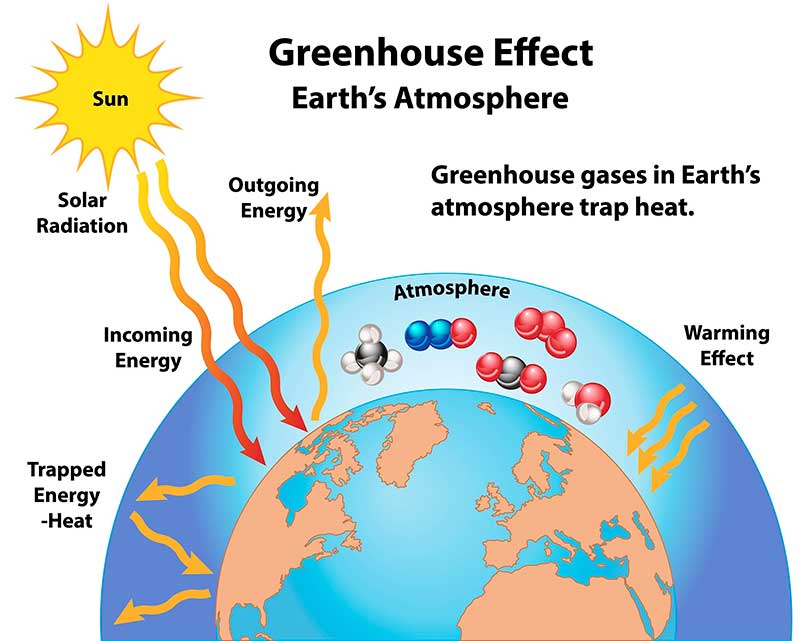
While it took billions of years to build this delicate balance, human behavior is altering it at an unprecedented geological speed. This is primarily driven by the Enhanced Greenhouse Effect.
The Mechanism of Risk
Humans extract “fossilized” carbon (coal, oil, gas) and burn it, returning billions of tons of CO2 to the atmosphere. This traps heat that would otherwise escape into space.
Mass Extinction Trigger
Atmospheric changes don’t just “make it warmer”; they disrupt the fundamental systems life relies on:
- Ocean Acidification: The oceans absorb excess CO2, turning the water more acidic. This dissolves the shells of shellfish and coral reefs, which are the “nurseries” of the ocean’s food chain.
- Climate Velocity: Evolution takes time. When the atmosphere changes over decades rather than millions of years, species cannot adapt fast enough. This leads to a “mismatch” where plants bloom before their pollinators emerge.
- Feedback Loops: Melting permafrost releases methane (CH4), a gas roughly 25 times more potent at trapping heat than CO2. This creates a “runaway” effect where the warming fuels more warming, independent of human activity.
The Importance of Arctic Ice
The melting of the Arctic ice is often called the “canary in the coal mine” for our planet. As of 2026, we have entered a “very alarming” phase where the Arctic is not only losing ice in the summer but is increasingly failing to recover it during the winter.
In March 2026, Arctic sea ice extent reached its seasonal maximum at 14.29 million square kilometers, statistically tying with 2025 for the lowest winter peak in the nearly 50-year satellite record.
The Albedo Feedback Loop: A Self-Heating Planet
The primary reason the Arctic is melting faster than the rest of the world (a phenomenon called Arctic Amplification) is the Albedo Effect.
- Ice is a Mirror: Fresh snow and ice have a high albedo, reflecting up to 80% of incoming solar radiation back into space. This keeps the poles cool.
- Water is a Sponge: When ice melts, it reveals dark ocean water. This water has a low albedo, absorbing about 94% of the sun’s heat.
- The Loop: More heat absorbed by the water leads to more ice melting, which exposes more water, which absorbs even more heat. This is a positive feedback loop—once it starts, it builds its own momentum.
Global “Domino Effects”
The Arctic isn’t just a remote block of ice; it is the “air conditioner” for the Northern Hemisphere. Its collapse triggers a chain reaction:
Weather Disruption
New research in 2026 has linked the loss of ice in the Barents Sea to simultaneous heatwaves in Europe and East Asia. When the Arctic warms, it weakens the Jet Stream (the high-altitude wind that moves weather systems). A weak Jet Stream becomes “wavy,” causing weather patterns to get stuck—leading to prolonged droughts, record-breaking heatwaves, or “polar vortex” freezes in places like the U.S. and Eurasia.
“Borealization” of the Oceans
We are currently witnessing the Atlantification of the Arctic. Warmer, saltier water from the Atlantic is pushing further north, fundamentally changing the ecosystem.
- The Winners: Boreal (temperate) species like Atlantic cod are moving into Arctic waters.
- The Losers: Native Arctic species, from specialized zooplankton to polar bears and seals that rely on sea ice for hunting and breeding, are facing extinction.
Methane “Time Bombs”
As the Arctic warms, it thaws permafrost—frozen ground that contains twice as much carbon as is currently in the entire atmosphere. In 2026, scientists are monitoring “methane seeps” where this potent gas is bubbling out of the earth and the seafloor, threatening to bypass human efforts to control emissions entirely.
Pollution – Micro Plastics
While we often focus on the atmosphere as a “gas” problem, microplastics have become a “solid-state” atmospheric and biological threat. Research has shifted from seeing plastic as just “litter” to seeing it as a fundamental alteration of Earth’s biogeochemical cycles.
Microplastics (and their smaller cousins, nanoplastics) are a serious liability to the stability of life:
The Atmospheric Connection
It was once thought that plastic was an ocean problem. We now know that microplastics have entered the atmospheric cycle.
- Plastic Rain: Microplastics are light enough to be swept up by winds and carried into the upper atmosphere. They have been found in the “pristine” snow of the Pyrenees and the Arctic.
- Cloud Seeding: There is emerging evidence that microplastic particles can act as “nuclei” for ice crystals in clouds, potentially altering rainfall patterns and how clouds reflect sunlight (albedo), adding an unpredictable variable to climate change.
Biological “Trojan Horses”
Microplastics are particularly dangerous because of how they interact with the chemistry of life.
- Chemical Magnification: Plastics act like sponges for persistent organic pollutants (POPs) like pesticides and industrial chemicals. When a small organism eats a microplastic, it isn’t just eating “fake food”; it is ingesting a concentrated dose of toxins.
- The “Generalist” Advantage: Specialized species die first. Microplastics stress the immune systems of complex mammals (including humans) by causing chronic inflammation. Meanwhile, “generalist” bacteria and pathogens often hitch a ride on floating plastic, spreading diseases to new territories.
The Threat to the Carbon Cycle
The highest “mass extinction” level liability of microplastics involves the Biological Pump.
- The Ocean’s Vacuum: Tiny marine organisms (zooplankton) eat carbon-rich algae and then sink to the bottom of the ocean when they die, or through their fecal pellets. This “pumps” carbon out of the atmosphere and into the deep ocean.
- The Glitch: When zooplankton eat microplastics, their fecal pellets become more buoyant and break apart more easily. This slows down the carbon pump, meaning the ocean becomes less effective at scrubbing CO2 from our atmosphere.
Microplastics are a massive “hidden tax” on our species:
| Liability Type | Impact |
|---|---|
| Healthcare | Microplastics have been detected in human blood, lungs, and placentas. The long-term cost of treating plastic-induced inflammatory diseases is a looming economic crisis. |
| Food Security | As microplastics degrade soil health and kill off marine nurseries, the cost of “real” food rises, hit hardest by those in developing nations. |
| Legal “Extended Producer Responsibility” | New 2026 legislation in many trading blocks (like the EU) is starting to hold plastic producers legally responsible for the “lifecycle” of their product, moving the cost from the taxpayer to the polluter. |
Other Mass Extinction Events
The history of life is a cycle of boom and bust. Interestingly, those who “win” during stable times are often the first to lose when the world changes.
The “Big Five” Mass Extinctions
While the atmosphere was stabilizing, Earth underwent five catastrophic events that nearly reset the biological clock:
| Event | Time | Likely Cause | Impact |
|---|---|---|---|
| End-Ordovician | 444 Mya | Intense glaciation and falling sea levels. | 85% of marine species lost. |
| Late Devonian | 365 Mya | Algal blooms & oxygen depletion in oceans. | 75% of species; reef ecosystems collapsed. |
| End-Permian | 252 Mya | Massive volcanism (Siberian Traps) & global warming. | The “Great Dying”: 96% of marine life, 70% of land life. |
| End-Triassic | 201 Mya | Volcanic activity & climate change. | 80% of species; paved the way for dinosaurs. |
| End-Cretaceous | 66 Mya | Asteroid impact (Chicxulub) & volcanism. | 75% of species; wiped out non-avian dinosaurs. |
In all these cases the species that were the “Most Adapted perished.
It seems counterintuitive—why would the species that spent millions of years perfecting their survival be the most vulnerable? The answer lies in Specialization vs. Generalization.
The Trap of Specialization
Evolution is an optimizer. In a stable environment, a species becomes “highly adapted” by specializing in a specific niche (e.g., eating only one type of plant or living at a specific temperature).
- The “Perfect” Fit: These species are the kings of their era because they are more efficient than anyone else.
- The Fragility: When the environment shifts suddenly, that “perfect fit” becomes a death trap. If the one plant you eat dies out due to climate change, your “adaptation” is now a liability.
High Energy Demands (The Size Tax)
The largest, most dominant species (like the T-Rex or large Permian reptiles) require massive amounts of calories to survive.
- During an extinction event, the food chain collapses from the bottom up.
- Plants die first (due to lack of sunlight or water), followed by small herbivores.
- Large predators at the top of the pyramid have no “buffer.” They cannot find enough fuel to power their massive bodies and are the first to starve.
Low Reproductive Rates
Dominant, large species often follow a “quality over quantity” reproductive strategy (K-selection). They live long lives, have few offspring, and invest heavily in them.
- Small, “less adapted” generalists (like early mammals or insects) reproduce rapidly.
- When 90% of a population is wiped out, the rats and insects can rebound in a few years. For a species that takes 10 years to reach maturity, a 90% loss is an unrecoverable death sentence.
If another mass extinction event occurred humans would be the ones to go.
This is Our Only Home
While the dream of terraforming another planet is a staple of science fiction, the reality is that our current technology is nowhere near being able to create a “Planet B.” In fact, the very tools we are developing to study other planets are showing us exactly why protecting Earth is our only viable option for the foreseeable future.
As of 2026, our “terraforming” capability is largely theoretical. While we have the engineering to build small, enclosed habitats (paraterraforming), changing an entire planet is a different scale.
- The Mars Problem: We’ve discovered that Mars lacks enough CO2 in its ice caps to thicken the atmosphere significantly. Even if we could melt it all, the pressure would only be a fraction of what humans need. Furthermore, without a global magnetic field, any atmosphere we “built” would be slowly stripped away by solar winds.
- The Venus Problem: Venus has the opposite issue—an atmospheric pressure 90 times that of Earth and temperatures hot enough to melt lead. “Cooling” a planet is arguably harder than warming one.
- The Time Scale: Most realistic scientific models suggest that full terraforming—where a human could walk outside without a space suit—would take centuries to millennia.
The “Planet B” Fallacy: It is much easier (and cheaper) to fix a damaged Earth than it is to build a new one from scratch. Restoring a degraded ecosystem on Earth is “terraforming” on easy mode; doing it on Mars is “impossible mode.”
Global Cooperation is Essential
Since we cannot leave, we must act as the “crew” of Spaceship Earth. This requires more than just individual action; it requires systemic change through legislation and literacy.
Climate change is a “tragedy of the commons.” If one country reduces emissions but its neighbor increases them to gain a trade advantage, the atmosphere still suffers.
- Leveling the Playing Field: International agreements (like the Paris Agreement or the updated 2026 climate frameworks) ensure that all nations move together.
- Carbon Border Adjustments: Trading blocks are now using “Carbon Taxes” on imports. This prevents companies from moving “dirty” factories to countries with weak laws, making sustainability a requirement for global profit.
Climate Literacy
Climate literacy is the shift from “knowing it’s warm” to “understanding the system.”
- From Anxiety to Action: Literacy helps people understand that the “melting Arctic” isn’t just about polar bears—it’s about food prices, insurance rates, and the stability of the power grid.
- Democracy and Policy: A climate-literate public can demand better laws and recognize “greenwashing” (when companies pretend to be eco-friendly).
Lessons for Humans
The combine stressors work in tandem:
- Climate change stresses a species’ environment.
- Microplastics weaken the species’ internal health.
- Pollution disrupts the natural cycles (like the Carbon Pump) that would normally help the planet heal.
This “toxic cocktail” is exactly the kind of multi-front assault that characterizes a mass extinction event, where it isn’t just one thing that fails, but the entire support system.
Working together isn’t just about “saving nature”; it’s about resource security.
- Humanity’s “Niche”: Complex life (humans) is highly specialized. We rely on predictable rainfall for crops and stable sea levels for our cities.
- The Insurance Policy: Legislation and global cooperation act as a planetary insurance policy. By keeping the global temperature rise within specific limits, we prevent the “feedback loops” (like methane release) that could take the climate out of human control entirely.
Humans are the ultimate “dominant” species today. We have adapted our environment to fit us, rather than adapting ourselves to the environment. This makes us arguably the most “specialized” species in history because we rely on a globally stable climate, specific crop cycles, and complex supply chains.
If we disrupt the atmosphere to the point of a sixth mass extinction, our high caloric needs and slow reproductive cycles put us in the same “high-risk” category as the dinosaurs and the giant reptiles of the Permian.
Current projections suggest we are on the verge of the first “Blue Ocean Event”—a summer where the Arctic is virtually free of sea ice. While this was once predicted for the mid-century, many models now suggest it could happen as early as the late 2030s or even sooner if current 2025–2026 trends persist.
The protection of the atmosphere is the only way to slow this “thermal inertia.” Once the multi-year thick ice is gone, it is incredibly difficult to grow back, making our current actions the defining factor for the next thousand years of climate stability.
We are currently seeing extinction rates 100 to 1,000 times higher than the natural “background” rate. If the atmosphere’s chemistry is pushed too far, the very oxygen-rich, temperature-stable environment that birthed humanity will become uninhabitable for the complex biomes we depend on for survival.
By investing in our current home, we aren’t just surviving; we are perfecting the very “planetary stewardship” skills we would eventually need if we ever did try to terraform another world in the distant future.

Other Articles
The Apex Predator with Morality
The Power of Music