













Most things can be explained logically and scientifically – including prayer. Today, we are going to look at how we can hack the positive effects of prayer without being religious.
This is going to be a fascinating journey. At the end, we will do an actual exercise to get the benefits of “prayer” – so read to the end.
Let’s start with a skeptics questions about prayer so we can understand where logic ends and “something else” takes over.
If God is All-Knowing, Why Talk?
The paradox is: if G (God) knows x (your need) before you say it, why say it?
Relationship over Information: Most theologians argue prayer isn’t about informing God (who already knows), but about alignment. It’s viewed as a way for the person to process their own desires and “tune” their will to what they believe is a higher purpose.
The “Parent” Analogy: A parent might know their child is hungry, but they still value the child asking for food because it fosters communication and acknowledgment of the relationship.
Why does it seems like most prayers go unanswered?
It often feels like prayers go into a void. People generally interpret this in three ways:
- The “No” or “Wait” Defense: Religious believers often say God answers in three ways: Yes, No, or Wait. From the outside, a “No” or “Wait” is indistinguishable from no one is listening at all.
- Statistical Probability: In a world of billions, many things people pray for (like winning a game) are mutually exclusive. If both teams pray to win, one must lose.
- The Free Will Conflict: If God intervened in every prayer, it would effectively erase human agency and the laws of physics.
Does God Need “Ears”?
Logically, an omnipotent being wouldn’t need physical sensory organs but let’s argue for ears:
Let’s say it is Metaphorical Language: When scriptures talk about God’s “ears” or “hands,” it’s usually anthropomorphism—assigning human traits to non-human entities to make them relatable.
The Medium vs. The Message: The “ears” are for the benefit of the human, who is a physical being and needs a physical way to conceptualize communication.
Why Not Thank Doctors or Coaches?
It often feels dismissive of human effort when someone says “Praise God” after a 12-hour surgery or “Thank God for this win”, when your opponent also prays to the same God.
- The Secular View: Credit belongs entirely to the years of training, skill, and technology utilized by the human.
- The Religious View: God is seen as the “First Cause” who provided the doctor with the steady hands, the intelligence to learn, and the breath of life to perform the task.
- The Balanced View: Many people do both—thanking the doctor for their expertise while thanking God for the “favorable outcome” of a risky situation.
It’s a bit of a “both/and” situation. One can recognize the brilliance of a surgeon while still feeling a sense of cosmic gratitude that the surgery happened to go well. However, when the human element is ignored entirely, it can certainly feel like a slight to those who did the actual work.

The Effects of Prayer
When we move away from the spiritual debate and look at prayer through the lens of neuroscience and psychology, it becomes a fascinating study of how the human brain responds to ritual and intention.
Even if one doesn’t believe a deity is listening, the act of prayer can trigger significant physiological changes.
The Placebo Effect and “Expected Healing”
The placebo effect isn’t “faking it”; it’s a robust neuro-biological response where the brain releases a pharmacy of chemicals because it expects to get better.
Dopamine and Endorphins: When a person prays for healing, the anticipation of relief triggers the reward system. This can physically reduce the perception of pain and improve mood.
The Power of Belief: Studies have shown that if a patient believes a higher power (or even a doctor) is “on their side,” their levels of cortisol (the stress hormone) drop, which allows the immune system to function more efficiently.
The “Relaxation Response”
Dr. Herbert Benson of Harvard Medical School famously coined the term “The Relaxation Response” to describe what happens during prayer and meditation.
Vagus Nerve Stimulation: Repetitive prayer (like the Rosary or chanting) slows the heart rate and breathing. This stimulates the vagus nerve, shifting the body from “Fight or Flight” (Sympathetic nervous system) to “Rest and Digest” (Parasympathetic nervous system).
Brain Wave Shifts: Frequent practitioners of prayer often show an increase in alpha and theta brain waves, which are associated with deep relaxation, creativity, and mental clarity.
Psychological Benefits: Control and Community
Beyond the individual brain, prayer serves two major psychological functions:
Secondary Control: In situations where we have zero “primary control” (like a loved one in surgery), prayer provides “secondary control.” It gives the brain a task to perform, reducing the feeling of helplessness that leads to trauma.
Externalization of Worry: Psychologically, “giving it to God” acts as a form of cognitive offloading. By verbalizing a fear and “handing it over,” the individual reduces the cognitive load of rumination (looping negative thoughts).
The Social Dimension
When people say “I’m praying for you,” it functions as a high-level form of social support.
Knowing that others are thinking of you increases feelings of belonging and safety.
From an evolutionary standpoint, “safe” humans live longer, recover faster, and have lower systemic inflammation than “isolated” humans.
The “Nocebo” Effect
It is worth noting that if prayer is used as a substitute for medical treatment (rather than a supplement), or if it leads to “religious coping” (feeling like God is punishing you), it can actually increase stress and worsen health outcomes. This is known as the nocebo effect—where negative expectations lead to negative physical results.
Whether or not there is a “signal” being sent out, the “receiver” (the human brain) experiences a measurable, beneficial shift in chemistry and architecture during the act of prayer.
The Science behind the Effect
To understand how prayer impacts the brain, we have to look at the Default Mode Network (DMN). This is the “background noise” of your brain—the part that’s active when you’re daydreaming, worrying about the future, or thinking about yourself.
The Brain: Prayer vs. Meditation
While both practices calm the nervous system, they “light up” the brain in slightly different ways.
Meditation (Focus-Based): Usually involves clearing the mind or focusing on a single object/breath. This heavily recruits the Prefrontal Cortex (attention) and seeks to deactivate the DMN to reach a state of “selflessness.”
Prayer (Relational-Based): Because prayer usually involves talking to a “Person” (God), it activates the Social Cognition areas of the brain (like the Temporoparietal Junction). Your brain treats God like a friend or a parental figure.
Key Neurological Shifts
The “Busy” Brain (Stress)
- Parietal Lobe: High activity (orienting you in space/time).
- Frontal Lobe: High activity (planning, worrying).
- Amygdala: Overactive (Fear/Anxiety).
- Dopamine: Spiky/Low (Seeking relief).
The “Praying” Brain (Rest)
- Parietal Lobe: Decreased activity. This leads to a “loss of self” or a sense of oneness with the universe.
- Frontal Lobe: Regulated activity. It shifts from frantic “problem-solving” to “focused intention.”
- Amygdala: Calmed. The “threat” signal is dampened by the repetitive nature of prayer.
- Dopamine: Steady Release. Provides a sense of safety and well-being.
The “Theory of Mind” in Prayer
One of the most unique psychological aspects of prayer is Theory of Mind. This is the human ability to attribute mental states (beliefs, intents, desires) to others.
When a person prays, they are actively exercising this faculty. By imagining what an all-loving being would say back to them, they often “internalize” that compassion. Essentially, they use their own brain’s social hardware to provide themselves with the comfort, perspective, and patience they need to handle a crisis.
Is it “Just” a Placebo?
In clinical terms, calling something a “placebo” isn’t an insult—it’s a confirmation that the mind has the power to alter the body’s chemistry. If a person feels less pain or lower blood pressure because they believe they are being watched over, the physiological result is 100% real, regardless of the “source” of the help.
This is why Doctors are OK if they are not given credit – the patient comes first.
A Brief look at “intercessory prayer” (praying for others)
When we look at intercessory prayer—the act of praying for someone else—the psychological and physiological effects are actually most measurable in the person doing the praying, though there is a fascinating “social loop” that affects the recipient as well.
The “Helper’s High” (Effects on the Intercessor)
When you pray for someone else, your brain shifts from self-referential worry to empathy and altruism. This triggers a specific neurological profile:
Ventral Striatum Activation: This is the brain’s reward center. Helping others (even through the intention of prayer) releases dopamine, creating a sense of purpose and lowering personal stress.
Oxytocin Release: Often called the “bonding hormone,” oxytocin is released when we feel connected to others. Praying for a friend or even an enemy strengthens the neural pathways associated with compassion, which physically lowers systemic inflammation in the pray-er’s body.
Cognitive Reframing: It forces the brain to look outside its own problems. By focusing on A (the friend’s illness) instead of B (one’s own financial stress), the brain gets a “recovery break” from its own cortisol loops.
Effects on the Recipient (The “Social Placebo”)
This is where it gets tricky. Scientific studies on intercessory prayer (like the famous 2006 STEP project funded by the Templeton Foundation) have shown that if a patient doesn’t know they are being prayed for, there is often no measurable medical difference in their recovery.
However, if the patient knows they are being prayed for, the effect is significant:
Perceived Social Support: Knowing “people are rooting for me” or “God is watching over me” lowers the patient’s heart rate and anxiety.
The Power of Expectancy: Like a placebo, if the patient expects to get better because of the prayers, their brain releases the “inner pharmacy” of endorphins.
The “Pressure” Risk: Interestingly, some studies found that patients who knew they were being prayed for actually had higher stress levels, possibly because they felt a “performance anxiety” to get well so they wouldn’t let their community down.
Prayer as a Tool for Conflict Resolution
Psychologically, praying for an enemy or someone you are angry with is one of the fastest ways to “de-escalate” the brain’s amygdala (the fear/anger center).
Humanization: It is neurologically difficult to maintain intense hatred for someone while simultaneously wishing for their well-being.
Lowering Reactivity: It moves the “conflict” from the emotional centers of the brain to the Prefrontal Cortex, allowing for more rational, less impulsive behavior when you next encounter that person.
Negative Effects: Guilt-Based Prayer
Let’s look at the negative effects, briefly, so we have “360 degree” view of prayer.
So far, we have seen, how prayer can be a “mental pharmacy” for good, it can also act as a significant stressor if the framework behind it is rooted in fear, shame, or “spiritual performance.”
When prayer is driven by Religious Trauma or Scrupulosity (a form of OCD focused on religious or moral issues), the brain’s response flips from the “Relaxation Response” to a “Chronic Threat Response.”
The Neurobiology of “Guilt-Based” Prayer
When a person prays out of a fear of punishment or a sense of “not being good enough,” the brain doesn’t enter a restorative state. Instead, it enters a loop of Hyper-vigilance.
The Amygdala Hijack: Instead of being calmed, the amygdala (the brain’s alarm system) remains highly active. The person is essentially praying to “appease” a threat rather than connect with a source of comfort. Cortisol Overload: Chronic “shame-based” prayer keeps cortisol levels high. Over time, this can actually weaken the immune system and impair the Hippocampus (the area responsible for memory and emotional regulation).
Scrupulosity and the “Doubt Loop”
In clinical psychology, Scrupulosity is a subtype of Obsessive-Compulsive Disorder (OCD) where religious or moral doubts become obsessions.
The Compulsion: For someone with scrupulosity, prayer isn’t a choice; it’s a compulsion. They might feel they have to repeat a prayer perfectly, or “start over” if a “bad thought” entered their mind. The Basal Ganglia: This area of the brain, which helps govern habits and repetitive behaviors, becomes overactive. Instead of the “peace” associated with typical prayer, the person feels a temporary drop in anxiety followed by a rapid spike of “What if I didn’t do it right?”
“Spiritual Bypassing” and Emotional Suppression
Sometimes prayer is used to bypass or suppress real human emotions like anger, grief, or trauma.
Suppression vs. Processing: If someone is told to “just pray about it” instead of processing a trauma, the Prefrontal Cortex (the logical brain) effectively tries to “shush” the Limbic System (the emotional brain). The Result: This often leads to Somatization—where the suppressed emotional stress manifests as physical pain, headaches, or digestive issues because the brain hasn’t been allowed to actually “solve” the emotional conflict.
Comparison: Healthy vs. Traumatic Prayer
Restorative Prayer
- Primary Emotion: Safety, Gratitude, Connection.
- Brain Activity: Low Amygdala, High Alpha Waves.
- Focus: “I am loved/supported.”
- Outcome: Lower Heart Rate, Lower Cortisol.
Traumatic/Anxious Prayer
- Primary Emotion: Fear, Guilt, Obligation.
- Brain Activity: High Amygdala, High Beta Waves (Anxiety).
- Focus: “I am failing/in danger.”
- Outcome: Racing Heart, Muscle Tension, “Brain Fog.”
The neurological “wins” of prayer without the religious framework
To recreate the neurological “wins” of prayer without the religious framework, modern psychology—specifically Cognitive Behavioral Therapy (CBT) and Mindfulness-Based Stress Reduction (MBSR)—uses secular techniques that target the same brain regions.
The goal is to move the brain from the “Default Mode Network” (ruminating/self-worry) into a state of “Objective Observation.”
Intentional Awe (The “Macro” Perspective)
In prayer, people often feel small in the presence of a vast God. This “Small Self” effect is actually very healthy—it shrinks your personal problems.
The Secular Version: “Awe-Walking” or looking at images of deep space (The Overview Effect).
The Brain: This deactivates the Parietal Lobe (which defines where “you” end and the world begins), creating a sense of peace and interconnectedness similar to deep mystical prayer.
Loving-Kindness Meditation (Secular Intercession)
This is the secular “twin” to praying for others. The practitioner mentally sends well-wishes to themselves, a loved one, and even a stranger or enemy.
The Brain: Studies show this practice increases gray matter volume in the Temporoparietal Junction (empathy) and the Insula (self-awareness).
The Result: It provides the “Helper’s High” and oxytocin boost of intercessory prayer without needing a deity to “deliver” the message.
Radical Acceptance (The “Thy Will Be Done” Tool)
One of the most powerful parts of prayer is the “surrender”—releasing the burden of a situation you can’t control.
The Secular Version: In Dialectical Behavior Therapy (DBT), this is called Radical Acceptance. It’s the conscious decision to acknowledge reality as it is, without judgmental “shoulds.”
The Brain: This reduces “Internal Friction.” By stopping the fight against reality, the Prefrontal Cortex can stop wasting energy on “What Ifs” and start focusing on “What Now.”
Comparison of Mental Exercises
Confession
Equivalent: Expressive Writing / Journaling
Results: “Ventralizes” emotions, moving them from the amygdala to the language centers for processing.
Adoration / Worship
Equivalent: Gratitude Practice
Results: Reprograms the brain to scan for “wins” rather than “threats” (Dopamine/Serotonin boost).
Petition (Asking)
Equivalent: Goal Visualization
Results: Activates the Reticular Activating System (RAS), making you more likely to notice opportunities to help yourself.
Repetitive Prayer
Equivalent: Box Breathing / Mantras
Results: Stimulates the Vagus Nerve to force a physical “system reset” into relaxation.
Why the Secular Version Works
The brain is a “meaning-making” machine. Whether you label the experience “talking to God” or “regulating my nervous system,” the biological hardware is the same. The secular approach simply removes the potential for “Religious Trauma” (fear of doing it wrong) and replaces it with Biological Agency (the understanding that you are the one steering your own brain chemistry).
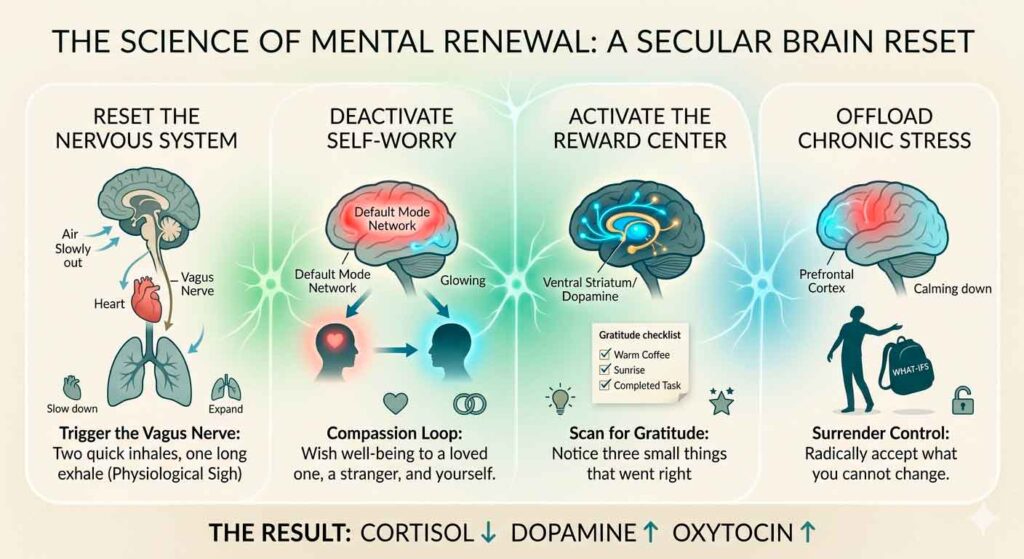
The 1-minute “Science-Based” mental reset exercise
This 60-second exercise is designed to mimic the neurological benefits of prayer—specifically gratitude, intercession, and surrender—using purely physiological and psychological triggers.
Follow these three steps:
The “Physiological Sigh” (The Reset)
This mimics the “Amen” or the deep breath taken during ritual. It is the fastest way to manually hack your Vagus Nerve.
- Inhale deeply through your nose.
- At the very top, take a second, shorter “sip” of air to fully inflate the lungs.
- Exhale very slowly through your mouth (like you’re breathing through a straw).
- The Brain Effect: This “pops” open the tiny air sacs in your lungs (alveoli) and forces your heart rate to slow down immediately.
The “3-Person Compassion” (The Intercession)
This mimics praying for others to trigger Oxytocin and move out of the “Default Mode Network.”
- Think of one person you love. Mentally say: “May you be at peace.”
- Think of one neutral person (a barista, a neighbor). Mentally say: “May you be at peace.”
- Think of yourself. Mentally say: “May I be at peace.”
- The Brain Effect: This activates the Temporoparietal Junction (empathy) and dampens the “Self-Worry” center of the brain.
The “Radical Drop” (The Surrender)
This mimics “Giving it to God” to reduce Cortisol.
- Identify one thing you are worried about that you cannot change right now (e.g., the weather, a past mistake, someone else’s opinion).
- Visualize yourself physically dropping a heavy bag on the floor. Mentally say: “I am not in charge of this right now.”
- The Brain Effect: This provides Cognitive Offloading. By “labeling” the worry as something outside your control, your Prefrontal Cortex stops wasting “processing power” on it.
If you relaxed and did the exercise you should notice a slight “lightness” in the chest or a softening of the jaw. This isn’t magic; it’s your brain shifting from a threat-based state to a connection-based state.
Here is a summary for replicating the neurological benefits of prayer without the religious framework. Copy and Paste it somewhere for those moments when you need a mental reset.
The Secular Prayer Cheat Sheet
Goal: Shift from “Survival Mode” (Amygdala) to “Thrive Mode” (Prefrontal Cortex).
- The Opening: The Physiological Sigh (30 Seconds) Action: Inhale deeply through the nose, take a second tiny “sip” of air at the very top, then exhale as slowly as possible through the mouth. Why: Manually hacks the Vagus Nerve to lower heart rate and blood pressure instantly.
- The Intercession: “The Compassion Loop” Action: Mentally send a wish of “peace/well-being” to three people:
A Loved One (Triggers Oxytocin). A Neutral Stranger (Expands Empathy). Yourself (Reduces Self-Criticism).Why: Deactivates the Default Mode Network (the “worry” center) and activates the Temporoparietal Junction (social connection). - The Petition: “Gratitude Scanning” Action: Identify three specific things that went “right” in the last 24 hours, no matter how small. Why: Forces the brain to exit “Threat Detection” and activates the Ventral Striatum (the reward system), releasing dopamine.
- The Surrender: “Radical Acceptance” Action: Identify one stressor you cannot control. Mentally say: “I am not in charge of this right now,” and visualize dropping it. Why: Reduces Cortisol by stopping the “Internal Friction” of fighting reality. It provides Cognitive Offloading, freeing up mental energy.
- The Closing: “Ritual Anchor” Action: Do this at the same time every day (e.g., right after your morning coffee or before bed). Why: Builds Myelin around these neural pathways, making “calm” your brain’s default high-speed setting. The Neuro-Logic: Your brain doesn’t need a deity to feel better; it needs connection, perspective, and a sense of safety. By practicing these steps, you are essentially “praying” to your own biological potential.
The “Loop” of Intention
The “Placebo Effect” of prayer depends entirely on the perceived nature of the “listener.” If the listener is perceived as a loving, supportive presence, the brain heals. If the listener is perceived as a demanding, judgmental, or unpredictable judge, the brain reacts as if it is being stalked by a predator.
While science struggles to measure a “supernatural” beam of energy moving from one person to another, it can easily measure the biological upgrade that happens to a human when they practice empathy. Whether the prayer is “answered” by a deity or not, the act of intercession makes the person praying more resilient, more compassionate, and less stressed.
You don’t need a “divine ear” to get the benefits of prayer. You just need a consistent practice that shifts your focus from threat to connection, and from worry to presence.

Other Articles