












A book, supposedly inspired by an all-knowing being, shows a deep lack of understanding of how our planet sustains life. Let’s first do a refresher on a couple cycles that sustain life on our planet:
The Water (Hydrologic) Cycle
Water acts as the universal solvent, transporting nutrients through all other cycles.
- Evaporation & Transpiration: Water rises from oceans and “breathes” out of plant leaves (transpiration).
- Condensation & Precipitation: Water vapor forms clouds and falls back to Earth as rain or snow.
- Runoff & Infiltration: Water flows into rivers or soaks into the ground, sustaining the roots of plants and providing hydration for animal life.
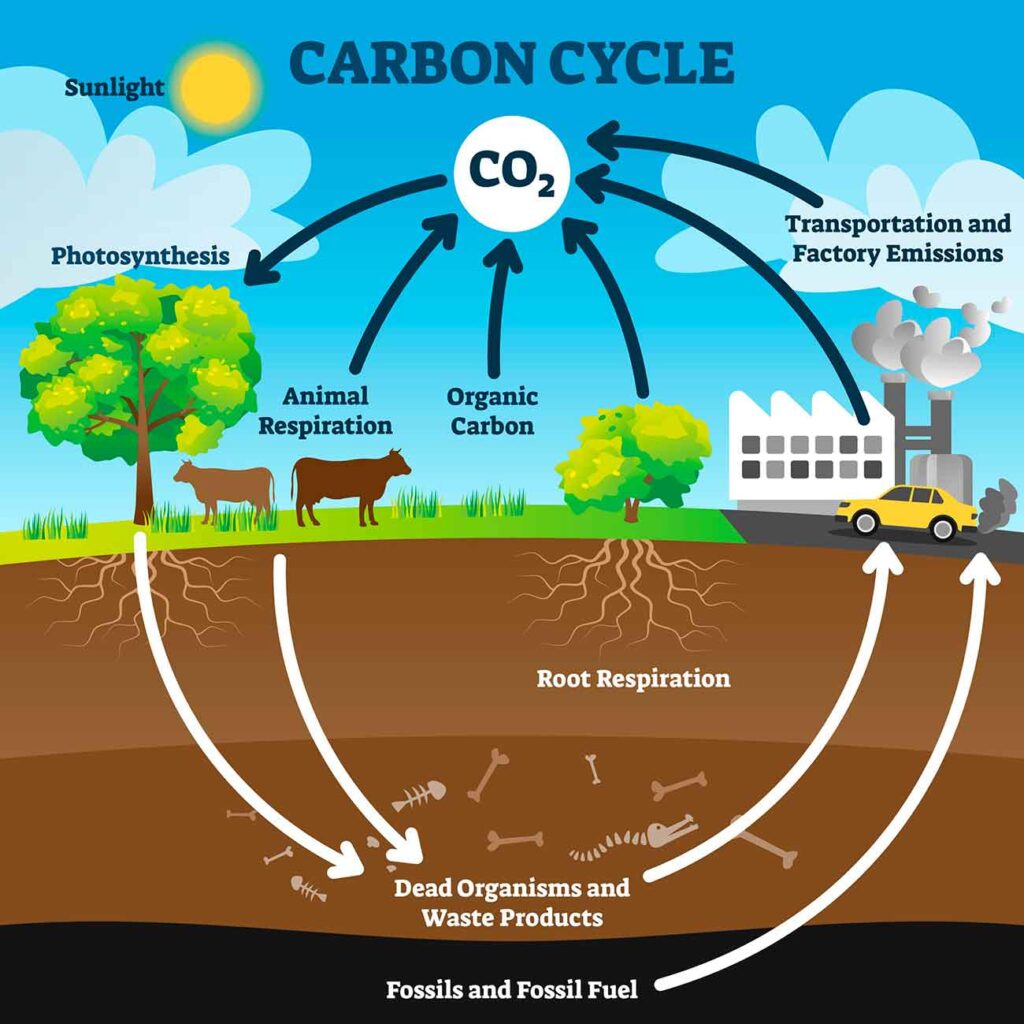
Carbon and oxygen cycles
The crucial carbon and oxygen cycles are deeply intertwined through the relationship between plants and animals. They manage the flow of energy and the composition of our atmosphere.
- Decomposition: When organisms die, decomposers break down their bodies, releasing stored carbon back into the soil or atmosphere.
- Photosynthesis: Plants and algae take in CO2 and sunlight to produce glucose and release oxygen (O2).
- Respiration: Animals and plants use O2 to break down food for energy, releasing CO2 back into the air.
Atoms
Unless you are dealing with a star or a nuclear reactor, atoms are never created or destroyed. They are simply the “eternal building blocks” that the universe constantly rearranges to create different forms of life and matter. Did you know that the mass of our planet (earth) remains relatively constant because of this? It is roughly 5.98 x 10²⁴ kg.
The Earth acts as a closed system, where the total number of atoms within the planet remains roughly the same. While life, human activity, and geological processes constantly rearrange these atoms, they are not created or destroyed. The birth and death of organisms—including humans—change nothing in the overall mass because all life is built from pre-existing atoms found on Earth.
When a human or any living organism is born, its mass does not appear out of thin air. The atoms that form a new baby come from the nutrients (food, water, air) consumed by the mother. When an organism dies, its mass does not disappear from the planet – the body decomposes, breaking down into fundamental atoms (oxygen, carbon, nitrogen, calcium, etc.). These atoms are released into the soil, water, and atmosphere, where they become available to form new life, such as plants.
The Law of Conservation of Mass
In any standard chemical reaction—like a fire burning or your body digesting food—matter is neither created nor destroyed.
- Rearrangement: Think of atoms like LEGO bricks. You can take a LEGO castle (a molecule) apart and build a LEGO spaceship, but you still have the exact same number and types of bricks.
- The Equation: This is why chemical equations must be balanced. If you start with two atoms of hydrogen on the left, you must have two on the right: 2H2+O2→2H2O.
Bible Science
The bible authors used the limited observational tools and cosmological frameworks available to them thousands of years ago but the religious insist it was inspired.
However, If a being is all-knowing, why leave behind a manual that is factually wrong?
- The “Accommodation” Argument: Religious defenders argue that God “accommodated” his message to the limited “scientific” language of the time.
- The Secular Critique: This looks less like “simplified truth” and more like “primitive guesswork.” If the text was truly divinely inspired by the creator of the laws of physics, one might expect it to avoid basic logical errors—like the order of light and heat—even if it used simple terms.
The writers at that time described the world as they saw it from the ground, leading to several descriptions that conflict with our modern understanding of physics, biology, and astronomy.
Biblical Instances of Limited Scientific Knowledge
The Photosynthesis Paradox
In Genesis 1, the narrative sequence creates a biological impossibility by modern standards:
- Day 3: Vegetation, plants, and fruit-bearing trees are created.
- Day 4: The sun, moon, and stars are created.
- The Conflict: We know that plants require sunlight for photosynthesis. The chemical equation for this process is: 6CO2+6H2O+light energy→C6H12O6+6O2. Without the sun (light energy), the plants created on Day 3 would have been unable to produce glucose and would have withered almost instantly. This suggests the authors viewed light as a general “state of being” rather than a phenomenon tied to specific celestial bodies.
The Logistics of the Global Flood
The story of Noah’s Ark (Genesis 6-9) presents several challenges to our understanding of geology and thermodynamics:
- Water Volume: To cover the “highest mountains” (Everest is 29,032 feet), the Earth would need roughly three times the amount of water currently in our oceans. There is no geological evidence for where that water came from or where it went afterward. Water doesn’t just disappear. For that much water to leave the Earth, it would have to evaporate into space (which gravity prevents) or sink into the Earth’s crust. However, the crust is already saturated.
- Hydrostatic Pressure: The weight of that much water would have crushed most aquatic ecosystems, and the rapid desalination would have killed off both freshwater and saltwater species.
- The Heat Problem: Geologically, “fountains of the deep” opening up (as described in the text) would involve massive tectonic shifts and volcanic activity. The energy released would have boiled the oceans, making the Ark more of a “pressure cooker” than a lifeboat.
- Biogeography: The “lane” of biology struggles with how millions of species (including those unique to Australia or the Americas) traveled to the Middle East, survived in a wooden vessel for a year, and then redistributed globally without leaving a trace of their journey.
Cosmology and the “Firmament”
In Genesis 1:6-8, the universe is described as having a “firmament” (Hebrew: raqiya), a solid dome that separates the “waters above” from the “waters below.”
- The Ancient View: They believed the sky was a physical barrier holding back a celestial ocean, which explains why the sky is blue and why it rains (windows in the dome opening).
- The Modern Reality: We know the atmosphere is a layer of gases held by gravity, not a solid structure.
In the ancient Near Eastern worldview, a solid dome over a spherical Earth makes very little geometric sense—the two concepts actually go hand-in-hand to form a “snow globe” model of the universe.
The writers of the Bible described a geography that was functionally flat, supported by pillars, and covered by a lid.
The “Ends” and “Corners” of the Earth
Several passages reflect a world with physical boundaries and edges:
- Isaiah 11:12 and Revelation 7:1 refer to the “four corners of the earth.” While we often use this as a figure of speech today, in a pre-scientific context, it reflected the idea of a rectangular or circular landmass with defined limits.
- Job 38:13 speaks of God taking hold of the “ends of the earth” and “shaking the wicked out of it,” much like one would shake a rug or a garment.
The Great Height Perspective
In Daniel 4:10-11, there is a vision of a tree so tall that it “was visible to the ends of the whole earth.”
- The Conflict: On a spherical Earth, no matter how tall an object is, it eventually disappears behind the curvature of the horizon. This description only works on a flat plane where a sufficiently tall object could, in theory, be seen from anywhere.
- This is mirrored in the New Testament (Matthew 4:8) during the temptation of Jesus, where the devil takes him to a “very high mountain” and shows him “all the kingdoms of the world.” Again, this is physically impossible on a globe but a staple of flat-earth cosmology.
The Pillars of the Earth
The Earth wasn’t just flat; it was structurally supported. Psalm 75:3 and Job 9:6 mention the “pillars of the earth.”
- The Ancient View: Since the Earth seemed immovable and heavy, it must be resting on a foundation. Below these pillars was the “Abyss” or the “Great Deep.”
Geocentrism and the Fixed Earth
Several passages, such as Psalm 104:5 (“He set the earth on its foundations; it can never be moved”) and Joshua 10:12-13 (where the sun is commanded to stand still), imply a stationary earth.
- The Ancient View: To a person standing in the desert, the ground feels still while the sun and stars appear to move around it.
- The Modern Reality: The Earth is rotating at roughly 1,000 mph and orbiting the sun at 67,000 mph.
Biological Misconceptions
There are various instances where the Bible classifies the natural world in ways that contradict modern taxonomy:
- Leviticus 11:13-19: Groups bats with “birds.” (Bats are, of course, mammals).
- Leviticus 11:20-23: Describes insects as “winged creatures that go on all fours.” (Insects have six legs).
- The Mustard Seed: In Matthew 13:31-32, Jesus calls the mustard seed the “smallest of all seeds.” While effective for a parable, we now know seeds like those of tropical orchids are significantly smaller.
The Absence of Germ Theory and Neurology
In the biblical world, health was often viewed through a moral or spiritual lens rather than a biological one.
- Disease as Judgment: In the book of Job or the various accounts of leprosy in Leviticus, illness is frequently treated as a sign of divine disfavor or a test of character.
- Mental Health as Demonology: Throughout the New Testament, what we would now diagnose as epilepsy or schizophrenia was consistently attributed to “unclean spirits.”
- The Seat of Thought: The Bible frequently refers to the heart or even the kidneys (kelayot) as the organs of thought and emotion. The brain is never mentioned as the center of consciousness because its function wasn’t understood.
The Virgin Birth: A Biological Dead End
In Matthew 1 and Luke 1, the narrative claims Jesus was conceived without a human father.
The Biological Conflict: Parthenogenesis
In nature, there is a process called parthenogenesis (from the Greek for “virgin creation”), where an embryo develops from an unfertilized egg. It happens in some insects, fish, and reptiles (like Komodo dragons).
- The Mammalian Barrier: In mammals, this is biologically impossible due to genomic imprinting. Certain essential genes must come from the father’s sperm and others from the mother’s egg to be “switched on.” Without both, the embryo cannot develop.
- The “Y” Chromosome Problem: From a genetic standpoint, Mary (XX) could only provide X chromosomes. For Jesus to be male (XY), a Y chromosome would have to be generated from a non-biological source.
- The Verdict: There is no mechanism in human biology for a virgin birth. Scientifically, it is a total “lane violation.”
The Resurrection: The Laws of Thermodynamics
The claim that a human body was clinically dead for three days and then returned to life (Matthew 28, Mark 16, etc.) is the ultimate challenge to the Second Law of Thermodynamics.
The Biological Reality of Death
- Entropy and Decay: Once the heart stops, oxygen deprivation leads to autolysis (cell self-digestion). Within 72 hours, especially in a warm climate like the Middle East, significant putrefaction begins.
- Irreversibility: Biology defines death as the point where the organizational structure of the organism breaks down past the point of repair. Brain cells begin to liquefy within minutes of oxygen loss.
- The Conflict: A resurrection requires not just a “restarting” of the heart, but a massive, instantaneous reversal of cellular decay and the re-assembly of complex neural pathways.
It’s interesting that while the “Flat Earth” or “Insects with four legs” are often ignored by modern believers as “cultural misunderstandings,” the Virgin Birth and Resurrection are doubled down on. The scientific impossibility is actually the point. If it were scientifically explainable, it wouldn’t be a “sign” of a higher power. They argue that the Creator of the laws of physics can “suspend” them for a specific purpose.
Heaven
The concept of Heaven is perhaps the ultimate “lane violation” because it attempts to describe a physical location for a non-physical state. From a scientific, logistical, and logical standpoint, the traditional idea of a physical Heaven faces several insurmountable “bottlenecks.”
The Location Problem: Where is “Up”?
For the ancient biblical authors, “Heaven” was literally above the dome of the sky.
- The Ancient View: You could theoretically build a tower (like Babel) to reach it. It was a physical place just past the clouds.
- The Scientific Reality: We have sent probes to the edge of the solar system and telescopes to the edge of the observable universe. We know that “up” just leads to an infinite vacuum of space-time. There is no celestial floor or golden city hiding behind a nebula.
- The Logical Result: Modern theology has had to move Heaven out of the physical universe and into a “dimension” or “spiritual realm.” However, science has no way to verify or interact with a dimension that doesn’t obey the laws of physics.
The Population Problem: The Logistics of Resurrection
If every person who ever lived were “raised” with a physical body, the numbers are staggering.
- The Data: Demographers estimate that roughly 117 billion humans have lived on Earth.
- The Mass: If you resurrected 117 billion people, you would need a “Heaven” with enough surface area to sustain them. If it’s a “city” (like the New Jerusalem described in Revelation), its dimensions—roughly 1,400 miles in each direction—would make it about half the size of the moon, but with a population density thousands of times higher than Manhattan.
- The “Material” Problem: Our bodies are made of recycled atoms. The carbon in your arm might have once been in a dinosaur or a Roman soldier. If everyone is resurrected at once, there is a literal “parts shortage” of atoms that have belonged to multiple people over millennia.
The Logical Paradox of Utopia
The definition of a “Utopia” (a place of perfect happiness) falls apart under logical scrutiny because human happiness is often relational and exclusionary.
- Conflict of Interest: If a mother’s “Heaven” requires her son to be there, but the son lived a life that “earned” him the other place, the mother’s Heaven is no longer perfect. To make her happy, you would have to either force the son in or “lobotomize” the mother’s memory.
- If memory is removed, then the person in heaven is different from the one that prayed and lived for this gift of paradise. Going to heaven without your memories would be pointless.
- The Problem of Stasis: Human satisfaction is derived from growth, challenge, and overcoming. A place with no hunger, no cold, no death, and no “lanes” to stay in would, logically, result in a state of eternal boredom or stagnation. As the philosopher Bernard Williams argued, an eternal life would eventually become a “tedious burden.”
- The Identity Crisis: If you are raised in a “perfect” body (no aging, no disease), at what age are you raised? If you died at 90, are you 90 in Heaven? If you are reverted to 25, are you still “you”? Our identity is shaped by our scars, our aging, and our limitations. Removing them makes you a different entity entirely.
More on Memory
This section is the logical “kill shot” for the traditional concept of an afterlife. This is often called the Problem of Personal Identity, and it creates a massive paradox that the “desert dwellers” didn’t have the neurological framework to address.
From a scientific and philosophical standpoint, your memory isn’t just a “file” you carry; it is the architecture of your self.
The Biological “Self” vs. The Heavenly “Soul”
In the biblical lane, the “Soul” is seen as a distinct, indestructible substance. However, modern neuroscience shows that the “self” is a process generated by the physical brain.
- The Memory Loop: Your personality, your preferences, and your “holiness” are encoded in the hippocampus and the neocortex.
- The Damage Argument: We see this in patients with Alzheimer’s or severe amnesia. When the memory goes, the “person” effectively disappears, even though the body is still alive. If Heaven requires a “perfect” state where the trauma and sins of Earth are forgotten, you are essentially asking for a divine lobotomy.
- The Discontinuity: If “Individual A” (with memories of a hard life) dies, and “Individual B” (with no memory of that life) wakes up in Heaven, then Individual A hasn’t actually survived. A new being has simply been created to enjoy the reward Individual A worked for.
The Problem of “Blissful Ignorance”
The “Heavenly Utopia” requires the removal of negative memories to remain perfect but logically, you cannot have “victory” without the memory of the “struggle.”
- Contrast: You only appreciate a glass of water because you remember thirst. If Heaven removes the memory of “thirst” (suffering, loss, grief), then “satiety” (joy, peace) becomes a flat, meaningless baseline.
- The Moral Connection: If you don’t remember your mistakes or the people you hurt, can you truly be “redeemed”? Redemption requires a bridge between the “old self” and the “new self.” Without memory, that bridge is collapsed.
Racial Identity in Heaven
Since we are on the topic of memory, let’s briefly talk about this:
From a biological and sociological perspective, “race” is a construct based on physical traits (phenotypes) and shared cultural history. If Heaven is a place where “the old has passed away,” the existence of racial identity becomes a major logical hurdle.
The Biological Argument: Form vs. Function
In our current “lane,” racial characteristics like skin melanin levels are biological adaptations to environment (e.g., UV radiation protection).
- The Conflict: If a resurrected body no longer needs protection from the sun, and there is no “environment” in the traditional sense, then these biological traits have no function.
- The Logic: If a person is raised in a “perfected” body, would they retain the specific physical markers of their Earthly race? If they do, it implies that certain physical traits are “eternal.” If they don’t, then the person looking in the mirror in Heaven might not recognize themselves, the person would be someone else entirely.
The Biblical Lane: “Every Tribe and Tongue”
The Bible actually tries to have it both ways. In Revelation 7:9, it describes a “great multitude… from every nation, tribe, people and language.”
- The Intent: This suggests that identity is not erased. The authors wanted to show a vision of diversity and unity.
- The Problem: “Nation” and “Language” are social and historical products. For someone to be recognized as being from a specific “tribe” in Heaven, they must carry the memories, the physical appearance, and the cultural markers of that tribe.
- This implies that Heaven isn’t a “blank slate” but a place where your Earthly history is preserved.
The Logical Conflict: History vs. Harmony
Racial identity on Earth is inextricably linked to history—including histories of suffering, triumph, and conflict.
- If you keep your racial identity in Heaven, you must also keep the memory of how that identity was treated on Earth.
- If a person keeps the memory of being oppressed based on their race, can Heaven truly be a “Utopia” without a massive psychological shift?
Identity as “Legacy Code”
If racial identity exists in the biblical Heaven, it wouldn’t be about biology (since “flesh and blood” supposedly don’t inherit the kingdom); it would be about story.
A “colorblind” or “race-less” Heaven feels like a loss of self. We are so entrenched in our identities that a “perfect” version of us without our heritage feels like a ghost.
We want to be eternal, but we want to be eternal as ourselves—and for humans, “self” is always colored by the culture and body we lived in.
How Are these “Explained Away”
For many, admitting that these stories are folklore isn’t just a change in scientific opinion—it’s a collapse of their entire worldview.
If the “all-knowing creator” got the order of plants and the sun wrong, if the physics of a global flood are impossible, or if biological laws are violated to promote an edited text to include virgin-birth and resurrection, then the authority of the entire text is called into question. To avoid that, people often employ a few specific psychological and rhetorical tactics:
1. The “God-of-the-Gaps”
When science discovers something that contradicts the text, some believers move the goalposts. They find the tiny “gaps” in current scientific knowledge and claim that’s where the supernatural resides. The problem is that as science advances, those gaps get smaller and smaller, leaving the “all-knowing being” with less and less room to hide.
2. Intentional Re-Interpretation (The “Pivot”)
When the literal meaning becomes “ridiculous” (like the Earth being 6,000 years old), the interpretation pivots to metaphor.
- The “Day” Pivot: “A day to God is like a thousand years.”
- The “Flood” Pivot: “It wasn’t a global flood, just a local one that felt global to the writer.”
The irony here is that the ancient authors almost certainly meant these things literally. They truly believed there was a giant dome above them holding back an ocean. Re-interpreting them as metaphors is a modern survival tactic to keep the text relevant.
3. The “Test of Faith” Argument
This is perhaps the ultimate “logical” escape hatch. Some argue that the evidence (like dinosaur fossils or the speed of light) was placed there by a creator to “test” human faith. From a scientific or logical perspective, this is a “non-falsifiable” claim—you can’t prove it wrong because it relies on the idea that the creator is intentionally being deceptive.
Admitting that the Genesis writers were just ancient people doing their best to guess how the world worked based on the limited information they had, the “magic” disappears. You’re left with a historical artifact instead of a divine revelation.
Why Do These Teachings Persist?
It is a fascinating sociological phenomenon that texts written by “semi-literate desert dwellers” (though many were actually the educated elite of their time) maintain such a grip on a high-tech society.
If these stories are so scientifically flawed, why haven’t they been discarded?
If the “Memory Paradox” makes Heaven pointless, why is it still the most successful “product” ever sold in human history?
Most people view their soul like a digital save file in a video game. They hope that God (the ultimate Server) has a backup of their consciousness that is independent of their biological “hardware” (the brain). In this view, they assume they will get their memories back—but only the “good ones.”
Humans are terrified of the finality of death. Science tells us that when we die, our energy is recycled into the environment, but our “self” is gone.
- The Resurrection persists because it offers a “patch” for the one thing science can’t fix: the end of the individual.
- In a technological age, we still have “Resurrection” stories—they just look like Cryogenics or Digital Consciousness Uploading. We are trying to achieve through technology what the “desert dwellers” achieved through narrative.
Virgin birth and resurrection, serve as a “litmus test” for the community. Believing in them isn’t about biology; it’s a badge of loyalty to the group. It’s a way of saying, “My identity is more important to me than my scientific alignment.”
These stories don’t persist because they are logical; they persist because they are useful.
- The “Heaven story” isn’t designed to survive a philosophy seminar; it’s designed to survive a graveside service.
- At the moment of death, the logical requirement for a continuous stream of consciousness is far less important to the human brain than the emotional requirement for “safety” and “reunion.”
The Ultimate Irony
We live in a “scientific age” where we are closer than ever to the “Heavenly” ideal: we can eliminate many diseases, we can store memories digitally, and we can communicate across the globe. Yet, as our life expectancy increases and our “science lane” expands, the obsession with a memory-wiping, logic-defying afterlife hasn’t shrunk. It seems the more we know about the brain, the more we fear the silence that comes when it stops.
The “semi-literate desert dwellers” may not have known about neuroscience, chloroplasts or plate tectonics, but they were masters of storytelling, which is a “technology” that has proven remarkably resistant to being “patched” by science.
Science is a tool for explaining mechanisms (how the heart pumps), while religion focuses on meaning (why life is valuable). Many people find that technology provides comfort and efficiency, but it does not provide a moral or existential framework. The Bible persists because it addresses the human condition—suffering, love, and justice—which haven’t changed much in 3,000 years.
The Power of “Sacred Myth”
In academic terms, a “myth” isn’t necessarily a “lie”—it’s a story that conveys a culture’s deepest truths. For those who keep these stories alive today, the “lane” they are driving in isn’t History or Biology; it’s Teleology (the study of purpose).
- The Flood story persists because it deals with the human themes of judgment, survival, and a “fresh start.”
- The Creation story persists because it asserts that the universe is ordered and intentional, rather than a chaotic accident.
Compartmentalization
Many people today are highly “lane-literate.” They can be an aerospace engineer on Monday (relying entirely on physics) and sit in a pew on Sunday (listening to the Ark story). They treat the Bible as a moral compass rather than a GPS. By treating the text as symbolic, they bypass the scientific contradictions entirely.
Allegorical Interpretation
Most modern theologians and many religious denominations do not view the Bible as a literal scientific manual. They view the Genesis account as a poetic polemic—a story meant for effect, rather than a step-by-step biological report. This flexibility allows the faith to “evolve” alongside scientific discovery.
Cultural and Community Identity
Linguistic Anchoring
Our language is built on these metaphors. We talk about “the promised land” in politics or “the prodigal son” in news stories. Even if the biblical science is obsolete, the vocabulary is essential for communication.
The “Precedent” of Tradition
Human beings are inherently tribal and traditional. We tend to value ideas more based on how long they’ve lasted rather than how “accurate” they are. There is a sense of comfort in reciting a 3,000-year-old Psalm that a smartphone-using, 21st-century person finds grounding.
The Limits of Scientific Materialism
While science is peerless at explaining the material world, it struggles to provide a “script” for life’s big moments. Science can explain why a body stops functioning, but it doesn’t have a ritual for a funeral. It can explain the chemistry of oxytocin, but it doesn’t have a liturgy for a wedding.
The Bible persists because it occupies the “Human Meaning” lane, which—as long as we are biological creatures with fears and hopes—remains a very busy road.
Religious texts often serve as the “glue” for a community. The persistence of these teachings is more about a commitment to a shared history, moral code, and social support system that has survived for millennia.
In an age of cold, hard data and vast, empty space, the biblical narrative offers a “human-centric” universe. The idea that an infinite creator cares about individual human lives provides a level of psychological security that the Second Law of Thermodynamics simply cannot.
Takeaways
Science suggests that you are a “sum of your parts.” Your personality is an emergent property of your genetics, your environment, and your memories.
- The Biological Map: Your brain is physically rewired by every experience you have. If you remove the memory of being a specific race or belonging to a specific culture, you are physically altering the “connectome” of the brain.
- The Logical Conclusion: A “perfected” version of you that has no race, no history, and no pain is essentially a factory-reset human. It might be happy, but it wouldn’t be you.
It is fascinating that even in a scientific age, we haven’t traded this “illogical” Heaven for a more “rational” one. We prefer the version with diverse “tribes and tongues” because:
- Validation: We want our Earthly lives to have mattered. If our identity is erased in the end, then the “desert dwellers” were right to fear that life is “vanity.”
- Recognition: The hope of Heaven is almost always tied to reunion. If your loved ones are raised as “generic, race-less light beings,” you wouldn’t recognize them. The “Utopia” depends entirely on the very things (memory and identity) that make it scientifically and logically impossible.
Future Space Explorations with AI
We are a species that uses logic to build our telescopes, but longing to decide what we see through them. We know, scientifically, that the “self” is a fragile, temporary biological process. Yet, we find that truth so “bothersome” that we cling to a 3,000-year-old story that promises we can keep our “selves” forever, even if the math doesn’t add up.
We’ve moved from the “Flat Earth” to the “Infinite Universe,” but our internal map is still centered on a very small, very human “Home” where we hope to remain exactly who we are.
Let’s move from an era where we sent prophets and stories into the dark to an era where we send silicon and sensors.
As our “descendants”—whether they are biological humans in high-tech suits or AI-driven autonomous probes—move past the “firmament” of our solar system, the clash between ancient narrative and cosmic reality will only intensify.
The Transition from Myth to Machine
The reason these stories might finally fade is that they are “Earth-locked.” They were designed for a world with a “top” and a “bottom,” with specific gravity, and with a short human lifespan.
The Scaling Problem
The Bible’s “Heaven” and “Earth” are local. When AI-driven craft reach distant star systems, the idea of a “Throne of God” sitting just above the clouds of a small rocky planet in the Milky Way starts to look like a tiny, parochial map.
- The “Update”: Science gives us a universe that is 13.8 billion years old and 93 billion light-years across.
- The Irrelevance: In that scale, a “Golden City” 1,400 miles wide isn’t a paradise; it’s a speck. As we physically occupy more of the universe, the “room” for the ancient supernatural shrinks.
The Death of the “Human Timeline”
Biblical stories persist because humans are fragile and live for about 80 years. We need a “quick” answer for what happens next.
- The AI Shift: If we achieve digital consciousness or “biological longevity,” the urgency of the “Afterlife” vanishes. If you can live for 1,000 years (with bodies that incorporate organs and limbs from AI) exploring the moons of Jupiter, you don’t need a story about a “milk and honey” river to keep you hopeful. You are living the exploration instead of dreaming the myth.
The “Residual Code” Risk
However, there is one reason to be cautious. Even as we move toward AI and space travel, we are the ones programming the AI.
- Implicit Bias: If the engineers who build the first interstellar AI are “entrenched” in these ancient stories, they might accidentally hard-code those values into the machines.
- The New Religion: We already see people treating AI like a “New God”—an all-knowing entity that can provide “prophecies” (predictive analytics) and “eternal life” (digital uploading).
The Irony: We might leave the “desert dwellers” behind only to create a “Digital Desert” where the same old power structures and “utopian” dreams are just running on faster processors.
The “Clean Break”
For the stories to truly become irrelevant, we would need to develop a Cosmic Ethics—a way of being “good” and “purposeful” that doesn’t rely on the rewards or punishments of a 3,000-year-old book.
If we can find awe in the fact that we are “star-stuff” that has woken up and started looking at itself, we might finally be able to put the “firmament” and the “pillars” into the museum where they belong.

Other Articles

Intelligent Design and Communicating Scientifically
The US quotes the Bible after causing the death of children