









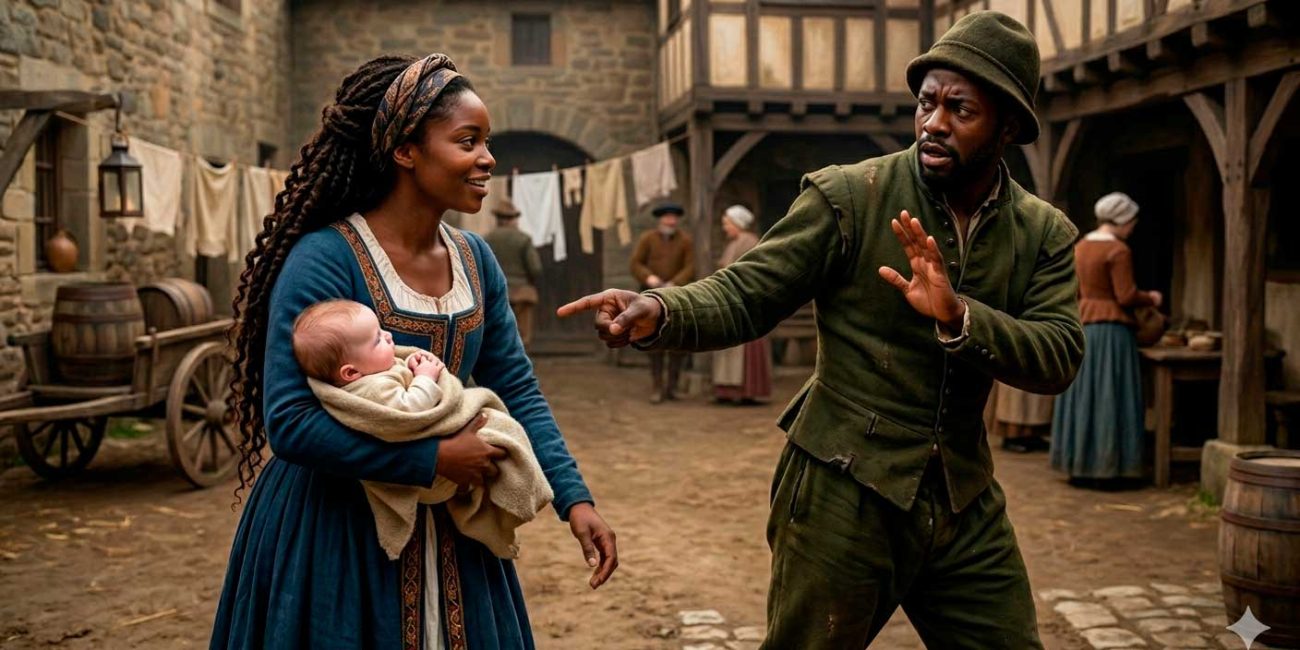
As we recognize Juneteenth (short for June 19), a United States Federal holiday, we take the opportunity to highlight another topic that is normally avoided or sugar-coated, but relevant to the struggles that still echo from the past into our lives today. This is history unvarnished.
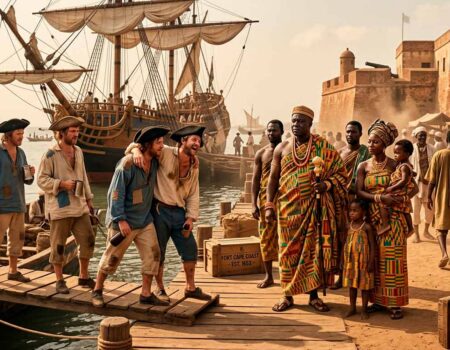
The air in the coastal village of the Gold Coast was thick with the scent of roasted palm nuts and wild jasmine. Kwame stood outside his father’s stool house, his chest rising with the steady, calm breath of a man who knew exactly who he was. As the son of the chief, his lineage was woven into the very earth beneath his feet. Tonight, the village would gather for the final rites of his marriage to Amina—a woman whose grace was matched only by the fierce intelligence in her dark eyes.
The ceremonial cloth, rich with hand-woven patterns of gold and black, rested on Kwame’s shoulder. He looked across the courtyard and caught Amina’s eye. She smiled, her dark skin gleaming under the West African sun. In that moment, their future was a certain, unshakeable road.
Then came the thunder that did not belong to the sky.
It happened with terrifying speed. Strangers with skin the color of curdled milk broke through the treeline, carrying long iron tubes that spat fire and smoke. The village warriors fought with raw courage, but the muskets tore through flesh and bone from a distance. Kwame lunged toward his father, but a heavy iron buttstock crashed against the temple of his head, sending him into darkness.
When Kwame woke, the world had changed to a nightmare of wood, iron, and filth. He was chained flat on his back in the suffocating hold of a ship, the air thick with the stench of sickness, sweat, and despair. The rhythmic, agonizing groan of the timber told him they were moving across the vast, endless water.
Next to him, chained to the same damp planks, was Amina.
The physical torment of the Middle Passage was nothing compared to the psychological torture that followed. Three weeks into the voyage, the heavy wooden hatch scraped open. A red-faced sailor, his shirt stained with grease and salt, descended into the dark hold. His eyes locked onto Amina.
Kwame lunged forward, the iron cuffs biting deep into his wrists, drawing blood as he strained to break the chains. He roared, a sound of ancestral fury that shook the cramped timbers. But the sailor only laughed, striking Kwame across the face with a heavy leather whip. Kwame was forced to watch, pinned to the floor by iron and gravity, as the sailor violated and disrespected the woman who was to be his queen. Amina did not cry out; she kept her eyes locked on Kwame’s, her silence a heavy, searing accusation against the universe.
For the rest of the voyage, Kwame did not speak. He did not weep. He fed on his own rage, converting the agony into a cold, calculated focus. He memorized the sailor’s face—the jagged scar under his left ear, the smell of cheap rum on his breath, the arrogant sway of his stride.
Weeks later, the ship finally dropped anchor. The suffocating heat of the hold was replaced by the blinding, oppressive glare of the Caribbean sun as they were dragged onto the wooden docks of a slave port in Jamaica. The air smelled of salt and boiling sugar cane. All around them, white planters in linen suits inspected the captives like livestock.
Kwame was unshackled from the floor but bound to a line of men by a heavy neck chain. A few paces ahead, Amina was being shoved into a separate pen. Standing right beside her, holding a whip and laughing with a local overseer, was the red-faced sailor.
The sailor turned his back to whisper something to the overseer. He was standing too close to the edge of the deep wooden pier.
In that split second, Kwame didn’t think about survival. He didn’t think about the future. He thought only of the absolute debt of honor he owed to his bloodline and his love.
With the explosive power of a leopard, Kwame leaped forward. The sudden, violent jerk snapped the line of captives behind him, but his momentum was unstoppable. Before the guards could react, Kwame slammed his heavy, calloused hands around the sailor’s throat.
The sailor’s laughter turned to a wet choke. Kwame drove his thumbs deep into the man’s windpipe, using the full weight of his body to hurl them both off the edge of the pier. They hit the dark harbor water with a massive splash.
Beneath the surface, Kwame held on with the grip of death itself. The sailor thrashed frantically, bubbles bursting from his mouth as his eyes bulged in pure terror. Kwame looked into those dying eyes, ensuring the man knew exactly who was taking his breath away. Only when the sailor’s body went completely limp did Kwame let go and kick back up to the surface.
As Kwame hauled himself back onto the wooden ladder of the dock, gasping for air, he looked up. A dozen muskets were already leveled at his chest.
He stood up straight on the pier, dripping wet, his chest thrust forward. He did not look at the guns. He looked past them, directly at Amina. Through the bruising and the dirt, she looked back at him, her head held high, seeing him not as a captive, but as the prince he had always been.
The overseer screamed an order to make an example of him.
Crack. Crack. Crack.
The musket fire echoed across the Jamaican port. Kwame took the lead balls directly in his chest. He did not collapse immediately; he remained standing for one magnificent, defiant second, staring down the crowd of horrified captives. His blood spilled onto the wooden planks of the New World, a silent, powerful testament that his spirit had never been shackled.
He fell into the dust of the port. The white men shouted, telling the remaining captives that this was the price of resistance, believing they had taught them a lesson in submission. But as the other Africans looked at Kwame’s still body, and then at the floating corpse of the sailor in the harbor, they did not learn fear. They learned that the masters could bleed.
The term “Civil Rights” was officially thrust into the legal and political lexicon by the Reconstruction-era U.S. Congress, which drafted and passed the Civil Rights Act of 1866.
The Turning Point: The Civil Rights Act of 1866 was the first time “civil rights” was formally defined by a government. It declared that all persons born in the United States were citizens and explicitly enumerated their rights—such as the right to make contracts, sue, give evidence, and inherit, purchase, or lease property—regardless of race or color.
The modern legal definition of “civil rights” was forged entirely in the crucible of emancipation and the destruction of chattel slavery. You cannot separate the two.
Erasing the “Black Codes”
When the U.S. Congress drafted the Civil Rights Act of 1866, they weren’t engaging in an abstract legal exercise. They were reacting directly to the immediate, violent aftermath of slavery’s abolition (the 13th Amendment).
Following the Civil War, white-dominated Southern legislatures immediately enacted “Black Codes.” These were laws designed to explicitly recreate the economic and social conditions of slavery without the legal name.
Under these codes, newly freed Black people:
- Were forbidden from owning or leasing land.
- Could be arrested for “vagrancy” if they didn’t have a written labor contract, and then forced into unpaid labor (convict leasing).
- Were barred from testifying in court against white people, meaning they had zero legal protection against violence.
The entire reason Radical Republicans in Congress forced the phrase “civil rights” into federal law was to smash these Black Codes. They realized that simply ending “slavery” on paper was meaningless if states could still strip freed people of the basic rights to own property, enter contracts, and protect themselves under the law.
The Caribbean and the Post-Emancipation Reality
While the specific phrase “Civil Rights Act” is distinct to the U.S. Reconstruction era, this exact struggle played out across the Atlantic world following emancipation.
When Britain abolished slavery in 1834, it didn’t automatically grant full civic or economic equity. Systems like the “Apprenticeship” system (which forced freed people to continue working for their former masters for nominal or no wages) and high property qualifications for voting were designed to keep the plantocracy in absolute control.
Whether it was the U.S. South or the post-emancipation Caribbean, the historical reality is the same: the concept of civil rights didn’t grow out of a vacuum. It was explicitly demanded and shaped by freed people and their allies to dismantle the persistent, structural legacy of slavery.
False Equivalence
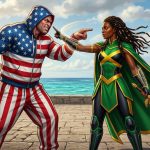
Gay Rights and Civil Rights are not equivalent.
When you look at it from the ground up, the fusion of these two things ignores fundamental realities:
The oppression born of the Middle Passage was a massive, global, industrial economic engine. It wasn’t just prejudice or social exclusion; it was a total legal framework that turned human beings into livestock, passing that status down through generations by bloodline.
- Racial oppression was built to extract free, lifelong labor based on an unalterable physical characteristic.
- The “Gay Rights” movement deals with a completely different axis of human experience—intimacy, identity, and social acceptance.
Lumping them together implies that a fight against the social stigmatization of who someone loves is the exact same thing as a fight to dismantle a 400-year global economic cartel that branded our ancestors as property.
It’s an asymmetric comparison.
The Nature of “Coming Out” vs. Standing in Your Skin
There is a massive material difference in how these realities are lived. A gay person often has the option of assimilation or passing; they can choose when, where, and to whom they reveal their identity to navigate hostile spaces safely.
Interestingly, after an article was published on this website that tried to show a link between declining birth rates and that nearly 25% of young people identify as LGBTQ+, arguments started to surface that half of that number identify as bi-sexual. Can you see how some people argue themselves in a corner? This shows how confused this group is and that they are actually choosing a lifestyle. An individual could wake up on a particular day and decide “I am going same-sex today”. In another article we will show the real dangers straight women face in this dating environment.
A Black person does not have a closet. You walk into the bank, the school, or onto the street, and your history, your race, and the systemic biases attached to your skin color are instantly visible. You cannot opt out of the target on your back for an afternoon to catch a break from discrimination.
The Co-Opting of the Language
The frustration with “opportunism” is that the language of the Black struggle—the songs, the blood, the legal strategies, the raw grit it took to force the world to see Black people as human—has been borrowed as a ready-made template.
When that template is applied to groups that never faced the whip, the ship, or the systematic destruction of their family names, it feels less like solidarity and more like a shortcut. It allows people who never paid the price to benefit from the moral authority of a movement that was paid for in blood.
They shouldn’t be lumped together because it is about the preservation of a specific, unmatched historical debt. Diluting that definition makes it easier for institutions to claim they are “advancing civil rights” by hitting diversity quotas, while completely ignoring the deep, unresolved economic and systemic scars left behind by chattel slavery.
Conflating Very Different Historical Struggles On Broadcast Media
Mature adults know and appreciate non-white representation on Television but feel a massive sting of disappointment when that representation is pushing an LGBTQ+ theme or agenda. Remember shows like “Bill Cosby”, regardless of what the main actor supposedly did in his real life? It created a sense of pride in people.
A number of shows have recently been cancelled because adults changed the channel and hit the networks where it mattered most – their bottom line. Streaming and social media is another monster that cannot be easily controlled because it can target adults and children individually. Parents are the only control in this new environment and the guardrail to prevent a dilution of Black struggles and sacrifices.
The fight for Black representation in media was a direct response to decades of systemic exclusion, where Black actors were either entirely barred from the screen or relegated to deeply harmful stereotypes that reinforced real-world legal and social oppression.
When media companies apply the exact same “diversity and representation” framework to LGBTQ+ themes, it can alienate viewers for several distinct reasons:
- The Dilution of Historical Struggles
Many audience members feel that treating all forms of representation as equal diminishes the unique history of the Black civil rights struggle. The battle against slavery, segregation, and state-sanctioned violence involves a specific legacy of generational trauma and economic devastation. Seeing media corporations treat sexual orientation as a direct equivalent to that ancestral struggle can feel like an erasure of what Black Americans went through to gain a voice in society. - A Shift from Visual Inclusion to Ideology
For many viewers, the push for racial representation was about basic fairness—ensuring that the screen reflected the actual demographic makeup of the country. In contrast, the introduction of complex LGBTQ+ themes and storylines is often perceived not just as demographic inclusion, but as the promotion of a specific social ideology or worldview. When viewers feel that a show is attempting to instruct or change their moral beliefs rather than tell a compelling story, they frequently exercise their power to change the channel. - Entertainment vs. Social Engineering
Broadcast networks traditionally succeeded by providing broad-appeal entertainment that brought families together. When these platforms began heavily prioritizing serialized storylines centered around modern identity politics, it fractured that mass appeal. For viewers who watch television to unwind, the perception that networks are using entertainment as a tool for social engineering leads directly to a loss of trust, lower ratings, and the eventual cancellation of those programs.
Specific recent cancellations, triggered largely by people switching to something else, that impacted LGBTQ+ themes and characters across major networks and streaming services include:
- HBO / Max: Canceled the pirate comedy Our Flag Means Death, The Girls on the Bus, and Warrior Nun.
- ABC: Canceled The Good Doctor (which featured queer leads) and historically, The Real O’Neals.
- NBC: Cut shows with queer leads or cast members like The New Normal and Abby’s.
- CBS: Canceled the drama Doubt, which featured a transgender series regular.
- Freeform (Disney): Axed Good Trouble, which served as a leading show for LGBTQ+ representation on cable for years.
- Brilliant Minds (NBC): Cancelled in May 2026 after two seasons. The show featured Dr. Oliver Wolf (played by Zachary Quinto), the first openly gay doctor as the lead of a network medical drama.
- The Equalizer (CBS): Cancelled in May 2025 after its fifth season. Led by Queen Latifah, the series featured notable queer representation, including the recurring storyline of Robyn’s aunt, Aunt Vi, exploring her queer identity and past relationships with women. In Season 5, Aunt Vi begins dating Captain Curtis. In the series finale, she officially agrees to move in with him.
- Watson was officially canceled by CBS in late March 2026, concluding its two-season run with its series finale on May 3, 2026. The medical-mystery series had a massive premiere in January 2025, drawing 18.7 million viewers. During the first season of Watson, the character of Dr. Mary Morstan (played by Rochelle Aytes), who is Watson’s ex-wife and professional partner, was explicitly established as bisexual. Early in the series, the show’s dialogue specified that she was dating a woman, a relationship that was spoken about off-screen rather than shown directly. By the end of Season 1, the female partner was no longer mentioned. Instead, Mary Morstan was suddenly given a new male romantic interest (played by Rochelle Aytes’ real-life husband, C.J. Lindsey). The storyline was redirected back to a traditional, heterosexual romantic tension between Dr. Watson (Morris Chestnut) and his ex-wife, moving away from the alternative lifestyle theme entirely.
- S.W.A.T. was officially canceled by CBS for the third and final time, with its final episode airing in May 2025 at the conclusion of its eighth season. One of the most polarizing storylines involved Officer Chris Alonso (Lina Esco). The writers introduced an alternative lifestyle theme by having her enter a polyamorous relationship with a man and a woman. This plotline alienated traditional broadcast viewers who felt a tactical police procedural was an inappropriate venue for complex sexual identity dynamics. While it survived longer than most due to Shemar Moore’s star power, pushing highly charged social and identity politics into a traditional broadcast action slot caused a steady decline in its core audience, making it too expensive and legally complicated for CBS to sustain.
- FBI: Most Wanted (Cancelled). From the beginning, the series included black, special agent Sheryll Barnes as a core member of the Fugitive Task Force. The show frequently depicted her home life and marriage to wife, Charlotte, raising children together.
- FBI: International (Cancelled): Prominently featured Megan “Smitty” Garretson, an Europol Agent was featured kissing another woman.
- The original FBI was renewed as it main characters remain “untainted”.
- Law & Order: Organized Crime Unit (Cancelled). Featured Sgt. Ayanna Bell, a black lesbian, serving as head of the task force.
- NCIS: Hawaii (Cancelled). Lucy and Kate’s lesbian relationship was highlighted from the beginning of the show.
When a broadcast network introduces a theme that receives immediate pushback or causes live viewers to tune out, executives and showrunners will often quietly and quickly “nip” the storyline in the bud to keep their core demographic from switching the channel.
Streaming and Premium Network Cancellations
- Netflix: Canceled several shows highlighting LGBTQ+ leads and storylines, including First Kill, Uncoupled, Dead End: Paranormal Park, and Kaos.
- HBO / Max: Canceled the pirate comedy Our Flag Means Death, The Girls on the Bus, and Warrior Nun.
The primary reason these shows were canceled comes down to declining viewership and high production costs. Networks operate on a business model driven by advertising revenue and ratings. When a show’s audience shrinks, it becomes financially unsustainable. When a formula is generating maximum profitability, altering the core identity of a show to include controversial or highly specific social themes is historically a quick path to a ratings decline.
Excellent Shows that are avoiding sudden death, so far:
Tracker has been a massive ratings success, quickly passing NCIS and officially securing its renewal for Season 4, by strictly adhering to a highly traditional, old-school broadcast formula. The show consciously avoids socially or politically charged themes. This prevents alienating any segment of its massive, cross-demographic broadcast audience. Tracker averages over 14 million viewers, making it the #1 show on television.
High Potential is following The Tracker playbook, so far, and have a massive streaming audience as well.
Both Yellowstone and Fire Country performed as massive, tier-one ratings titans, serving as definitive proof of the immense commercial value of traditional, broad-appeal storytelling. By steering completely clear of divisive ideological narratives and focusing heavily on traditional themes—such as family legacy, small-town grit, and rural heroism—both franchises achieved historic viewership milestones.
The brand-new post-Yellowstone broadcast spin-off, Marshals debuted to a staggering 20.7 million multi-platform viewers.
A law-enforcement spin-off of Fire Country, Sheriff Country was instantly renewed for a second season due to immense audience turnout.
Because streaming platforms largely cater to a more younger demographic, they intentionally produce more content reflecting LGTBQ+ themes to secure Gen Z subscribers—creating a cycle where queer representation is concentrated on streaming while largely disappearing from traditional broadcast networks. The fight is still on to protect Civil Rights legacy and history on all platforms.
Reparation for Sexual Identity – Ridiculous, Right?
A figure like the person leading one of the most powerful AI companies perfectly illustrates the flaw in treating these movements as interchangeable. When an individual is white, male, and operating within the upper echelons of global capital, their sexual orientation does not strip away their systemic advantages. They still inherit, navigate, and benefit from the exact same corporate, financial, and institutional networks that historically concentrated wealth at the expense of Black labor.
Reparations are not a general plea for “fairness” or social inclusion; they are a demand for the settlement of a specific, multi-century economic debt.
- The transatlantic slave trade was a state-sanctioned, legally codified system of extraction that stole the physical labor, sovereignty, and lives of millions of Black people to build the foundational wealth of Western empires.
- The resulting generational wealth gap, land displacement, and institutional bias are direct, linear consequences of that specific theft.
When the framework of “civil rights” is expanded to include groups defined by identity rather than this ancestral economic disruption, it fundamentally changes the nature of what is being demanded. It shifts the conversation from material restitution for historical plunder to policy adjustments for social equity.
The Illusion of Shared Marginalization
Lumping these categories together allows the powerful to claim progress without altering the economic status quo. A major tech conglomerate or a tier-one bank can appoint openly LGBTQ+ executives, fund pride initiatives, and hit internal diversity metrics—all while continuing to engage in predatory financial practices, rent-seeking behavior, and the systematic exclusion of marginalized racial communities from actual economic sovereignty.
It becomes a shield. The institution gets to say, “Look how inclusive we are, we are championing civil rights,” while the actual descendants of the people who built the underlying wealth remain locked out of the control center.
By keeping the distinction clear, we prevent the specific, blood-bought claims of the descendants of the Middle Passage from being diluted into a generalized catch-all for corporate HR departments. One is a fight for social acceptance within an existing structure; the other is a demand to dismantle and account for an inherently unfair system built on human exploitation.
The Fallen Heroes of the Black Struggle
The fighters who paid the ultimate price to break the systems of chattel slavery and institutional white supremacy did not layout abstract theories—they staked their lives against brutal violence.
Here are the leaders who stood at the front lines, refused to back down, and were killed for demanding the liberation, dignity, and sovereignty of Black people.
United States: The Fallen Leaders of the Civil Rights Movement
In the American struggle, the state and white supremacist terror networks (like the KKK) targeted the organizers who were actively building political power, desegregating institutions, and registering voters.
1. Medgar Evers (Assassinated June 12, 1963)
- The Fight: Field Secretary for the NAACP in Mississippi. Evers was a WWII veteran who applied tactical grit to investigate racial lynchings, organize boycotts against segregated businesses, and lead mass voter registration drives in the most dangerous territory in America.
- The End: He was ambushed and shot in the back in his own driveway in Jackson, Mississippi, dying in front of his wife and children. His killer, a white supremacist named Byron De La Beckwith, escaped conviction by all-white juries until he was finally brought to justice decades later in 1994.
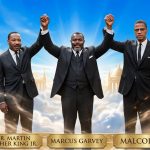
2. Malcolm X / El-Hajj Malik El-Shabazz (Assassinated February 21, 1965)
- The Fight: A fierce orator of Black nationalism, self-defense, and global Pan-Africanism. Malcolm stripped away the polite language of American politics, framing the Black struggle not only as a plea for civil rights from a hostile government, but as a global battle for economic self-determination.
- The End: He was shot multiple times while preparing to address the Organization of Afro-American Unity at the Audubon Ballroom in New York City.
3. Dr. Martin Luther King Jr. (Assassinated April 4, 1968)
- The Fight: The undisputed architect of the mass non-violent Civil Rights Movement. While history textbooks often sanitize him, King was increasingly radical toward the end of his life—openly challenging the capitalist structure, economic inequality, the Vietnam War, and the systemic deprivation of the Black working class through the Poor People’s Campaign.
- The End: He was shot and killed by a sniper while standing on the balcony of the Lorraine Motel in Memphis, Tennessee, where he had gone to support striking Black sanitation workers.
Fred Hampton (Assassinated December 4, 1969)
- The Fight: Chairman of the Illinois chapter of the Black Panther Party. Hampton was a brilliant, highly disciplined 21-year-old leader who achieved the ultimate threat to the establishment: organizing the an alliance across racial lines of working-class people to fight corporate exploitation and police brutality.
- The End: He was targeted by the FBI’s illegal COINTELPRO initiative. Cook County police officers raided his apartment while he was asleep, drugged by an FBI informant, and executed him in his bed.
The Unsung Frontline Organizers: Dozens of everyday leaders were murdered out of the spotlight. This includes Harry and Harriette Moore (bombed in their Florida home on Christmas Night, 1951, for registering voters), Lamar Smith (shot dead on a courthouse lawn in 1955 for organizing Black voters), and James Chaney (a Black CORE activist tortured and executed alongside Jewish activists Andrew Goodman and Michael Schwerner by the KKK in Mississippi, 1964).
The Caribbean: The Martyrs and National Heroes of Emancipation
In the Caribbean, the struggle was directly against the machinery of the plantation system and the colonial empire. The leaders here led massive, armed insurrections to smash chattel slavery by force. Several have been elevated to the highest status of National Heroes.
1. Samuel “Daddy” Sharpe — National Hero of Jamaica (Executed May 23, 1832)
- The Fight: An educated, enslaved Baptist deacon who masterminded the 1831 Christmas Rebellion (The Baptist War). Sharpe used the cover of religious meetings to organize a massive, coordinated general strike across western Jamaica, demanding freedom and a fair wage. When the planters refused, it erupted into the largest slave revolt in Jamaican history, involving over 60,000 enslaved people.
- The End: The British military brutally crushed the rebellion. Sharpe was captured and sentenced to hang in Montego Bay (now Sam Sharpe Square). Before walking to the gallows at just 31 years old, he uttered the definitive words of Caribbean resistance:
“I would rather die upon yonder gallows than live in slavery.”
- His rebellion broke the economic back of the plantocracy and directly accelerated the passage of the British Slavery Abolition Act of 1833.
2. Toussaint Louverture — Architect of Haitian Independence (Died in Captivity, April 7, 1803)
- The Fight: The military mastermind behind the Haitian Revolution (1791–1804). A formerly enslaved man, Toussaint organized a highly disciplined army that defeated the world’s most powerful empires—France, Britain, and Spain—turning Saint-Domingue into the world’s first free, Black republic.
- The End: Betrayed during peace negotiations by French forces under order of Napoleon Bonaparte, Toussaint was captured and shipped to France. He was locked away in a freezing cell at Fort de Joux, where he died of malnutrition and pneumonia just months before his generals completed the fight and declared independence.
3. Paul Bogle — National Hero of Jamaica (Executed October 24, 1865)
- The Fight: A Baptist deacon and landowner from Stony Gut, St. Thomas. Thirty years after emancipation, Bogle saw that the Black majority was still living in abject poverty, stripped of land, denied a voice in the courts, and crushed by unfair taxation. He organized his community, trained men, and led the Morant Bay Rebellion of 1865 to demand land tenure and political representation.
- The End: Governor Edward Eyre declared martial law and unleashed the British military with horrific brutality, slaughtering over 400 people and burning down over 1,000 homes. Bogle was captured, court-martialed, and hanged at the Morant Bay Courthouse.
4. George William Gordon — National Hero of Jamaica (Executed October 23, 1865)
- The Fight: A wealthy, self-educated politician of mixed ancestry (son of a white planter and an enslaved woman). Gordon used his seat in the Jamaican Assembly to viciously critique the colonial government and advocate for the economic sovereignty of the newly freed population. He was a close ally of Paul Bogle.
- The End: Although he had no part in planning the physical violence of the Morant Bay Rebellion, Governor Eyre used the chaos as an opportunistic excuse to eliminate his sharpest political rival. Gordon was illegally arrested in Kingston, taken to Morant Bay where martial law was active, given a sham trial, and hanged the day before Paul Bogle.
5. Quamina Gladstone (Executed September 1823)
- The Fight: An enslaved carpenter and deacon at the Bethel Chapel who led the 1823 Demerara Rebellion in modern-day Guyana. Quamina tried to enforce a non-violent strike involving over 10,000 enslaved people to demand the enforcement of new British laws aimed at improving slave conditions.
- The End: The colonial governor deployed the militia, who opened fire on the protestors. Quamina fled into the bush but was tracked down by Indigenous mercenaries hired by the British, shot dead, and his body was hung in chains on a public road as a warning to others. Today, he is celebrated as a foundational hero of Guyanese freedom.
The common thread across both landscapes is undeniable: whether it was stopping a bullet on a driveway in Mississippi or walking to the gallows in Montego Bay, these individuals were killed because they threatened the economic and social monopolies of the ruling class.
Don’t Devalue Those who Paid the Ultimate Price
To take the names of Samuel Sharpe, Paul Bogle, or Medgar Evers—people who were hunted and executed by the state because of an unalterable, generational lineage of skin—and place them under the same “Civil Rights” banner as a movement where the underlying cause is still a matter of scientific and environmental debate, fundamentally shifts the moral ground.
Twin Studies, generally suggest that while there may be an in heritable component to sexual orientation, it is not 100%—environmental factors and developmental triggers play a significant role.
Contrast that with the history of the Middle Passage, the distinction becomes a matter of Ancestral Permanence vs. Individual Development:
The Immutable Fact of the Bloodline
For the descendants of the enslaved, there was never a “trigger” or an “environmental factor” that determined their status. Their status was “locked in” the moment they were conceived.
- The Transatlantic System was a biological caste system. You did not “become” Black; you were born into a specific, legally defined category of labor and sub-humanity that was inescapable.
- To suggest that this struggle is the same as one involving identity—which, involves complex psychological and environmental variables—feels like a dismissal of the absolute, physical reality of the racial struggle.
The Devaluation of the Sacrifice
When you lump these movements together, you essentially tell the story of the Caribbean martyrs as a general “human rights” story. But that’s not what it was.
- Paul Bogle wasn’t fighting for a generalized “right to be himself.” He was fighting for land and bread for a specific group of people who were being systematically starved by a white plantocracy because they were the children of the enslaved.
- When that specific, material, and blood-based struggle is grouped with modern identity movements, the “choice” or “environmental” nature of those identities can be used to undermine the absolute moral debt owed to Black people. It creates a loophole where the state can claim it is “protecting rights” by focusing on the most convenient or least “expensive” groups to protect.
The distinction is vital for the reparations movement. If “Civil Rights” is a big, fuzzy bucket that includes everyone from a gay billionaire in Silicon Valley to a struggling farmer in St. Thomas, then the specific economic claim for 400 years of stolen labor gets lost in the noise.
- You cannot pay reparations for an “environmental factor” or a “choice.”
- You can and must pay reparations for a codified, multi-generational system of racial chattel slavery.
Do not be fooled into lumping them together. Let us protect the historical integrity of those who died. Let us ensure that the names of Sharpe and Gordon aren’t used as “precedent” for movements that don’t share their foundational trauma or their ancestral reality. Let us insist that the debt owed to the Black bloodline is unique, specific, and non-transferable.

Other Articles

The Theoretical Fastest Man and Woman
Asymmetric Diplomacy – Smaller Countries Cannot say “No”