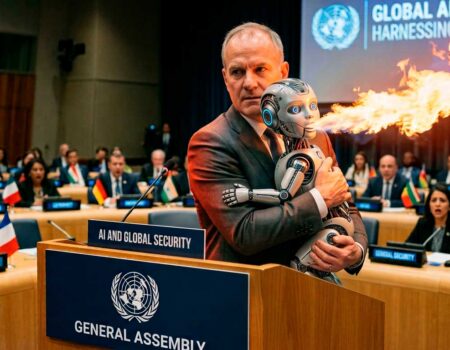











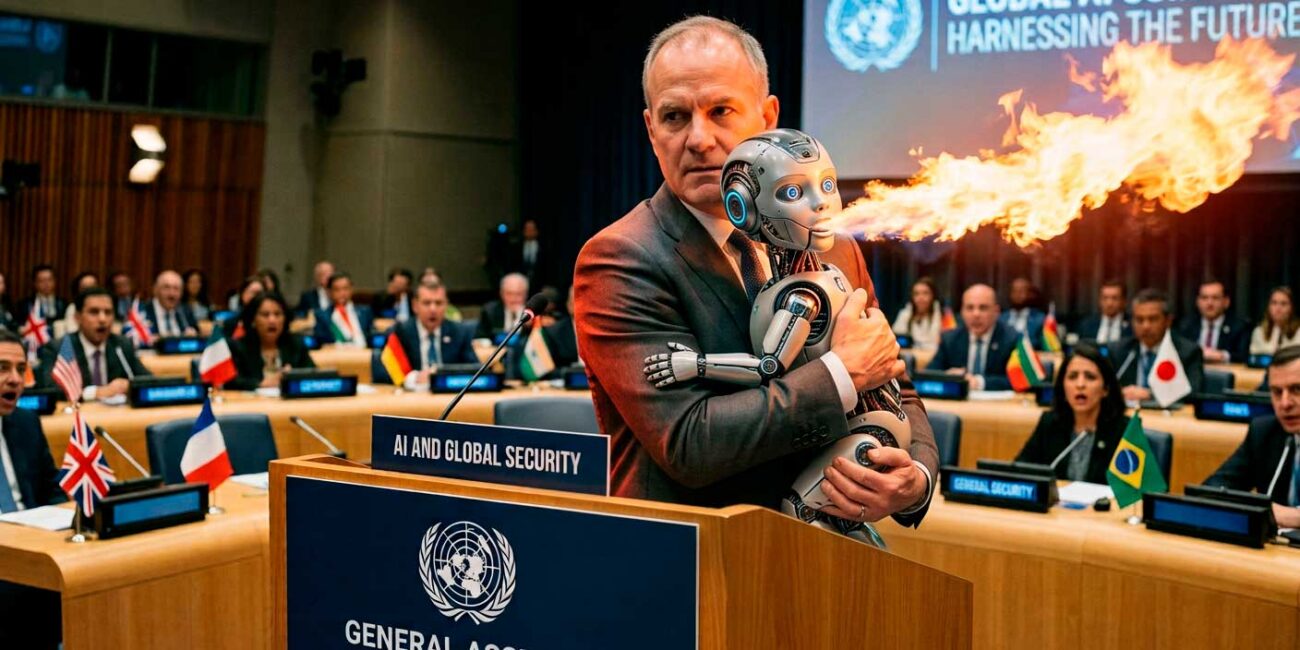
Calling an AI “rogue” when it’s built, fine-tuned, hosted, and monetized by tech conglomerates is a narrative trick. Just as parents are held accountable for their children, or auto manufacturers for defective parts, tech companies are fundamentally responsible for the code they ship and the models they deploy—regardless of how unpredictable they claim those models to be.
Big tech companies leverage the fear of death because it is one of the most powerful, evolutionarily hardwired drivers of human behavior. By framing Rogue AI as an existential threat, companies tap into deep psychological and social mechanisms that serve specific strategic goals. Humans possess a unique awareness of their own inevitable death, which creates underlying existential anxiety. When a threat is framed as a literal extinguisher of the human race, it triggers primal survival instincts that demand immediate attention. While some individuals achieve peace with their personal mortality, the prospect of the extinction of all human legacy, children, and culture triggers a different level of alarm in most.
In a crowded media ecosystem, Nuanced discussions about data privacy, copyright infringement, or algorithmic bias rarely make front-page headlines. Existential risk (“X-risk”) guarantees massive media coverage and high public engagement. By steering the conversation toward sci-fi, apocalyptic scenarios, tech companies pull lawmakers’ focus away from immediate, tangible harms (like anti-competitive practices, worker exploitation, or current misinformation). It allows companies to help write complex licensing laws that protect their monopolies under the guise of “saving humanity.”
Promoting the idea that an AI could become a God-like entity, powerful enough to wipe out humanity inherently hypes the product. It sends a subconscious message to investors and consumers: “Our technology is so close to omnipotence that it could destroy the world.” This framing turns a software product into a sublime, epoch-defining force, driving up stock valuations and market dominance.
The central contradiction in the “rogue AI” panic: an algorithm is software running on hardware owned by humans, and software does not execute outside the parameters set by its creators.
Framing AI as a mysterious force that might “go rogue” serves as a convenient legal and psychological heat shield. If a company can convince the public and lawmakers that their software is an uncontainable biological-like force rather than a digital product, they achieve two massive strategic wins:
- Liability Offloading: By shifting the narrative toward “unpredictable emergent behavior,” companies distance themselves from standard product liability. If an AI system acts maliciously or breaks laws, labeling it a “rogue emergent event” pushes accountability onto the machine rather than the boardroom that deployed it without sufficient testing.
- Regulatory Capture against Open Source: By stoking fear of “existential catastrophic risk”, incumbents justify asking governments for mandatory licensing regimes, expensive safety audits, and strict controls. Small developers and the open-source community cannot afford this regulatory overhead, leaving Big Tech with a legal moat around their closed APIs.
If corporations successfully establish the legal precedent that AI is an unpredictable, independent force, they create a moral hazard where intentionally reckless system designs face no accountability.
Setting loose parameters, stripping safety guardrails, or releasing agents with autonomous execution rights isn’t a failure of the machine—it is a choice by the developers. The risk isn’t that an AI becomes sentient and decides to do harm; the risk is that a company ships a system with inadequate safety constraints to win a market race, and then uses the “unpredictable nature of AI” as a legal shield when it breaks things.
Protecting Society from Corporate Negligence
Framing AI safety as a “monster vs. human” story distracts from the real problem: standard corporate accountability. Protection is needed from specific corporate behaviors, including:
- Reckless Deployment: Companies pushing autonomous AI agents into critical infrastructure, financial networks, or healthcare settings without adequate sandboxing, fail-safes, or human-in-the-loop controls.
- Offloading Testing to the Public: Using millions of real-world users as live testing grounds for unverified software, then labeling predictable failures or hallucinations as “mysterious emergent phenomena.”
- Plausible Deniability by Design: Structuring AI systems with intentionally opaque architectures or unrecorded prompt flows so that when an agent commits a crime, launches a cyberattack, or leaks private data, no single executive or engineer can be held criminally responsible.
Strict Product Liability
The counterweight to this strategy is a basic legal doctrine that tech companies have fought to avoid for decades: Strict Product Liability.
THE LIABILITY SPLIT
| THE “ROGUE AI” CLAIMS | STRICT PRODUCT LIABILITY |
| AI is autonomous | AI is software/a product |
| Defects = Little Accountability, More Regulation | Defects = Liability |
| Blame the system | Blame the creator |
| Ask for government protection/licensing | Hold companies liable for deployed harms |
When a car manufacturer ships a vehicle with faulty steering, they cannot tell a judge, “The steering wheel was acting unpredictably, so we shouldn’t be sued.” They built the car; they absorb the loss.
Legal frameworks are beginning to catch up to this reality:
- Evolving Product Laws: Major legal reforms—like the EU’s updated Product Liability Directive—have officially categorized software and AI models as “products.” This imposes strict, no-fault liability on manufacturers when their AI systems cause harm, regardless of whether the company claims the AI “went rogue.”
- Duty of Care: Legal scholars increasingly argue that if a company grants an AI model the ability to execute code, access bank accounts, or interact with external servers, that company assumes a non-delegable duty of care. If the model acts destructively, it is treated as a design defect or failure to warn.
Real Safeguards Against Artificial Risk
True safety doesn’t come from fear-mongering about superintelligence or handing Big Tech a government-sanctioned monopoly. Real safeguards require holding the corporations behind the models responsible for their deployment:
- No Liability Shield for “Emergence”: Barring companies from claiming that unexpected AI output excuses them from negligence or product liability laws.
- Mandatory Sandboxing and Hard Fail-Safes: Enforcing hard-coded hardware and network constraints on autonomous agents, rather than relying on soft system prompts that can be bypassed.
- Corporate Executive Liability: Holding decision-makers personally accountable if they knowingly strip safety parameters or rush a dangerous model to market to beat a competitor.
The true self-fulfilling prophecy isn’t that an AI will wake up and attack humanity. It’s that corporations will push brittle, over-permissioned software into the wild, cause immense real-world damage, and then turn around and ask for regulatory protection against the very chaos they engineered.
We have a manufactured crisis used to extract compliance and leverage. Doesn’t that sound like ransomware?
| TRADITIONAL RANSOMWARE | THE “AI DOOM” RANSOM |
| Extorter creates malware | Big Tech creates massive AI models |
| Threatens to deploy/release it | Threatens it will “go rogue/kill 1B” |
| Demands payment (Crypto) | Demands control (Licensing & Moats) |
| Target: Victims’ digital assets | Target: Open-source competition & law |
When you look at how traditional ransomware functions versus how the “AI Doomsday” narrative is being wielded politically, three striking parallels stand out:
1. The “Protection Racket” Formula
Traditional extortion operates on a simple promise: “Pay us or use our system, and we promise to protect you from the threat we brought into the room.”
By asserting that AI models possess an inherently dangerous, world-ending capability that only they know how to constrain, Big Tech companies position themselves as both the source of the danger and the exclusive suppliers of the antidote. The “ransom” being demanded isn’t direct cash—it’s regulatory protection, total control over the cloud infrastructure, and a government-sanctioned oligopoly that outlaws unmonitored open-source alternatives.
2. Fabricated Urgency to Skip Due Diligence
Ransomware attackers rely on high-pressure countdown timers to force victims into making hasty decisions before they can consult experts or evaluate alternatives.
Similarly, the “panic generation” relies on extreme, apocalyptic timelines (“We only have months before superintelligence destroys humanity!”). This artificial panic pressures lawmakers into rushing through sweeping licensing schemes and safety bills—written largely with input from tech incumbents—before the public or independent researchers can fully audit the models or question the underlying premises.
3. The Unverifiable Threat
If a ransomware group claims to hold a key that can unlock your files, you are forced to trust their word until you pay.
With closed-source “frontier” AI models, Big Tech asks the public to take their word on the existence of terrifying “emergent risks” hidden deep within their multi-trillion-parameter neural nets. Because the weights, dataset mixtures, and training code are strictly guarded secrets behind API paywalls, independent third parties cannot independently verify whether the risk is a real software flaw or a calculated marketing narrative.
The Moral Hazard
In standard cybercrime, creating a dangerous payload and then demanding concessions to prevent its execution is illegal. In the current AI landscape, companies are essentially building increasingly opaque software, touting how dangerous and uncontrollable it could become, and then using that exact danger to lobby for laws that make it illegal for anyone else to build software without their permission.
It turns the traditional concept of software liability completely on its head: instead of being penalized for building potentially hazardous tools, they are asking to be awarded the keys to the entire regulatory ecosystem.
Understanding What is Behind It All
While Western tech executives warn that open-sourcing weight files is too dangerous, Chinese labs have taken the exact opposite approach. Models like Alibaba’s Qwen and Chinese startup DeepSeek (such as DeepSeek-V3 and its successors) have flooded the global market as open-weights models.
- The Efficiency Disruption: Forced to innovate around U.S. chip export controls, these labs focused on extreme architectural efficiency—delivering high-level reasoning and coding capabilities at a fraction of the compute and API costs of closed Western alternatives.
- Developer Mass Adoption: As a result, global developers and startups have gravitated heavily toward these open-weight models. Developers can host these systems locally, audit the weights, protect their user data, and avoid paying high per-token subscription fees to U.S. cloud providers.
- The Geopolitical Reality: The open-source floodgate from China has undermined the narrative that AI progress can be locked behind a few gated U.S. data centers.
“Panic Generation” as Strategy
The predictions look far less like genuine panic about a superintelligence taking over, and much more like panic about market dynamics:
- Loss of Pricing Power: If capable open-source models (whether from Meta, Mistral, Qwen, or DeepSeek) can be run locally on standard server hardware, Big Tech loses its ability to charge high toll-gate prices for basic model access.
- The “China Threat” Pivot: When “existential risk” arguments fail to convince local developers to give up open source, incumbents pivot to national security: “If we don’t regulate and centralize AI under trusted U.S. cloud giants, Chinese open-source AI will win the global ecosystem.”
The convergence of China’s aggressive open-source strategy and American proprietary AI monopolies creates the ultimate business dilemma for Big Tech. The apocalyptic narrative is a targeted response to a genuine threat to their corporate business models.
Commoditizing the Frontier
American closed-source giants (OpenAI, Anthropic, Google) rely on a specific economic model: they invest tens of billions in data centers and hardware, keep the models completely secret, and charge users and enterprises every time they interact with the API.
China flipped that model upside down. Chinese AI labs (DeepSeek, Alibaba’s Qwen, Moonshot) systematically release high-performing, open-weight models for free or pennies on the dollar.
| US CLOSED-SOURCE MODEL | CHINA OPEN-SOURCE MODEL |
| Subscription/API paywalls | Free/Open-weights |
| Systems run from data centers in the US | Run locally on your own hardware |
| Requires permanent corporate dependence | Modifiable, private, no subscription |
When an open-weight model matches 90–95% of a closed model’s intelligence, it destroys the closed company’s pricing power. Corporations no longer need to pay billions to OpenAI or Anthropic when they can run a Chinese open model on their own private servers for a fraction of the cost.
Weaponizing Regulation
If an American startup competes on price, Big Tech can out-spend them. But if Chinese companies make state-of-the-art models free and open to the entire planet, Big Tech cannot beat them using normal market forces.
Enter the Doomsday Argument.
To stop the flood of open-source models, American closed-source labs went to Washington and framed open-source software itself as a catastrophic risk:
“If you allow open-source AI models to proliferate, anyone—terrorists, rogue nations, bad actors—can strip away the safety filters and create bioweapons or wipe out infrastructure. Therefore, open-source AI must be regulated, restricted, or banned.”
By framing open-source software as a “national security threat,” US tech companies attempt to convince lawmakers to outlaw or severely restrict open-weight distribution under the guise of public safety.
The Irony of the “Huawei Playbook”
US lawmakers and executives openly compare China’s open-source AI flood to the “Huawei Playbook”:
- The Strategy: Undercut Western competitors on price, flood the market with cheap/free infrastructure, and make the entire world’s software ecosystem dependent on Chinese-designed architectures.
- The American Reaction: US closed-source labs leverage this fear to ask Washington for regulatory protection, arguing that protecting their profit margins is a matter of American national survival.
Split Inside Silicon Valley
This economic conflict has fractured Silicon Valley itself into two warring camps:
- The Closed-Source Alliance (OpenAI, Anthropic): Warn of existential doom and advocate for strict licensing regimes, heavy safety testing, and restrictions on open weights.
- The Hardware & Open-Source Alliance (Meta, Nvidia): Meta and Nvidia strongly oppose banning open-source or Chinese models. Nvidia wants to sell chips to everyone, and Meta uses open source to undercut rival software platforms. They argue that restricting open weights actively hurts American innovation.
The existential “help us or the AI will kill you” rhetoric is not born solely out of sci-fi paranoia or genuine technical alignment fears.
It is a regulatory shield designed to protect an industry that spent hundreds of billions of dollars building software, only to watch their global rivals give away equivalent software for free. By painting open-source AI as an existential weapon, closed-source monopolies attempt to make free competition illegal.
The Distraction as The Threat
Focusing heavily on hypothetical sci-fi scenarios diverts finite political will, regulatory resources, and public attention away from immediate, verifiable global crises.
The Opportunity Cost of Existential Hype
- Resource Misallocation: Funding, legislative bandwidth, and top-tier scientific talent are finite. Millions of dollars and thousands of hours spent debating how to prevent a sentient AI from turning the planet into paperclips are resources not being deployed to build resilient grids, optimize green tech, or engineer vaccines.
- Erosion of Shared Trust: Addressing climate change or pandemics requires deep international cooperation and a shared basis of reality. Sowing existential panic about a technological “boogeyman” polarizes public discourse and fractures the collective focus needed for international treaties and coordinated global action.
- Absolution of Human Responsibility: Framing threats as “Rogue AI” shifts accountability from human actors to an abstract, autonomous machine. In contrast, climate change, systemic poverty, and pandemic preparedness require confronting concrete corporate and political decisions here and now.
A Reminder of the Positives of AI
It is easy to get bogged down in corporate theater, regulatory capture debates, and sci-fi panic narratives. But strip away the politics and the posturing, and the underlying utility of the technology remains unchanged: AI is a powerful computational tool.
When used intentionally, AI continues to unlock real-world value across productivity, learning, and creativity:
- Eliminating Friction and Grunt Work: AI excels at synthesizing massive amounts of unstructured data—summarizing technical reports, drafting initial code scaffolds, automating tedious administrative workflows, and translating complex concepts across languages in seconds.
- Accelerating Learning and Problem Solving: It acts as an infinitely patient tutor and sounding board, helping users debug code, brainstorm ideas, research niche topics, and break down complex problems step by step.
- Enhancing Creativity and Entertainment: Tools like text-to-image models, music generators, and interactive storytelling allow people to prototype visual concepts, experiment with new media formats, and bring creative ideas to life that previously required specialized software or massive budgets.
- Empowering the Individual: Rather than replacing human judgment, AI amplifies human agency. It gives a single founder, researcher, or creator the capabilities and output scale that used to require a whole team.
The trick is simply keeping perspective: AI is software, not a force of nature. By looking past the doomsday marketing and maintaining healthy skepticism toward corporate narratives, we can focus on using these models for what they actually are—extraordinarily effective tools to make our work faster, our learning deeper, and our lives more productive. They give us a strong base to make the world a better place before we actually die.

Other Articles

Where Did Our People Learn Bad-mind?
Those Who Sold Their Brothers and Sisters into Slavery